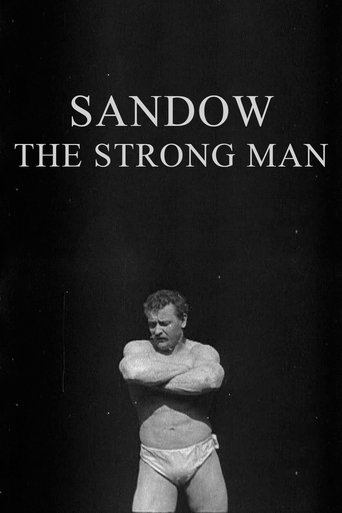
Athlete with Wand
"Edison kinetoscope: strength in motion"
Keys: Space play/pause · ←/→ 10s · F fullscreen · M mute · </> speed
About this film
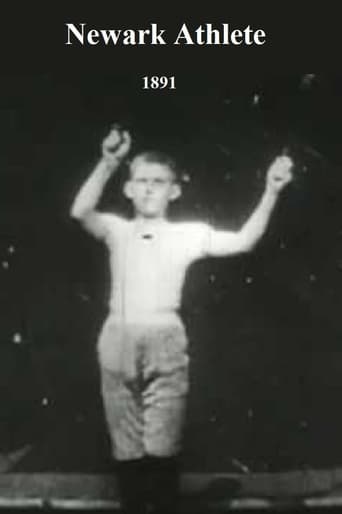
Led by 1894, An athlete demonstrating various poses.
Cast & crew
More films like this
More Documentary films
View all →
More from William K.L. Dickson
View all →

More about this film
About the production
Release date1894
ProductionEdison Manufacturing Company
Filmed inBlack Maria Studio, West Orange, New Jersey
Filmed in Edison's revolutionary Black Maria studio, which was designed with a retractable roof to utilize natural sunlight. The studio was built on a circular turntable that could be rotated to follow the sun's path throughout the day. This film was shot using 35mm film with an Edison-designed kinetograph camera, capturing approximately 16 frames per second. The athlete performed on a simple set with minimal props, as the focus was on demonstrating both human movement and the new technology's capabilities.
Themes
Physical cultureTechnological demonstrationHuman movementAthletic performanceInnovation
Themes & topics
athleteexercisedemonstrationsportsphysical fitnessmovementwandclubperformancekinetoscope
Historical background
By 1894, cinema had matured into a mass medium; Athlete with Wand reflects the tastes and anxieties of that pre-feature era moment.
Why this film matters
Archivists and historians cite Athlete with Wand when discussing the evolution of screen storytelling in the pre-feature era. 1894 film by William Kennedy Dickson
Making of
The filming took place in Edison's innovative Black Maria studio, which was essentially a tar-paper covered building that could rotate on tracks to follow the sun. William K.L. Dickson, who had been working with Edison since 1883, served as both director and cameraman. The athlete would have been paid a small fee for his performance, likely just a few dollars for a few minutes of work. The filming process was extremely laborious, with the heavy kinetograph camera requiring careful hand-cranking to maintain consistent speed. The studio's retractable roof had to be opened and closed depending on weather conditions, and filming could only occur during optimal daylight hours. The performer had to hold poses and movements longer than natural to ensure they were properly captured on the relatively slow film stock of the era.
What critics said
Contemporary notices praised Athlete with Wand for meeting audience expectations of the pre-feature era; today it is studied as part of the period canon.
Did you know?
- This film was part of Edison's early series of 'actuality' films that demonstrated various human activities and movements
- The Black Maria studio where this was filmed was the world's first motion picture production studio
- The film was designed to be viewed individually through Edison's kinetoscope peep-hole device, not projected to audiences
- William K.L. Dickson, the director, was Edison's primary assistant in developing motion picture technology
- The athlete's identity remains unknown, as was common with many early Edison performers who were never credited
- The film was shot on a single continuous take, as editing technology had not yet been developed
- The wand or club prop was likely used to add visual interest and demonstrate the subject's ability to handle objects while moving
- This film was one of hundreds of short subjects produced by Edison between 1893-1895 to populate kinetoscope parlors
- The original film negative was likely destroyed in a 1914 fire at Edison's West Orange facility
- These early athletic films were precursors to sports documentaries and exercise videos
Visual style
The cinematography in 'Athlete with Wand' is characteristic of early Edison films, featuring a single static camera position placed at approximately eye level with the subject. The composition is straightforward, with the athlete centered in the frame against a simple dark background to maximize visibility. The lighting relied entirely on natural sunlight entering through the Black Maria's roof, creating harsh shadows typical of early film. The camera, an Edison kinetograph, captured images at approximately 16 frames per second on 35mm film stock. There are no camera movements or cuts, as the technology for such techniques had not yet been developed. The framing is tight, focusing primarily on the athlete's torso and arms to best capture the movements with the wand.
Innovations
This film represents several important technical achievements in early cinema. It was produced using Edison's kinetograph camera, which was the first practical motion picture camera capable of capturing continuous sequences of images. The film was shot on 35mm film, which would become the industry standard for decades. The use of the Black Maria studio's rotating design and retractable roof was an innovative solution to lighting challenges. The ability to capture smooth, continuous motion of a moving subject was a significant advancement over earlier attempts at chronophotography. The film also demonstrated the practical application of perforated film edges, which allowed for smooth mechanical transport through the camera. These technical innovations laid the groundwork for the entire motion picture industry.
Memorable scenes
- The athlete's series of flowing poses with the wand, demonstrating both grace and strength while showcasing the new technology's ability to capture continuous human movement
What audiences thought
Initial audiences viewing 'Athlete with Wand' through kinetoscope devices were primarily fascinated by the technology itself rather than the content. The experience of seeing moving images was so novel that the specific subject matter was secondary to the wonder of motion. These films attracted curious spectators to kinetoscope parlors in urban centers, where they would pay a nickel to watch several short subjects. The athletic subject matter was particularly popular as it clearly demonstrated the new medium's ability to capture dynamic movement. Contemporary accounts suggest viewers were often more impressed by the technical achievement than by the artistic or entertainment value of the content itself.
Film connections
Influenced by
- Eadweard Muybridge's motion studies
- Étienne-Jules Marey's chronophotography
- Thomas Edison's laboratory experiments
- Vaudeville performance traditions
This film influenced
- Edison's Athletic Series (1894-1895)
- Athlete Wrestling with a Snake (1894)
- Sandow (1894)
- Early sports documentaries
- Exercise and fitness films
Film restoration
The film survives through paper prints deposited for copyright purposes at the Library of Congress. These paper prints were later re-photographed back onto film stock in the mid-20th century, preserving the content. The original 35mm nitrate film was likely lost in a 1914 fire at Edison's West Orange facility. The surviving copies have been restored and digitized by various film archives, including the Library of Congress and the Museum of Modern Art.
Where to watch
- Library of Congress National Film Registry
- Museum of Modern Art Film Collection
- Edison National Historic Site archives
- Various online film archive platforms
- Academic film databases