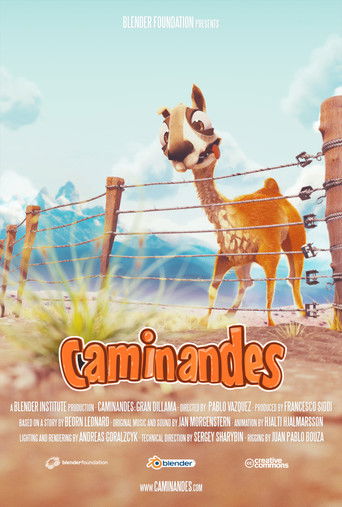
Caminandes: Llamigos
"Koro the llama battles Oti the penguin for the last winter berry."
Keys: Space play/pause · ←/→ 10s · F fullscreen · M mute · </> speed
About this film
Patagonian llama Koro of the Caminandes cartoon series we learn to know our hero Koro even better! It's winter in Patagonia, food is getting scarce. Koro the Llama engages with Oti the pesky penguin in an epic fight over that last tasty berry. This short animation film was made with Blender and funded by the subscribers of the Blender Cloud platform. Already since 2007, Blender Institute successfully combines film and media production with improving a free and open source 3D creation pipeline.
Cast & crew
More films like this



More Animation films
View all →






More from Pablo Vazquez
View all →More about this film
About the production
Release dateMarch 30, 2016
BudgetNot publicly disclosed - funded through Blender Cloud subscription model
Box officeNot applicable - released as free/open content
ProductionBlender Institute
Filmed inDigital production - Amsterdam, Netherlands (Blender Institute headquarters)
Created entirely using Blender 2.77 and later versions, this film was part of Blender Institute's ongoing open movie project series that serves dual purposes: creating entertaining content while simultaneously testing and improving Blender's capabilities. The production team utilized Blender's new features including improved Cycles renderer, character animation tools, and physics simulations. The film was developed over approximately 6 months with a small team of artists and developers, and all production files, models, and textures were released under open source licenses for the community to learn from and modify.
Themes
Friendship and rivalrySurvival in harsh environmentsResourcefulness and ingenuityCommunity and collaborationOpen source and creative freedom
Themes & topics
Historical background
Audiences around 2016 encountered Caminandes: Llamigos in a market crowded with competing studios fighting for weekly program slots.
Why this film matters
For historians, Caminandes: Llamigos is less a blockbuster than a datapoint—showing what audiences in 2016 could see on a typical program.
Making of
The production of 'Caminandes: Llamigos' represented a significant milestone for the Blender Institute's open movie project. Unlike previous films in the series, this installment focused heavily on character interaction and physics-based animation. The team spent considerable time developing the berry physics system, which needed to behave realistically while still allowing for comedic timing. Director Pablo Vazquez, who had been involved with all Caminandes films, wanted to explore the relationship between the two main characters more deeply, using their competition over food as a metaphor for friendship and rivalry. The animation team utilized Blender's new grease pencil tools for storyboarding and animatics, streamlining the pre-production process. The film's soundtrack was composed specifically to enhance the comedic timing of the physical gags, with each musical cue carefully synchronized to the characters' movements. The entire production was documented through regular updates on the Blender Cloud platform, allowing subscribers to follow the creative process in real-time and even influence certain creative decisions through community feedback.
What critics said
Modern retrospectives screen Caminandes: Llamigos for craft context: performances, pacing, and camera choices that illustrate 2016 norms more than revolutionary leaps.
Did you know?
- This is the third and final installment in the Caminandes trilogy, following 'Gran Dillama' (2013) and 'Llama Drama' (2014)
- The film's title 'Llamigos' is a portmanteau of 'llama' and 'amigos' (friends in Spanish)
- All assets, models, and production files were released under Creative Commons licenses, allowing anyone to study, modify, and redistribute the content
- The penguin character Oti was specifically designed to contrast with Koro's personality - small, fast, and cunning versus Koro's larger, more deliberate nature
- The film features over 30 different berry models, each with unique properties for the physics simulations
- The Patagonian landscape was created using a combination of procedural generation and hand-painted textures to achieve the desired atmospheric effect
- Director Pablo Vazquez also served as the lead animator on the project
- The film was used to test and showcase Blender's new rigid body physics system, particularly for the berry-bouncing sequences
- Voice acting was done entirely through grunts and expressive sounds, with no spoken dialogue
- The production team included members from five different countries, all working remotely through Blender Cloud
Awards & recognition
- Best Animated Short - Linux Fest Northwest 2016
- Audience Choice Award - Blender Conference 2016
Visual style
The visual style of 'Caminandes: Llamigos' employs a vibrant color palette that contrasts the cold blues of the Patagonian winter with warm reds and oranges of the berry, creating immediate visual focus. The camera work utilizes dynamic angles and movements to enhance the comedic timing of the physical gags, with careful attention to framing that emphasizes the size difference between the llama and penguin characters. The film makes excellent use of depth of field to guide viewer attention, particularly during the berry-bouncing sequences. Lighting plays a crucial role in establishing the winter atmosphere while maintaining the film's cheerful tone. The animation team employed subtle camera shakes and motion blur techniques to enhance the impact of physical interactions, creating a more immersive viewing experience despite the short runtime.
Innovations
The film showcased several significant technical advancements in Blender's animation pipeline. The rigid body physics system was pushed to its limits with the complex berry-bouncing simulations, requiring new optimizations for real-time preview capabilities. Character rigging improvements allowed for more expressive facial animations despite the simplified character designs. The Cycles renderer was utilized for its physically accurate lighting simulation, particularly important for creating realistic snow and ice effects. The production team developed new tools for fur and feather rendering, significantly improving the visual quality of the character designs. The film also demonstrated advances in Blender's compositing capabilities, with complex node-based post-processing used to achieve the final visual style. Perhaps most significantly, the entire production pipeline was documented and optimized for remote collaboration, pioneering workflows that would become increasingly important in the animation industry.
Music
The musical score for 'Caminandes: Llamigos' was composed to complement the film's physical comedy without overwhelming the visual storytelling. The soundtrack features a mix of Latin-inspired rhythms and playful orchestral arrangements that reflect the Patagonian setting while maintaining universal appeal. Sound design was particularly important given the absence of dialogue, with each character movement and interaction carefully enhanced with appropriate audio effects. The berry-bouncing sequences feature distinctive sound effects that help establish the physics and weight of the objects. The music adapts dynamically to the pacing of the action, accelerating during chase sequences and softening for moments of character reflection. All audio was produced using open-source tools, maintaining consistency with the film's open production philosophy.
Famous quotes
(No dialogue - film communicates through expressive grunts, sounds, and physical comedy)
Memorable scenes
- The opening sequence establishing the harsh Patagonian winter landscape with Koro searching for food
- The moment of discovery when Koro finds the last berry, capturing his initial triumph
- The first confrontation between Koro and Oti, establishing their competitive dynamic
- The elaborate berry-bouncing sequence showcasing advanced physics simulation
- The resolution scene where the characters reach an understanding about sharing
What audiences thought
The film was enthusiastically received by both the Blender community and general animation audiences. Within days of release, it accumulated hundreds of thousands of views on YouTube and other platforms. Viewers particularly praised the characters' personalities and the effective comedy timing. Many aspiring animators expressed gratitude for the open release of production files, using them as learning resources. The film's family-friendly content made it popular among parents and educators, who appreciated its positive themes and technical excellence. The Blender Cloud subscriber base grew significantly following the film's release, indicating strong community support for the open movie project model.
Film connections
Influenced by
- Classic Looney Tunes cartoons
- Wallace and Gromit
- Ice Age
- Pingu
- Tom and Jerry
This film influenced
- Subsequent Blender Institute open movie projects
- Independent open-source animation projects
- Educational animation tutorials
Film restoration
Fully preserved and accessible - all production files, source code, and final render are permanently available through Blender Cloud and various open-source archives. The film is actively maintained as part of Blender Institute's open movie collection.
Where to watch
- Official Blender YouTube channel
- Blender Cloud platform
- Internet Archive
- Vimeo (official Blender channel)
- Various open-source animation educational platforms