

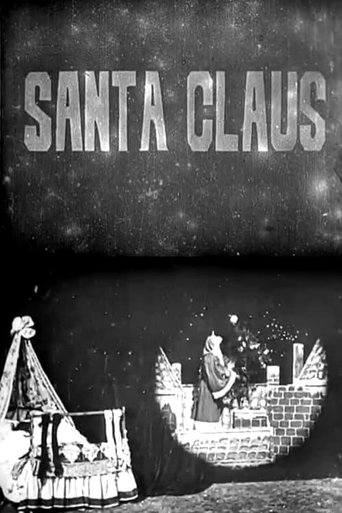
Santa Claus Conquers the Martians
"1964 film directed by Nicholas Webster"
Keys: Space play/pause · ←/→ 10s · F fullscreen · M mute · </> speed
About this film
Martians fear their children have become lazy and joyless due to their newfound obsession with Earth TV shows. After ancient Martian leader Chochem suggests that the children of Mars need more fun—including their own Santa Claus—supreme leader Lord Kimar assembles an expedition to Earth. Once there, they kidnap two children who lead them to the North Pole, then capture the real Santa Claus, taking all three back to Mars in an attempt to bring the Martian children happiness.
Cast & crew
More films like this
More Comedy films
View all →







More about this film
About the production
Release dateNovember 14, 1964
Budget$200,000
Box officeUnknown - minimal theatrical release
ProductionPolaris Productions
Filmed inLong Island, New York, Brooklyn, New York
The film was shot in just 21 days on a shoestring budget. The Martian costumes were reportedly made from green pajamas and motorcycle helmets. The polar bear in the film was actually a man in a cheap costume that was clearly visible. The spaceship sets were constructed from cardboard and painted to look metallic. The film was shot during the summer of 1964, requiring actors to wear heavy winter costumes in sweltering heat.
Themes
Commercialization of ChristmasCultural imperialismChildhood innocenceTechnology's impact on societyCultural exchange and misunderstanding
Themes & topics
Historical background
Santa Claus Conquers the Martians (1964) emerged during the post-studio era and expanding independent production, when exhibition habits and national film industries were still taking shape.
Why this film matters
Santa Claus Conquers the Martians remains accessible through digital archives, giving modern viewers a direct link to 1964 screen culture.
Making of
The production was plagued by budget constraints that forced creative solutions to special effects problems. The Martian spaceships were suspended by visible wires, and the 'flying' sequences were achieved through simple animation techniques. The cast reportedly had a difficult time maintaining straight faces during filming, especially during scenes with the obviously fake polar bear and robot. John Call, who played Santa Claus, was a respected Broadway actor who took the role seriously despite the film's campy nature. The child actors were often left unattended on set, and Pia Zadora's mother reportedly had to intervene when producers wanted her daughter to work longer hours than child labor laws permitted.
What critics said
Retrospective notes on Santa Claus Conquers the Martians emphasize its value as a period production rather than blockbuster reception.
Did you know?
- This film is often cited as one of the worst movies ever made and was featured on Mystery Science Theater 3000 in 1991.
- The character of Dropo, played by Bill McCutcheon, was clearly intended to be the Martian equivalent of a comedian and bears an uncanny resemblance to Jerry Lewis.
- The young actress who played Girmar, Pia Zadora, was only 8 years old at the time and would later become known as a controversial pop singer and actress.
- The Martian robot Torg was played by a 6'7" actor who could barely see or move in the cumbersome costume.
- The film's director, Nicholas Webster, primarily worked in television and directed episodes of popular shows like The Twilight Zone and Bonanza.
- The film entered the public domain due to copyright notice issues, which is why it appears on so many budget DVD compilations.
- The film's theme song 'Hooray for Santa Claus' was written by Milton Delugg, who later composed the theme for The Gong Show.
- The Martian language in the film was completely made up on set by the actors.
- The film was shot in color but many television broadcasts and early home video releases were in black and white.
- The character of Chochem, the 800-year-old Martian sage, was played by Carl Don, who was actually in his early 40s during filming.
Awards & recognition
- Golden Turkey Award for Worst Film Ever Made (1978)
- Golden Turkey Award for Worst Director (Nicholas Webster, 1978)
Visual style
The cinematography by William H. Clothier Jr. was rudimentary even by 1960s standards, with basic lighting setups and static camera work. The film attempted to create a futuristic Martian environment through simple color filters and painted backdrops. The spaceship effects were achieved through obvious model work and wire work that was clearly visible. Despite these limitations, the film maintains a bright, colorful aesthetic that gives it a distinctive look among low-budget films of its era.
Innovations
The film's technical achievements were minimal, but it did represent an early attempt to combine the Christmas and science fiction genres. The makeup effects for the Martians, while crude by modern standards, were ambitious for the budget. The film's use of green screen technology was primitive but present in several scenes. The spaceship models, while obviously fake, showed some creativity in design. The film's technical limitations have become part of its charm, with the visible wires and cardboard sets adding to its camp appeal.
Music
The musical score was composed by Milton Delugg, who would later become famous for composing The Gong Show theme. The soundtrack features the memorable song 'Hooray for Santa Claus,' which plays over the opening credits and has become the film's most enduring element. Delugg's score attempts to blend traditional Christmas music with space-age electronic sounds, creating a bizarre but catchy musical landscape. The film's sound effects were equally low-budget, with many alien sounds created through simple vocal effects and basic audio manipulation.
Famous quotes
Santa, I'm going to make you the happiest man in the solar system! - Lord Kimar
A Martian Christmas! What will they think of next? - Santa Claus
We're Martians! We don't have time for fun! - Voldar
Hooray for Santa Claus! - Dropo (repeated throughout the film)
Earth people are very strange. - Girmar
Memorable scenes
- The opening sequence where the Martians watch Earth television broadcasts, showing distorted images of Christmas commercials and Santa Claus.
- The scene where the Martians first encounter the polar bear at the North Pole, featuring an obviously fake costume that has become among bad movie fans.
- Dropo's transformation into the Martian Santa Claus, complete with a green Santa suit and his clumsy attempts to deliver toys.
- The final battle scene where Voldar attempts to destroy the toy factory, featuring slow-motion fighting and visible stunt wires.
- The closing musical number where everyone sings 'Hooray for Santa Claus' while dancing awkwardly.
What audiences thought
Initial theatrical audiences were reportedly small, with the film receiving limited release primarily as children's matinee programming. Over the decades, audience perception has transformed from dismissive to affectionate, with modern viewers embracing it as a holiday tradition for its unintentional humor. The film's MST3K appearance created a new fanbase that appreciates it specifically for its flaws. Today, it enjoys regular screenings at revival houses and has become a staple of holiday bad movie marathons.
Film connections
Influenced by
- The Day the Earth Stood Still (1951)
- Santa Claus (1959 Mexican film)
- Invaders from Mars (1953)
- The Wizard of Oz (1939)
This film influenced
- Elf (2003) - similar fish-out-of-water Christmas theme
- The Santa Clause (1994) - modernization of Santa mythology
- Christmas with the Kranks (2004) - commercialization of Christmas theme
Film restoration
The film entered the public domain due to copyright notice issues, which has ironically helped preserve it through multiple home video releases. The original negatives are believed to be lost, but decent quality prints survive through various public domain distributors. The film has been restored to varying degrees for different DVD releases, with the most complete versions containing the original color elements.
Where to watch
- Available on multiple streaming platforms including Amazon Prime Video
- YouTube (multiple public domain uploads)
- Tubi (free ad-supported streaming)
- The Film Detective (specialized streaming service)
- Various DVD and Blu-ray compilations from public domain distributors
- Available for digital purchase on iTunes and Google Play