

Snafuperman
"World's dumbest because won't."
Keys: Space play/pause · ←/→ 10s · F fullscreen · M mute · </> speed
About this film
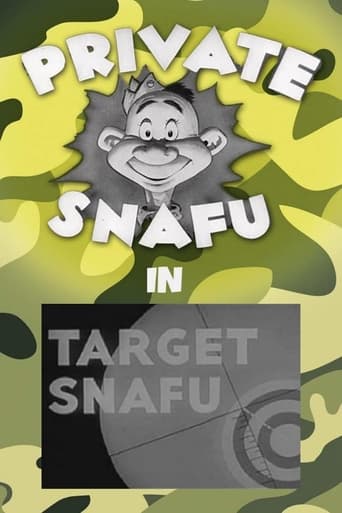
The cartoon's title is a play on "Superman" and parodies the popular Superman cartoons of the 1940s. The "Private Snafu" cartoons were not released commercially, until December 2010. Snafu becomes a superhero, only for him to become the world's dumbest one because he won't study his field manuals.
Cast & crew
More Comedy films
View all →






More from Friz Freleng
View all →

More about this film
About the production
Release date1944
ProductionWarner Bros. Cartoons, U.S. Army Signal Corps
Filmed inWarner Bros. Studios, Burbank, California
This was one of 26 Private Snafu cartoons produced between 1943-1945 as part of the U.S. Army's training film series. The cartoons were classified as military training materials and not shown to the general public during WWII. They were allowed to use more adult humor and risqué content than typical Warner Bros. cartoons because they were intended only for military personnel. The production team included many of Warner Bros.' top animators and writers.
Themes
Military trainingEducation through entertainmentCompetence vs. incompetenceFollowing proceduresParody of popular culture
Themes & topics
superheroparodymilitary trainingeducationincompetenceWorld War IIanimationcomedyfield manualssoldier
Historical background
By 1944, competing studios crowded weekly bills, and Snafuperman had to win attention alongside newsreels and shorts.
Why this film matters
Festival and repertory screenings keep Snafuperman in circulation among silent- and classic-film communities.
Making of
The Private Snafu series was a unique collaboration between Warner Bros. and the U.S. Army Signal Corps. Friz Freleng, one of Warner's top directors, helmed several entries including 'Snafuperman.' The animation team worked under strict military supervision but was given unusual creative freedom to use adult humor. The cartoons were produced quickly on tight schedules to meet wartime needs. Mel Blanc's voice recordings were done in secret sessions, and the scripts were reviewed by military officials before production. The Superman parody was particularly effective as the character was extremely popular with soldiers during WWII. The animation team incorporated inside jokes and military slang that would resonate with the target audience of enlisted men.
What critics said
Audience surveys from 1944 are sparse; interest in Snafuperman is inferred from reissue and archive activity.
Did you know?
- Private Snafu was created by Theodor Geisel (Dr. Seuss) and Phil Eastman specifically for these Army training films
- The name 'Snafu' comes from the military acronym 'Situation Normal: All Fucked Up'
- These cartoons were classified during WWII and not available to the public until decades later
- Mel Blanc voiced not only Snafu but also the narrator and other characters in the series
- The cartoons could use content prohibited in regular theatrical cartoons, including mild profanity and sexual innuendo
- Warner Bros. charged the U.S. Army only $1 per cartoon, essentially donating their services to the war effort
- The animation style parodied Superman cartoons of the era, which were also produced by Fleischer Studios
- Tedd Pierce, credited as cast, was actually a writer for Warner Bros. who occasionally provided voice work
- The Snafu series was considered so effective that the Army requested more cartoons than originally planned
- Some Snafu cartoons were 'lost' for decades after the war and only rediscovered in film archives
Visual style
The animation employed Warner Bros.' signature style of the 1940s, characterized by fluid movement, exaggerated expressions, and dynamic action sequences. The Superman parody elements allowed for dramatic camera angles and perspective shots typical of superhero cartoons of the era. The color palette was vibrant despite the limited technology of the time, using bold primary colors to emphasize the comic book superhero theme. The animation team used squash and stretch techniques extensively during Snafuperman's failed attempts at heroics, creating visual humor that complemented the verbal comedy.
Innovations
The Private Snafu series pushed technical boundaries in terms of what could be shown in animated films during the 1940s. The production team developed new techniques for quickly producing high-quality animation on military deadlines. The cartoons featured more sophisticated timing and editing than typical theatrical shorts of the era, reflecting the urgency and efficiency of military training. The series also pioneered the use of animation for adult education, demonstrating that the medium could effectively communicate complex information to mature audiences.
Music
The musical score was composed by Carl Stalling, Warner Bros.' musical director who created the iconic 'Looney Tunes' sound. Stalling adapted popular military songs and march music alongside his original compositions. The soundtrack included dramatic superhero themes parodying the Superman radio show and cartoons of the period. Sound effects were exaggerated for comedic effect, particularly during Snafuperman's failed heroic attempts. The voice work by Mel Blanc demonstrated his remarkable range, creating distinct characters through vocal manipulation.
Famous quotes
Even with super powers, you're still a dummy if you don't study your manuals!
Situation Normal: All Fucked Up
A soldier who doesn't study is just a target with a uniform
Memorable scenes
- Snafu's transformation into Snafuperman with a dramatic superhero parody sequence
- Snafuperman attempting to stop a tank but failing because he doesn't know the proper procedures
- The dream sequence where Snafu imagines himself as a powerful superhero
- The final scene showing Snafu back in reality, still confused about why he keeps failing
What audiences thought
The original audience of soldiers reportedly loved the Private Snafu cartoons, finding them entertaining and relatable. The character's incompetence and the risqué humor that couldn't appear in regular cartoons made them popular among enlisted men. Many veterans later recalled these cartoons as highlights of their training. When the cartoons became available to the public years later, animation enthusiasts and history buffs embraced them as fascinating artifacts of wartime cinema. Modern audiences viewing them on streaming platforms and in film archives appreciate both the historical significance and the timeless humor of Snafu's misadventures.
Film connections
Influenced by
- Superman cartoons (Fleischer Studios)
- Military training manuals
- Dr. Seuss's writing style
- Warner Bros. Looney Tunes formula
This film influenced
- Later military training films
- Adult animation series
- Educational cartoons
- Military comedy films
Film restoration
The film is preserved in the National Archives and Records Administration as part of the U.S. Army Signal Corps collection. Several 35mm prints exist in various film archives, and digital restorations have been created for educational and historical purposes. The cartoon entered the public domain due to its status as a government work, contributing to its preservation and availability.
Where to watch
- YouTube (public domain uploads)
- Internet Archive
- Warner Bros. streaming services (when available)
- Military history websites
- Educational film collections
- DVD compilations of WWII animation