
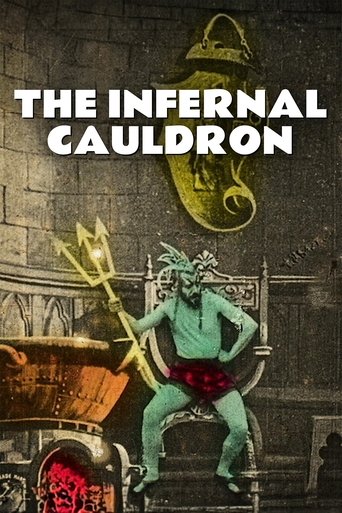
The Enchanted Well
"A witch is denied a handout and casts a spell on the town's well"
Keys: Space play/pause · ←/→ 10s · F fullscreen · M mute · </> speed
About this film
A witch is denied a handout and casts a spell on the town's well.
Cast & crew
More films like this
More Fantasy films
View all →



More from Georges Méliès
View all →

More about this film
About the production
Release date1903
Box officeUnknown - box office records from 1903 are not preserved
ProductionStar Film Company
Filmed inMontreuil, Seine-Saint-Denis, France (Méliès' studio)
Filmed in Méliès's glass-walled studio in Montreuil using theatrical sets and painted backdrops. The production utilized Méliès's pioneering substitution splicing technique for magical transformations. The well was constructed as a practical set piece with trap doors for disappearances and appearances. Multiple takes were required to achieve the complex magical effects, with each transformation requiring precise camera stops and actor positioning.
Themes
Good versus evilCommunity solidaritySupernatural interventionMagic and witchcraftWater as life force
Themes & topics
Historical background
The Enchanted Well (1903) emerged during the earliest years of motion pictures. A witch is denied a handout and casts a spell on the town's well. Archival records and catalog entries help place the work within film-history surveys of the period.
Why this film matters
Preserved under Wikidata ID Q18708941, The Enchanted Well is valued as a screen drama within catalog and archive collections. Wikipedia's "The Enchanted Well" entry connect it to broader histories of cinema exhibition and restoration.
Making of
The production took place in Méliès's innovative glass studio, which allowed for natural lighting control essential for the complex special effects. The witch character underwent multiple costume changes during filming to create the illusion of magical transformation. The well set featured a complex system of pulleys and trap doors to enable actors to appear and disappear mysteriously. Méliès employed his signature substitution splicing technique, stopping the camera, changing elements in the scene, then restarting filming to create magical effects. The filming process was extremely methodical, with each special effect requiring precise timing and coordination between the camera operator and performers. The production likely took 1-2 days to complete, which was typical for Méliès's short films of this period.
What critics said
Trade and archival sources offer limited day-one review coverage for The Enchanted Well. Modern reception rests on its availability in collections, repertory screenings, and reference works that document 1903 cinema.
Did you know?
- This film was released as part of Méliès's prolific 1903 output, when he produced approximately 50 films
- The witch character was likely played by Méliès himself, as he often portrayed magical characters in his films
- The film would have been hand-colored frame by frame for special screenings, a laborious process that Méliès employed for his most important works
- Like many Méliès films, it was designed to be projected with live musical accompaniment, typically piano or small orchestra
- The film was distributed internationally through Méliès's Star Film Company and given different titles in various markets
- The well set was reused in multiple Méliès productions, a common practice to maximize production efficiency
- This film represents Méliès's fascination with water-based magic, a theme he explored in several other works
- The special effects were achieved entirely in-camera, without post-production editing as we know it today
- The film was likely shot on 35mm film at approximately 16 frames per second, standard for the era
- Méliès's theatrical background heavily influenced the film's staging, with actors performing in a highly stylized manner
Visual style
The cinematography employed Méliès's characteristic static camera positioning, reminiscent of theatrical proscenium staging. The film utilized a single, fixed camera angle that captured the entire set, allowing audiences to witness the magical transformations without distraction. The lighting was natural, filtered through the glass walls of Méliès's studio, creating soft, even illumination ideal for the special effects. The composition was carefully arranged to maximize the impact of appearances and disappearances within the well setting. The camera work was precise and mechanical, essential for the successful execution of substitution splicing effects.
Innovations
The film showcased Méliès's mastery of substitution splicing, a technique he pioneered for creating magical effects. The production utilized multiple exposure techniques to create ghostly apparitions. The well set incorporated mechanical effects for the appearance and disappearance of water and magical elements. Méliès employed pyrotechnics for magical flashes and transformations. The film demonstrated advanced matte painting techniques for extending the set beyond its physical boundaries. The production utilized carefully choreographed timing between camera stops and actor movements to create seamless magical effects. These innovations represented the cutting edge of cinematic special effects in 1903.
Music
Like all films of 1903, this was a silent production accompanied by live music during exhibition. The typical accompaniment would have been piano music, with selections chosen to match the film's magical and dramatic moments. In larger theaters, small orchestras might have provided the score, using popular classical pieces and original compositions. The music would have been particularly important during the witch's appearances and the magical transformations. Méliès sometimes provided musical suggestions with his films, though specific recommendations for this work are not preserved. The score would have emphasized the contrast between the mundane village setting and the supernatural events.
Famous quotes
No dialogue - silent film with intertitles if any
Memorable scenes
- The witch's dramatic appearance at the well, the magical transformation of water into supernatural elements, the villagers' collective confrontation with the witch, the final restoration of the well's purity
What audiences thought
Audiences in 1903 would have been captivated by the film's magical effects and supernatural narrative, which were still novel attractions in cinema. The film likely played well in both fairground booths and emerging permanent theaters. Méliès's fantasy works were particularly popular with family audiences and those seeking wonder and escapism. The witch character would have been both frightening and fascinating to viewers of the era. The film's short length and spectacular effects made it ideal for the varied programming of early cinema exhibitions. Modern audiences viewing the film today often express fascination with its primitive charm and historical significance.
Film connections
Influenced by
- Victorian stage magic
- Gothic literature
- French theatrical traditions
- Folk tales and legends
- Opera and ballet productions
This film influenced
- Later horror films featuring witches
- Fantasy films with magical curses
- Special effects-driven narrative cinema
- Supernatural thriller genre
Film restoration
Like many Méliès films from this period, preservation status is uncertain. Many of his works were lost due to decomposition and the 1917 fire at his studio. However, copies of Méliès films have been discovered in archives worldwide. The film may exist in private collections or film archives such as the Cinémathèque Française. Some Méliès films have been restored from surviving prints and nitrate fragments. The film's survival would depend on whether copies were distributed internationally and preserved in various archives.
Where to watch
- Potentially available through film archive screenings
- May be included in Méliès compilation DVDs
- Possible availability on specialized streaming platforms for classic cinema
- Film archive websites such as the Cinémathèque Française
- Museum exhibitions featuring early cinema