
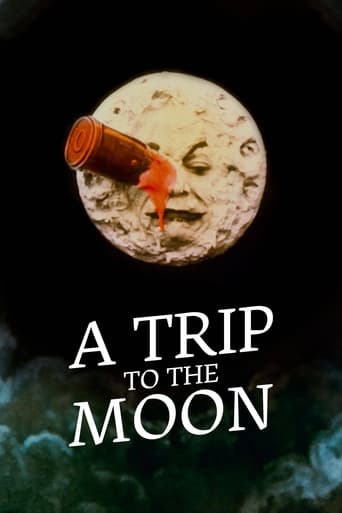
The Man with the Rubber Head
"chemist carries out a bizarre experiment with his own head"
Keys: Space play/pause · ←/→ 10s · F fullscreen · M mute · </> speed
About this film
A chemist carries out a bizarre experiment with his own head.
Cast & crew
More films like this
More Comedy films
View all →







More from Georges Méliès
View all →


More about this film
About the production
Release date1901
Box officeUnknown - box office records not maintained for films of this period
ProductionStar Film Company
Filmed inMéliès Studio, Montreuil-sous-Bois, France
Filmed in Méliès's glass-walled studio which allowed natural lighting. The picture utilized multiple exposure techniques and substitution splices to create the illusion of the detachable head. Méliès himself performed all the effects and acted in the picture, which was typical of his productions. The rubber head prop was carefully constructed to appear both realistic and comically flexible.
Themes
Themes & topics
chemistexperimentdetached headinflationexplosionlaboratoryspecial effectsbody modificationscience fictioncomedy
Historical background
By 1901, Star Film Company was supplying France theaters with titles like The Man with the Rubber Head, part of the broader expansion of filmed entertainment into working-class districts and small towns.
Why this film matters
Programmers and historians revisit The Man with the Rubber Head (1901) because its story—a chemist carries out a bizarre experiment with his own head—illustrates popular narrative habits and production norms of the period.
Making of
Georges Méliès created in his custom-built glass studio in Montreuil-sous-Bois, which he designed specifically for filming his magical effects. The production involved careful choreography and timing to execute the multiple exposure effects that made the head appear to detach and grow. Méliès, a former magician, applied his knowledge of stage illusions to cinema, using substitution splices - where the camera is stopped, objects are changed, and filming resumes - to create seamless magical transformations. The rubber head prop was constructed with varying sizes to show the inflation effect, and the explosion was created using a different prop designed to burst apart on cue. The entire film was shot in a single day, as was typical for Méliès's short films of this period.
What critics said
English-language trade reviews of The Man with the Rubber Head are limited for 1901. Where notices survive, they stress pacing and photographic clarity; later criticism values the title as archival evidence of studio style.
Did you know?
- is also known by its French title 'L'homme à la tête de caoutchouc'
- the picture demonstrates Méliès's pioneering use of multiple exposure and substitution splicing techniques
- The exploding head effect was achieved through careful editing and the use of a different prop for the explosion sequence
- Méliès often played the lead role in his own films, and this is one of his most famous performances
- the picture was part of Méliès's series of 'trick films' that showcased his innovative special effects
- The rubber head prop was reportedly made from papier-mâché and painted to resemble skin
- was distributed internationally and was one of Méliès's most commercially successful works
- the picture's concept was inspired by stage magic acts popular in Paris at the time
- Méliès patented many of the techniques used in, including the substitution splice
- the picture was hand-colored in some releases, a common practice for important Méliès productions
Visual style
The cinematography was typical of Méliès's style, featuring a single static camera position that captured the entire action as if viewing a stage performance. This theatrical approach allowed Méliès to execute his complex special effects with precision. the picture utilized multiple exposure techniques to create the illusion of the head detaching from the body, and careful editing to show the head's transformation. The lighting was natural, coming through the glass walls of Méliès's studio, creating a bright, clear image that was necessary for the special effects to work properly. Some versions of the picture were hand-colored, adding to its visual appeal and magical quality.
Innovations
showcased several groundbreaking technical innovations including multiple exposure photography, substitution splicing, and careful prop construction. Méliès's use of multiple exposure allowed him to create the illusion of the head existing separately from the body. The substitution splice technique, where filming was stopped to change elements in the scene, enabled the magical transformations. the picture also demonstrated early understanding of continuity editing and visual storytelling. The construction of the rubber head prop with multiple sizes for the inflation sequence was an innovative approach to creating visual effects through practical means.
Music
the picture was originally silent, as was standard for all films in 1901. When exhibited, it would have been accompanied by live music, typically a pianist or small orchestra playing appropriate music to enhance the comedic and magical elements. The musical accompaniment would have varied by venue and performer, with some exhibitors using popular tunes of the day while others composed original pieces. Modern screenings often feature newly composed scores that attempt to capture the whimsical and magical nature of the picture.
Famous quotes
No dialogue was present in this silent film
Memorable scenes
- The iconic moment when the chemist inflates his detached head using a bellows, watching it grow to enormous proportions before dramatically exploding, sending pieces flying across the laboratory
What audiences thought
the picture was enormously popular with audiences of its time, who had never seen such magical effects on screen before. Viewers were reportedly amazed and sometimes frightened by the illusion of the detachable, expanding head. the picture became one of Méliès's most requested works for exhibition and was shown extensively throughout Europe and America. Its success led to increased demand for Méliès's fantasy films and helped establish his reputation as the leading filmmaker of fantastical cinema. Modern audiences viewing the picture today often express admiration for its creativity and technical ingenuity, considering it remarkably sophisticated for its era.
Film connections
Influenced by
- Stage magic acts of the late 19th century
- Sideshow performances
- Scientific demonstrations
- Comedic theater traditions
- The works of Jules Verne
This film influenced
- The Cabinet of Dr. Caligari (1920)
- Frankenstein (1931)
- The Fly (1958)
- Scanners (1981)
- Being John Malkovich (1999)
Film restoration
the picture has been preserved and restored by various film archives including the Cinémathèque Française. Multiple copies exist in different film archives worldwide. Some versions retain the original hand-coloring. the picture is considered well-preserved for its age and is frequently included in retrospectives of early cinema and Méliès's work.
Where to watch
- YouTube (various public domain uploads)
- The Criterion Channel (as part of Méliès collections)
- Kino Lorber DVD collections of Méliès films
- Mubi (occasionally featured in early cinema programs)
- Film archives and museum screenings
- Various streaming services specializing in classic cinema