
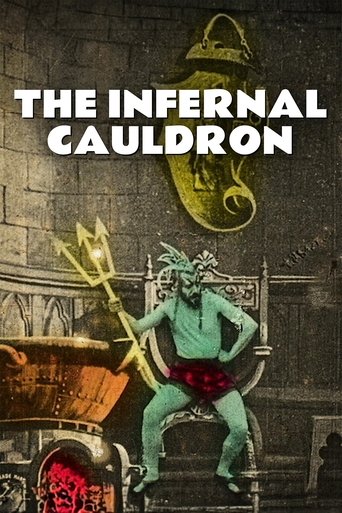
The Merry Frolics of Satan
"Satan torments two travelers"
Keys: Space play/pause · ←/→ 10s · F fullscreen · M mute · </> speed
About this film
Two travellers are tormented by Satan from inn to inn and eventually experience a buggy ride through the heavens courtesy of the Devil before he takes one of them down to Hell and roasts him on a spit.
Cast & crew
More films like this
More Comedy films
View all →







More from Georges Méliès
View all →


More about this film
About the production
Release date1906
Box officeUnknown - box office records from 1906 are not preserved
ProductionStar Film Company
Filmed inGeorges Méliès's studio in Montreuil-sous-Bois, France
Filmed entirely in Méliès's glass-walled studio using painted backdrops and stage machinery. The film employed multiple exposure techniques, substitution splices, and elaborate mechanical effects for the heavenly ascent sequence. Méliès built a special rig to create the illusion of the carriage flying through clouds, using pulleys and painted scenery. The Hell sequence required complex pyrotechnic effects and miniature work for the roasting scene.
Themes
Supernatural tormentDivine justiceThe battle between good and evilThe consequences of sinMagical transformation
Themes & topics
travelersSataninntormentsupernaturalheavenhellpunishmentmagictransformationflyingdevilroasting
Historical background
Fairground exhibitors screened The Merry Frolics of Satan around 1906, when projected images still traveled as curiosity entertainment.
Why this film matters
The Merry Frolics of Satan belongs to early staged screen fiction, when producers tested camera placement and trick cuts.
Making of
Georges Méliès, a former magician, brought his theatrical expertise to, creating elaborate illusions through carefully choreographed camera tricks. The production took place in his custom-built studio with glass walls and ceilings to maximize natural light. For the famous ascent scene, Méliès mounted the carriage on a hidden platform that could be tilted and raised while the camera remained stationary, creating the illusion of flight. The Hell sequence required careful timing of pyrotechnics and the use of a mechanical spit system. Méliès performed all the roles himself, using quick costume changes between takes, a common practice in his films. The hand-colored versions required teams of women to carefully paint each frame by hand using stencils, a process that could take weeks for a single film.
What critics said
Press notices for The Merry Frolics of Satan (1906) are sparse in digitized sources; interest today rests on preserved prints and comparison with related titles.
Did you know?
- is cataloged as Star Film Company production number 822-823
- The original French title was 'Les Fourberies de Satan' (The Deceits of Satan)
- Méliès himself played multiple roles in the film, including both travelers and Satan
- The heavenly ascent sequence was among the leading complex special effects shots of its time
- The film was hand-colored in some releases, a laborious process where each frame was individually painted
- The roasting scene was considered particularly shocking for 1906 audiences
- Only one copy of the film survives today, preserved at the Cinémathèque Française
- The film was part of Méliès's series of 'devil' films, which were among his most popular productions
- The buggy used in the film was a real carriage modified with hidden mechanisms for the flying effect
- Méliès used the same Hell set design in several of his other films featuring demonic themes
Visual style
The cinematography, handled by Méliès himself, employed multiple exposure techniques to create supernatural appearances and disappearances. The film utilized substitution splices for transformation effects, where the camera was stopped, elements were changed, and filming resumed. The heavenly ascent sequence required careful camera positioning to maintain the illusion of flight while the carriage was manipulated on hidden machinery. Méliès used theatrical lighting techniques enhanced for the camera, creating dramatic contrasts between the earthly scenes, heavenly realms, and Hell. The film's visual style reflects Méliès's background in stage magic, with carefully composed shots that resemble theatrical tableaux. The hand-colored versions added another layer of visual spectacle, with vibrant reds and oranges dominating the Hell sequence and ethereal blues for the heavenly scenes.
Innovations
The film pioneered several technical innovations including complex multiple exposure photography, sophisticated mechanical effects for the flying carriage sequence, and advanced pyrotechnic effects for the Hell scenes. Méliès developed new techniques for creating smooth transitions between reality and supernatural elements, using carefully timed cuts and substitutions. The film's use of perspective and forced perspective in creating the illusion of vast spaces was particularly advanced for its time. The hand-coloring process used in some versions represented a significant technical achievement in early color film techniques. The seamless integration of various effects techniques into a cohesive narrative was groundbreaking and influenced subsequent developments in special effects cinema.
Music
As a silent film, it would have been accompanied by live music during exhibition. Typical accompaniment might have included popular songs of the era, classical pieces, or improvised piano music. For the hand-colored versions, theaters might have used colored lights synchronized with the music to enhance the supernatural atmosphere. No original score was composed specifically for the film, as was common for productions of this period. Modern restorations are often accompanied by newly composed scores that attempt to capture the film's magical and dramatic qualities.
Famous quotes
As a silent film, it contains no spoken dialogue. The narrative is conveyed entirely through visual storytelling and intertitles in some versions.
Memorable scenes
- The spectacular ascent of the carriage through the heavens, with Satan at the reins and the travelers clinging on as they rise above painted clouds toward the sky. The scene culminates with one traveler being unceremoniously dropped into the fiery depths of Hell below, creating a dramatic visual contrast between the ethereal heavens and the infernal punishment below.
What audiences thought
The film was popular with audiences of its time, who were captivated by Méliès's magical effects and fantastical storytelling. Contemporary reports indicate that the heavenly ascent and Hell sequences elicited strong reactions from viewers, ranging from wonder to shock. The film was part of Méliès's most commercially successful period, when his fantasy films were in high demand across Europe and America. Modern audiences viewing the film today often express amazement at the sophistication of effects achieved with such primitive technology. The film continues to be shown at film festivals and retrospectives, where it typically receives enthusiastic responses from viewers interested in cinema history and early special effects.
Film connections
Influenced by
- Gothic literature
- Medieval mystery plays
- Theatrical magic traditions
- Religious iconography
- Dante's Inferno
- Faust legends
This film influenced
- Later horror films depicting Hell
- Fantasy films with supernatural tormentors
- Films featuring journeys through supernatural realms
- Early horror cinema of the 1910s and 1920s
Film restoration
The film is preserved but incomplete. A single copy survives at the Cinémathèque Française in Paris. The surviving version may be missing some footage, as was common with early films that were often cut or damaged over time. The film has been digitally restored and is available in various formats, including some hand-colored versions. The restoration work has helped preserve Méliès's innovative effects techniques for future generations to study and appreciate.
Where to watch
- YouTube (various uploads of the restored version)
- The Criterion Channel (as part of Méliès collections)
- Kanopy (through participating libraries)
- Internet Archive (public domain versions)
- Various DVD collections of Méliès's films
- Museum screenings and film festival retrospectives