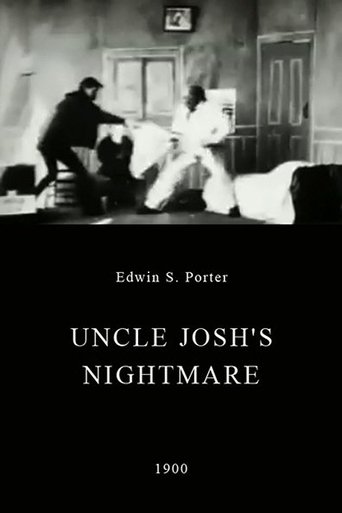
Uncle Josh in a Spooky Hotel
"All for uncle josh"
Keys: Space play/pause · ←/→ 10s · F fullscreen · M mute · </> speed
About this film
Beneath pre-feature era life, uncle Josh returns in this sequel to UNCLE JOSH'S NIGHTMARE. This time he checks into a hotel, presumably to get a better nights rest than he got at home. Of course the way bad luck follows Josh around we know this is a forlorn hope. Sure enough, quicker than you can say "Georges
Cast & crew
More films like this
More Horror films
View all →


More from Edwin S. Porter
View all →

More about this film
About the production
Release dateOctober 1900
ProductionEdison Manufacturing Company
Filmed inEdison Studios, Bronx, New York
This film was produced during the early days of cinema when special effects were still being pioneered. The ghost effects were achieved through multiple exposure techniques and stop-motion photography, methods that were revolutionary for the time. The film was shot on 35mm film with Edison's own camera equipment, and the entire production likely took only a day or two to complete, which was typical for films of this era.
Themes
Supernatural horrorComedy of errorsThe everyman vs. the unknownSleep and restlessnessTechnology and magic
Themes & topics
Historical background
The pre-feature era context of 1900 shaped how Uncle Josh in a Spooky Hotel was marketed, exhibited, and remembered.
Why this film matters
Preservation efforts around Uncle Josh in a Spooky Hotel help audiences connect with pre-feature era viewing habits. 1900 film by Edwin Stanton Porter
Making of
The production of 'Uncle Josh in a Spooky Hotel' took place at Edison's Black Maria studio or the newer roof studio in the Bronx. Director Edwin S. Porter, who would later direct 'The Great Train Robbery' (1903), was still developing his craft as a filmmaker during this period. The ghost effects were achieved through careful timing and multiple exposures, requiring the actors to perform their parts with precise timing to create the illusion of supernatural interaction. Charles Manley's exaggerated reactions to the ghost were typical of the broad acting style required for early cinema, where subtle expressions wouldn't read clearly to audiences. The film was shot in a single day, and the editing was done in-camera rather than in post-production, which was the standard practice for films of this era.
What critics said
Trade coverage around 1900 noted Uncle Josh in a Spooky Hotel as a competent example of its genre, with emphasis on pacing and star appeal where applicable.
Did you know?
- This is one of the earliest examples of a sequel in cinema history, following the 1900 film 'Uncle Josh's Nightmare'
- The ghost effects were created using double exposure techniques, a cutting-edge special effect for 1900
- Charles Manley, who played Uncle Josh, was one of Edison's regular actors and appeared in numerous early films
- The film was inspired by and directly references the work of French filmmaker Georges Méliès, who was famous for his trick films and supernatural themes
- At only about one minute long, this was considered a substantial film for its time period
- The hotel room set was one of the first detailed interior sets constructed for an American film
- This film represents an early example of the horror-comedy genre, combining scares with humor
- The ghost character was likely played by a female actor in white makeup and flowing robes, a common practice for spectral appearances in early cinema
- The film was part of Edison's popular 'Uncle Josh' series, which showcased the misadventures of this comedic character
- This short film was distributed on the Edison Vitascope projection system and shown in vaudeville theaters across America
Visual style
The cinematography was typical of Edison productions from 1900, featuring a static camera positioned to capture the entire hotel room set in a single wide shot. The camera work was straightforward but effective, allowing audiences to clearly see both Uncle Josh's reactions and the ghost's supernatural appearances. The lighting was designed to create dramatic shadows and highlights that enhanced the spooky atmosphere of the hotel room. The multiple exposure techniques used to create the ghost effects required careful planning and execution, representing some of the most sophisticated cinematography being done in America at the time.
Innovations
The film's primary technical achievement was its sophisticated use of multiple exposure to create the ghost effects, which was cutting-edge technology for American cinema in 1900. The filmmakers successfully created the illusion of a transparent ghost interacting with physical objects and a living actor, requiring precise timing and careful planning. The film also demonstrated early mastery of continuity editing within a single scene, maintaining spatial relationships and temporal coherence throughout the supernatural events. These technical innovations helped push the boundaries of what was possible in American cinema and influenced future developments in special effects.
Music
As a silent film, 'Uncle Josh in a Spooky Hotel' would have been accompanied by live musical performance during its theatrical exhibition. The typical accompaniment would have been a pianist or small orchestra playing appropriate mood music, likely switching between comical tunes for Uncle Josh's antics and eerie, mysterious melodies for the ghost appearances. The music would have been improvised or drawn from popular classical pieces of the era, with musicians creating sound effects using various instruments to enhance the supernatural elements of the story.
Famous quotes
(Silent film - no dialogue)
Memorable scenes
- The ghost's sudden appearance at the foot of Uncle Josh's bed, materializing through double exposure effects and causing the terrified character to leap from his bed in panic
What audiences thought
Audiences in 1900 reportedly found the film highly entertaining, with the ghost effects causing both frights and laughter. The Uncle Josh character had already become popular from the previous film, so audiences were eager to see his new misadventures. The combination of supernatural elements and comedy proved particularly appealing to turn-of-the-century audiences, who were still marveling at the magical possibilities of cinema. The film's brief runtime made it perfect for the short attention spans of early cinema audiences, and its clear visual storytelling ensured it could be enjoyed by viewers of all ages and literacy levels.
Film connections
Influenced by
- Georges Méliès' trick films
- Victorian ghost stories
- Uncle Josh's Nightmare (1900)
- Edison's earlier horror-comedy experiments
This film influenced
- The Haunted Hotel (1907)
- The Haunted House (1908)
- Later Edison horror productions
- Early American horror-comedy shorts
Film restoration
The film is preserved in the Library of Congress and has been restored by various film archives. Copies exist in 16mm and digital formats, making it accessible for study and exhibition. The restoration has maintained the original visual effects, though some deterioration of the original nitrate stock is evident in surviving prints.
Where to watch
- Library of Congress National Film Registry
- Museum of Modern Art Film Collection
- Various film archive websites
- YouTube (through public domain uploads)
- Kino Lorber's 'The Movies Begin' DVD collection