
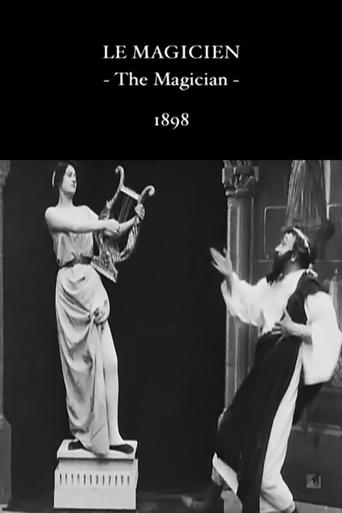
Whimsical Illusions
"Hand-colored magic from a Méliès-style conjurer."
Keys: Space play/pause · ←/→ 10s · F fullscreen · M mute · </> speed
About this film
In 1910, in a hand-colored short, a magician and his assistant do a series of magic tricks, including making potted plants appear, among others. Melies played the magician, and the actor Manuel played his assistant.
Cast & crew
More films like this
More Comedy films
View all →







More from Georges Méliès
View all →


More about this film
About the production
Release date1910
BudgetNot documented - typical for Méliès's short films of this period
Box officeNot documented - box office records were not systematically kept for 1910 short films
ProductionStar Film Company (Georges Méliès's own production company)
Filmed inMéliès Studio, Montreuil-sous-Bois, France
The film was hand-colored using the stencil coloring technique employed by Méliès's workshop, where each frame was individually colored by female workers. This was a labor-intensive process that added significant value to the film prints. The production utilized Méliès's signature substitution splicing technique, where the camera was stopped, objects were changed or added, and filming resumed to create magical effects. The potted plants appearing trick was achieved through careful timing and multiple exposures.
Themes
Magic and illusionTransformation and metamorphosisTheatrical performanceThe power of creativityThe boundaries between reality and fantasy
Themes & topics
Historical background
Released in 1910, Whimsical Illusions reached audiences during the silent era, when exhibition and production norms differed sharply from today's.
Why this film matters
Whimsical Illusions remains viewable through digital archives, preserving 1910 screen culture for modern audiences.
Making of
The production of 'Whimsical Illusions' took place in Méliès's elaborate glass-walled studio in Montreuil-sous-Bois, which he built specifically for creating his magical films. The studio was equipped with a complex system of trap doors, pulleys, and flying rigs that enabled the spectacular illusions seen in his movies. The hand-coloring process was particularly laborious, with each frame requiring careful application of color through stencils by a team of skilled female colorists. Méliès himself was deeply involved in every aspect of production, from writing and directing to performing and designing the special effects. The collaboration with his regular assistant Manuel was well-established by this point, allowing for smooth execution of complex magical sequences that required precise timing between the performers.
What critics said
Where contemporary reviews survive, Whimsical Illusions is read against the tastes of 1910; revival screenings keep it in circulation.
Did you know?
- This film was created during the later period of Méliès's career when he was struggling financially but still producing technically sophisticated work
- The hand-coloring process used in this film could take weeks to complete, with each color requiring a separate stencil
- Méliès played the magician role himself, as he did in approximately 300 of his 500+ films
- The actor Manuel was one of Méliès's regular collaborators, appearing in multiple films during this period
- The film was distributed internationally by Star Film Company, with different catalog numbers for different markets
- Many of Méliès's films from this period were accidentally destroyed when the French military confiscated his film stock for boot heels during World War I
- The potted plant illusion technique was one of Méliès's favorite tricks, appearing in various forms across multiple films
- This film represents the refinement of techniques Méliès had been developing since the late 1890s
- The original French title may have been 'Illusions Fantaisistes' or similar, though records are incomplete
- The film was shot on Méliès's custom-built glass studio stage, which allowed for elaborate set pieces and trap doors
Visual style
The cinematography in 'Whimsical Illusions' showcases Méliès's mastery of early film techniques, particularly his use of substitution splicing to create magical transformations. The film was shot on a single camera setup typical of Méliès's theatrical approach, with the camera positioned to capture the entire stage as if watching a live performance. The hand-coloring adds a rich visual dimension, with each frame carefully tinted to enhance the magical atmosphere. The lighting design was sophisticated for its time, using the glass studio's natural illumination combined with artificial lighting to create dramatic effects. The camera work is static but precise, allowing the magical effects to unfold clearly without distraction.
Innovations
The film showcases several of Méliès's signature technical innovations, most notably the substitution splice technique that allowed objects to appear and disappear magically. The hand-coloring process using stencils was particularly sophisticated, requiring precise alignment and consistent application across hundreds of frames. The film also demonstrates Méliès's mastery of multiple exposure techniques, which he used to create layered visual effects. The production design, including the elaborate sets and props, shows the sophisticated workshop capabilities Méliès had developed. The coordination between live performance and camera tricks represents a significant achievement in early film choreography.
Music
As a silent film, 'Whimsical Illusions' would have been accompanied by live music during its original theatrical presentations. The musical accompaniment would typically have been provided by a pianist or small orchestra, often playing popular classical pieces or theater music appropriate to the magical theme. Méliès himself sometimes provided detailed suggestions for musical accompaniment with his film prints, though specific recommendations for this film are not documented. The music would have been synchronized with the on-screen action, particularly the magical transformations and appearances, to enhance the theatrical experience.
Memorable scenes
- The sequence where potted plants magically appear from empty space, showcasing Méliès's mastery of substitution splicing and the vibrant hand-coloring that makes the illusion particularly striking
What audiences thought
Audiences in 1910 still found Méliès's magical films entertaining, though their popularity was declining compared to earlier years. The hand-coloring of the film added significant appeal, as color films were still a rarity and commanded premium ticket prices. The familiar formula of a magician performing impossible tricks continued to draw crowds, particularly family audiences. However, the growing sophistication of cinema audiences meant that many were beginning to prefer the more complex narratives being produced by competing studios. Modern audiences rediscovering Méliès's work through restorations and retrospectives are often amazed by the creativity and technical skill displayed in films like 'Whimsical Illusions'.
Film connections
Influenced by
- Stage magic and theatrical illusion shows of the late 19th century
- The conjuring traditions of Parisian theaters
- Earlier trick films by Méliès himself
- Theatrical traditions of the Paris Music Hall
This film influenced
- Later special effects films that used substitution techniques
- Contemporary magic-themed films and videos
- Modern tribute films to early cinema
- Music videos that employ similar visual trick techniques
Film restoration
Many of Méliès's films from this period were lost due to the 1917 fire at his studio and the confiscation of his film stock during World War I. However, some prints of 'Whimsical Illusions' have survived in various film archives, including the Cinémathèque Française. The surviving versions show varying degrees of deterioration, but some have been restored to preserve the hand-coloring effects. The film exists in incomplete form in several archives, with some scenes missing from different versions.
Where to watch
- Available through the Cinémathèque Française archives
- Included in some Méliès compilation DVD collections
- Accessible through select film preservation websites
- Occasionally screened at classic film festivals and retrospectives
- Available through some academic film archives and university collections