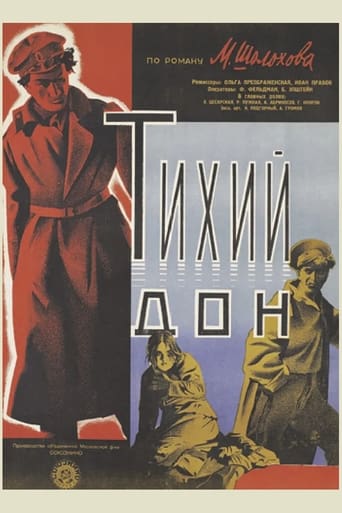
Films
1 film
About Ivan Pravov
Soviet film director active during the early sound era of Russian cinema, best known for his ambitious 1931 adaptation of Mikhail Sholokhov's epic novel 'And Quiet Flows the Don.' Working during a transformative period in Soviet filmmaking, Pravov emerged as part of the first generation of directors transitioning from silent films to talkies. His directorial approach reflected the socialist realist aesthetic that was becoming dominant in Soviet cultural policy during the early 1930s. Despite the significance of his literary adaptation, Pravov's career appears to have been brief, with 'And Quiet Flows the Don' standing as his sole major directorial credit. The film itself was notable for being one of the earliest attempts to capture the sweeping scope of Sholokhov's monumental work about Cossack life during the Russian Revolution and Civil War. Pravov's work demonstrated the technical and artistic challenges Soviet filmmakers faced in adapting complex literary works to the new medium of sound cinema during this period.
The Craft
Behind the Camera
Pravov's directing style reflected the emerging socialist realist aesthetic of early Soviet sound cinema, emphasizing collective narratives and historical materialism. His approach to 'And Quiet Flows the Don' attempted to balance the epic scope of the source material with the technical limitations of early sound filming, focusing on broad historical themes over individual character development. His visual language incorporated both the montage techniques of earlier Soviet cinema and the more narrative-driven approach required by sound technology.
Milestones
- Directed the first major film adaptation of 'And Quiet Flows the Don' (1931)
- Pioneered early Soviet sound cinema techniques
- Adapted one of Russia's most important literary works for the screen
Best Known For
Must-See Films
Working Relationships
Studios
Why They Matter
Impact on Culture
Ivan Pravov's contribution to cinema lies primarily in his ambitious attempt to adapt Mikhail Sholokhov's monumental novel 'And Quiet Flows the Don' to the screen during the formative years of Soviet sound cinema. His 1931 film represented one of the earliest cinematic interpretations of what would become. The film itself serves as a historical artifact documenting the technical and artistic challenges faced by Soviet filmmakers during the transition from silent to sound cinema, as well as the ideological pressures of creating films that aligned with socialist realist principles. While Pravov himself may not have achieved lasting fame, his work contributed to the broader project of bringing Russia's literary heritage to the screen during a crucial period in Soviet cultural history.
Lasting Legacy
Ivan Pravov's legacy is primarily tied to his role as an early adapter of one of Russia's most significant literary works. His 1931 version of 'And Quiet Flows the Don' paved the way for subsequent, more famous adaptations, including Sergei Gerasimov's acclaimed 1957-1958 trilogy. Though Pravov's film itself is largely forgotten and rarely screened today, it represents an important milestone in the history of Russian cinema and the ongoing dialogue between Russian literature and film. His work exemplifies the challenges and ambitions of early Soviet sound cinema and the attempts to create a distinctly Soviet cinematic language that could accommodate both artistic expression and ideological requirements.
Who They Inspired
Due to the brief nature of his documented career, Ivan Pravov's direct influence on subsequent generations of filmmakers appears limited. However, his early adaptation of 'And Quiet Flows the Don' contributed to the tradition of literary adaptation in Soviet cinema, demonstrating both the possibilities and challenges of bringing complex Russian novels to the screen. His work can be seen as part of the foundation upon which later Soviet directors like Sergei Gerasimov and Andrei Tarkovsky would build their more successful and influential adaptations of Russian literature.
Off Screen
Very little is documented about Ivan Pravov's personal life, which is not uncommon for Soviet-era filmmakers whose careers were brief or occurred during the turbulent early years of the Soviet film industry. What is known suggests he was part of the generation of filmmakers who came of age during the revolutionary period and attempted to establish careers in the state-controlled film industry of the 1930s.
Did You Know?
- His 1931 film was one of the earliest adaptations of Sholokhov's epic novel, which wouldn't win its author the Nobel Prize until 1965
- The film was produced during the First Five-Year Plan period, a time of rapid industrialization and cultural transformation in the Soviet Union
- Early Soviet sound films like Pravov's faced significant technical challenges, including primitive recording equipment and soundproofing issues
- The original novel 'And Quiet Flows the Don' was published in parts between 1928 and 1940, meaning Pravov was adapting a work that was still being written
- Soviet directors of this period often worked under intense political scrutiny, with films required to align with Communist Party cultural policies
- The film's focus on Cossack life during the revolution reflected the Soviet interest in depicting the transformation of traditional Russian societies
- Pravov's career appears to have coincided exactly with the transition from silent to sound cinema in the Soviet Union
Frequently Asked Questions
Who was Ivan Pravov?
Soviet on YTB.my.
What films is Ivan Pravov best known for?
Titles linked here include And Quiet Flows the Don (1931).
When was Ivan Pravov born and when did he die?
Born 1899; died death date not listed.
What awards did Ivan Pravov win?
There are no documented awards or honors for Ivan Pravov, which was not uncommon for Soviet filmmakers during this early period, especially those with brief careers.
What was Ivan Pravov's directing style?
Pravov's directing style reflected the emerging socialist realist aesthetic of early Soviet sound cinema, attempting to balance the epic scope of literary adaptation with the technical limitations of early sound filming while adhering to Soviet ideological requirements.