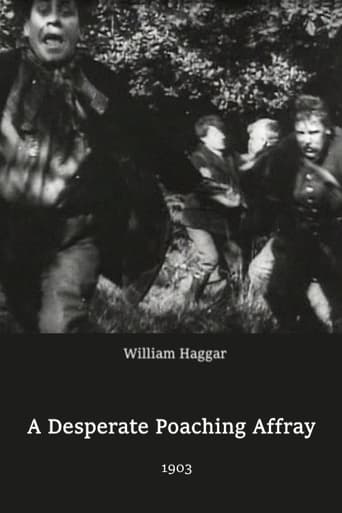
William Haggar
Director
- Born
- December 12, 1851, Merthyr Tydfil, Wales, United Kingdom
- Died
- November 1, 1925
- Active
- 1903-1903
Films directed 1
About William Haggar
William Haggar was a Welsh pioneer of early British cinema, best known as an inventive filmmaker, exhibitor, and showman whose work helped shape the language of the chase film and early narrative motion pictures. Born in Merthyr Tydfil, Wales, he first built his career in popular entertainment before moving into film exhibition and production with his family, working closely with his wife and children in what became one of the most remarkable early cinema family enterprises in Britain. By the early 1900s he was making short films in Wales that combined local settings, melodrama, and fast-moving action, with Desperate Poaching Affray (1903) becoming his best-known title and a landmark for its energetic cross-cutting and pursuit scenes. Haggar's films were generally short, direct, and audience-friendly, designed for popular taste and for the practical demands of fairground and travelling cinema exhibition. He is remembered as one of the earliest directors to understand how editing, repetition, and spatial clarity could intensify suspense and motion on screen. Although his directing career was brief and concentrated around the turn of the century, his importance lies in the fact that he helped demonstrate how cinema could transform familiar stage and melodramatic material into a distinct visual spectacle. His contribution is especially significant in Welsh and British film history, where he is regarded as a foundational figure in the pre-studio era.
More about William Haggar
Behind the camera
Haggar's directing style was brisk, practical, and highly visual, shaped by the needs of short-form early cinema and by the tastes of mass audiences. He favored clear storytelling, strong movement, and exterior action, often using real locations and straightforward staging to maximize immediacy and legibility. In his best-known work, he emphasized pursuit, repetition, and escalating tension, using editing and motion to drive the narrative rather than relying on elaborate character development. His films reflect a showman's instinct for spectacle, but they also show an early understanding of how cinematic cutting could create excitement and momentum. Because he worked before standardized studio techniques had fully developed, his style is best understood as inventive, adaptable, and rooted in popular entertainment.
In film history
William Haggar occupies an important place in the cultural history of early British cinema because he helped show that film could become more than a novelty act or recorded stage item. His work demonstrated the appeal of action-driven storytelling built around pursuit, danger, and spatially legible movement, which became a durable template for the chase film and for later adventure cinema. As a Welsh filmmaker working outside the dominant metropolitan centers, he also represents the regional and grassroots energies that helped cinema grow in Britain. His films are now valued not only as entertainment but as evidence of the medium's rapid evolution from recorded actuality to constructed narrative. In Welsh cultural memory, he stands as one of the earliest cinematic figures to associate the nation with film production and screen storytelling.
Later reputation
Haggar's legacy rests on the fact that his few surviving and documented films are studied as key examples of early editing, action construction, and audience-oriented storytelling. Desperate Poaching Affray is often discussed by film historians as a landmark in the chase film tradition and as an early demonstration of how parallel action and quick pacing could intensify screen drama. He is also remembered for working at the intersection of exhibition and production, embodying the entrepreneurial spirit that characterized the cinema's formative years. Although he did not build a large studio career or a long list of credited features, his influence endures through film scholarship, national cinema histories, and retrospectives of early British filmmaking. His name remains associated with the emergence of cinema as a modern visual language.
Influence
Haggar influenced later filmmakers primarily through technique rather than through a large body of direct discipleship. His chase-film approach helped validate rapid action, clear geography, and editorial momentum as essential tools of screen storytelling, anticipating practices that would become standard in adventure, crime, and thriller films. Later historians and filmmakers studying early cinema have cited his work as part of the foundation for narrative editing and action construction in popular film. His family-based production model also reflects an early independent spirit that influenced how non-studio filmmakers approached location shooting and audience appeal. In this sense, his influence is felt more in cinematic form and historical development than in a documented mentorship lineage.
Off screen
William Haggar worked closely with his family in entertainment and film exhibition, and his domestic and professional lives were closely intertwined. He and his wife, Elizabeth, were central to the family enterprise, and several of their children were involved in the business as performers, exhibitors, or production partners. The Haggar family became known for traveling shows and for adapting to the changing entertainment marketplace as moving pictures grew in popularity. His career reflects the collaborative nature of early cinema, when family networks often supplied the labor, performance, and entrepreneurial drive needed to mount productions and exhibitions. Available sources emphasize his role as a working showman and filmmaker more than private celebrity, so detailed personal documentation beyond his family business is limited.
Education
Formal educational background is not well documented; he is generally described through his career in popular entertainment and exhibition rather than academic training.
Credits
- Helped pioneer early British narrative filmmaking outside the London studio system
- Directed Desperate Poaching Affray (1903), one of the most celebrated early British chase films
- Worked with family members in a traveling exhibition and production enterprise that bridged live entertainment and cinema
- Used Welsh locations and practical action to create vivid, accessible short films for popular audiences
- Earned lasting recognition as an important figure in the development of cinematic suspense and editing
Films
- Desperate Poaching Affray (1903)
Honors
- Recognized as a pioneer of early British cinema
- Frequently cited in histories of Welsh film and early chase-film development
Collaborators
- Elizabeth Haggar
- Members of the Haggar family, including children involved in exhibition and production
Studios
- Haggar family travelling exhibition enterprise
- Early independent production in Wales
Family
- Elizabeth Haggar
Notes
- He is one of the earliest notable Welsh filmmakers.
- Desperate Poaching Affray is frequently cited as an important early chase film.
- His films were made for popular audiences and often relied on outdoor action and clear visual storytelling.
- He worked in an era when film production, exhibition, and family entertainment businesses often overlapped.
- His career is short in surviving film credits, but his historical importance is disproportionately large.
- He is often discussed in relation to the development of editing for suspense and pursuit scenes.
- His family was deeply involved in the moving-picture business, not just as audiences but as participants.
- He represents the pre-studio, entrepreneurial phase of British cinema history.
Questions
Who was William Haggar?
William Haggar was a Welsh early film director, exhibitor, and cinema pioneer. He is best known for his short silent films made at the dawn of British filmmaking, especially Desperate Poaching Affray (1903).
What films is William Haggar best known for?
He is best known for Desperate Poaching Affray (1903), his most famous and historically significant film. That work is especially important for its fast-paced chase structure and its place in early British cinema history.
When was William Haggar born and when did he die?
William Haggar was born on December 12, 1851, in Merthyr Tydfil, Wales, United Kingdom. He died on November 1, 1925.
What awards did William Haggar win?
No formal film awards are known for William Haggar, which is not unusual for an early cinema pioneer active before the modern awards era. His recognition comes through film history, scholarly attention, and his status as an important figure in early British and Welsh cinema.
What was William Haggar's directing style?
Haggar's directing style was direct, energetic, and strongly visual, with an emphasis on outdoor action, clear movement, and suspenseful pursuit. He helped show how editing and pacing could create excitement in early silent film storytelling.
What is William Haggar's legacy in film history?
Haggar is remembered as a pioneer of early British cinema and as a key figure in the development of the chase film. His work is studied for its contribution to editing, action choreography, and the transformation of cinema into a distinct narrative art form.