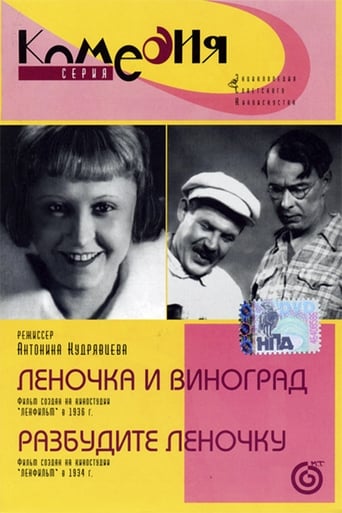
Films
2 films
About Antonina Kudryavtseva
Soviet film director active during the mid-1930s, a period of significant development in Soviet cinema under Stalin's cultural policies. Her brief but notable from 1934 to 1936, during which she directed two feature films that reflected the social realist aesthetic prevalent in Soviet cinema of the era. 'Wake Lena Up' (1934) and 'Helen and Grapes' (1936) represent her complete known filmography, suggesting she may have been part of the new generation of filmmakers emerging during this transformative period in Soviet cinema. Her work coincided with the establishment of socialist realism as the official artistic doctrine, which heavily influenced the themes and styles of Soviet films. Despite her limited output, Kudryavtseva contributed to the expansion of women's participation in Soviet filmmaking during a time when female directors were still relatively rare. Her films likely addressed contemporary social issues and collective values, as was typical of Soviet productions during this period.
The Craft
Behind the Camera
Social realist approach typical of mid-1930s Soviet cinema, focusing on collective themes and contemporary social issues
Milestones
- Directed 'Wake Lena Up' (1934)
- Directed 'Helen and Grapes' (1936)
- Part of early Soviet women directors movement
Best Known For
Must-See Films
Working Relationships
Studios
Why They Matter
Impact on Culture
Antonina Kudryavtseva represents the often-overlooked contribution of women to early Soviet cinema during a period of intense cultural and political transformation. Her work, though limited in output, is part of the broader narrative of how Soviet cinema developed its distinctive social realist style during the 1930s. Her films, like many from this era, likely served both artistic and propaganda purposes, reflecting the Soviet state's vision of cinema as a tool for social education and ideological reinforcement. The fact that she was able to direct feature films during this period indicates the relatively progressive stance on women's participation in certain professional fields in the early Soviet Union, even as artistic expression became increasingly constrained by state control.
Lasting Legacy
Antonina Kudryavtseva's legacy lies in her representation of women filmmakers in early Soviet cinema, a field historically dominated by men. While her films may not have achieved lasting fame, they contribute to our understanding of the diverse voices that shaped Soviet cinema during its formative years. Her brief career also illustrates the challenges faced by many Soviet artists during the politically volatile 1930s, when artistic careers could be cut short by changing political winds or shifting aesthetic requirements. Today, film historians studying gender roles in Soviet cinema and the development of social realism recognize figures like Kudryavtseva as important, though often underdocumented, contributors to film history.
Who They Inspired
Due to the limited scope of her work and the historical obscurity surrounding her career, specific influences of Antonina Kudryavtseva on other filmmakers are difficult to trace. However, as part of the generation of Soviet directors working during the establishment of socialist realism, she would have contributed to the development of this cinematic style. Her work may have influenced other women considering careers in Soviet filmmaking, demonstrating that directing was possible despite the male-dominated nature of the industry. The themes and techniques employed in her films likely reflected and reinforced the aesthetic and ideological standards that would guide Soviet cinema for decades.
Off Screen
Very little is documented about Antonina Kudryavtseva's personal life, which is common for many Soviet-era filmmakers who were not part of the most prominent circles. Her brief active years covered only two years, suggesting she may have faced the challenges that many Soviet artists encountered during the politically charged 1930s.
Did You Know?
- Her entire known filmography consists of only two films made within a two-year period
- She was active during the crucial period when socialist realism became the official Soviet artistic style
- Women directors were relatively rare in Soviet cinema during the 1930s, making her work notable
- Her career coincided with Stalin's consolidation of cultural control over Soviet arts
- The brief span of her directorial career (1934-1936) was typical of many Soviet filmmakers who faced political challenges
Frequently Asked Questions
Who was Antonina Kudryavtseva?
Soviet on YTB.my. She was part of the relatively small group of women directors working in Soviet cinema during this period.
What films is Antonina Kudryavtseva best known for?
Titles linked here include Wake Lena Up (1934), Helen and Grapes (1936).
When was Antonina Kudryavtseva active as a director?
Her known directorial active years covered only from 1934 to 1936, a brief but significant period in Soviet cinema history when socialist realism was being established as the official artistic style.
What was Antonina Kudryavtseva's directing style?
Her directing style likely followed the social realist approach typical of Soviet cinema in the mid-1930s, focusing on contemporary social issues and collective values in accordance with the state's artistic guidelines.
Why is Antonina Kudryavtseva significant in film history?
She represents the contribution of women to early Soviet cinema during a period when female directors were uncommon. Her work helps illustrate the diverse voices that shaped Soviet film during the establishment of socialist realism.