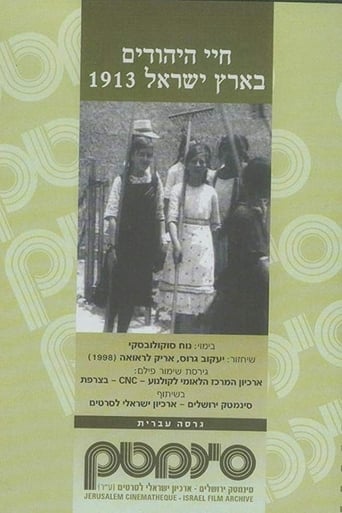
Films
1 film
About Noah Sokolovsky
Russian-Jewish filmmaker active during the very early days of cinema, best known for his singular documentary achievement, 'The Life of the Jews of Palestine' (1913). Working as a director and cinematographer, Sokolovsky was part of a small but dedicated group of artists who sought to use the new medium of motion pictures to document the realities of Jewish life and the burgeoning Zionist movement in the early 20th century. His 1913 film is a landmark in cinematic history, considered one of the earliest surviving full-length documentaries and an invaluable visual record of the Jewish communities in Ottoman Palestine, capturing scenes of agriculture, daily life, and religious observance. The film was commissioned by the Odessa-based M. Z. Thomashevsky's Cinema Company, reflecting a growing interest among diaspora Jewish communities in the developments in the Holy Land. Sokolovsky's career appears to have been brief but intensely focused, culminating in this one major work that has secured his place in film history. While details about his life beyond this project are scarce, his work to the power of cinema as a tool for cultural preservation and political documentation during the silent era. His film provides a rare, unmediated glimpse into a pivotal moment in Middle Eastern and Jewish history, making him a significant, if enigmatic, figure in early documentary filmmaking.
The Craft
Behind the Camera
Noah Sokolovsky's directing style was observational and documentary in nature, characteristic of early non-fiction cinema. His approach was purely ethnographic, focusing on capturing real-life scenes without staging or interference. The camera work is static and composed, presenting long takes of daily activities such as farming, construction, and religious ceremonies, providing a straightforward, unembellished record of the subject matter. His style prioritized informational and historical value over artistic flourishes, serving as a visual time capsule for contemporary and future audiences.
Milestones
- Directed 'The Life of the Jews of Palestine' (1913), one of the earliest feature-length documentary films
- Created an invaluable historical record of Jewish life in Ottoman Palestine before World War I
- Contributed to early Zionist cinematic propaganda and documentation
Best Known For
Must-See Films
Accolades
Special Recognition
- Recognized posthumously as a pioneer of documentary and Zionist cinema
Working Relationships
Studios
Why They Matter
Impact on Culture
Noah Sokolovsky's cultural impact is immense, stemming almost entirely from a single film. 'The Life of the Jews of Palestine' serves as a foundational text in both documentary cinema and the visual history of Zionism. For the Jewish diaspora in the early 20th century, the film was a powerful tool, offering a rare and tangible connection to the realities of life in the Yishuv (the Jewish community in Palestine) and promoting the ideals of the Zionist movement. Culturally, the film preserved a vision of pre-state Israel, capturing agricultural settlements, urban life in Jerusalem and Jaffa, and religious traditions at a critical historical juncture. Its impact is felt today by historians, sociologists, and filmmakers who view it as a primary source document, a window into a lost world that provides context for the complex history of the region. Sokolovsky's work demonstrated the potential of film to serve as a vehicle for nation-building and cultural identity, influencing countless documentaries that followed.
Lasting Legacy
Noah Sokolovsky's legacy is that of a foundational figure in documentary film whose work has transcended its original purpose to become a priceless historical artifact. While he may not be a household name like later documentary pioneers such as Robert Flaherty or Dziga Vertov, his film is frequently cited by film historians as a crucial early example of non-fiction filmmaking. His primary legacy is the film itself, which has been restored and preserved by institutions like the Steven Spielberg Jewish Film Archive and the National Center for Jewish Film. He is remembered for providing one of the only moving-image records of Jewish life in Palestine during the final years of Ottoman rule, making his work indispensable for understanding the period. Sokolovsky's name is forever linked to the birth of both Israeli cinema and Jewish documentary film, securing his place as a key, if mysterious, figure in the annals of film history.
Who They Inspired
As an early practitioner, Noah Sokolovsky influenced the field of documentary filmmaking by demonstrating its capacity for cultural and historical documentation. His observational, non-interventionist style prefigured the cinéma vérité and direct cinema movements that would emerge decades later. His work influenced Zionist and Israeli filmmakers who followed, establishing a tradition of using film to explore and shape national identity. While there is no direct line of protégés, his film served as an inspiration for generations of documentarians who sought to capture reality with authenticity and purpose, proving that a camera could be a tool for both art and historical preservation.
Off Screen
Very little is known about Noah Sokolovsky's personal life outside of his professional work. His name appears in film credits and historical records almost exclusively in connection with his 1913 film. It is presumed he was of Jewish heritage and likely had connections to the Zionist movement, which would have motivated his project. The lack of biographical information suggests he was not a major public figure in his time but rather a specialized filmmaker hired for a specific purpose.
Did You Know?
- 'The Life of the Jews of Palestine' was originally a silent film with intertitles, likely accompanied by live musical score during its initial screenings.
- The film was shot on location in Ottoman Palestine, making it one of the first films ever made in what is now Israel.
- The runtime of the original film was approximately 80 minutes, qualifying it as a feature-length documentary, a rare feat for 1913.
- Sokolovsky not only directed but also likely served as the cinematographer for the film, handling the cumbersome and primitive camera equipment of the era.
- The film was commissioned to be screened at the 11th Zionist Congress in Vienna, which was postponed due to the outbreak of World War I.
- For decades, the film was believed to be lost until a print was discovered and restored in the late 20th century.
- The film's intertitles were written in Russian, reflecting its primary target audience of Russian Jews.
- It is sometimes known by its French title, 'La Vie des Juifs en Palestine'.
- The film provides rare footage of early kibbutzim and moshavim, showcasing the agricultural experiments of the early Zionist pioneers.
- Despite its historical significance, virtually nothing is known about Sokolovsky's life before or after the production of this single film.
Frequently Asked Questions
Who was Noah Sokolovsky?
Russian filmmaker from the silent era, best known for directing the 1913 documentary 'The Life of the Jews of Palestine.' He is a significant but obscure figure in film history, celebrated for creating one of the earliest and most important visual records of Jewish life in Ottoman Palestine before the establishment of the state of Israel.
What film is Noah Sokolovsky best known for?
Noah Sokolovsky is exclusively known for his 1913 documentary film, 'The Life of the Jews of Palestine.' This film is his sole credited work and has become an invaluable historical document for its rare footage of early Zionist settlements and daily life in the region during the Ottoman period.
When was Noah Sokolovsky born and when did he die?
Unfortunately, the specific dates and places of Noah Sokolovsky's birth and death are unknown to historians. All available information about him is tied to his filmmaking activities in the Russian Empire around the year 1913, leaving his personal biography largely a mystery.
What was Noah Sokolovsky's directing style?
Sokolovsky's directing style was purely observational and documentary, characteristic of early non-fiction cinema. He used static, long takes to capture un-staged scenes of daily life, agriculture, and religious ceremonies, aiming to create an authentic and straightforward record rather than a narrative film with artistic embellishment.
What is the cultural significance of Sokolovsky's film?
The film's cultural significance is immense, as it serves as a foundational document of Zionist cinema and a priceless historical record. It provided early 20th-century Jewish communities worldwide with a visual connection to life in Palestine and today offers historians a unique, unmediated glimpse into a pivotal era in Middle Eastern history before World War I.