Shinpei Takagi
Actor
- Active
- 1923-1923
Films 1
About Shinpei Takagi
Shinpei Takagi was a Japanese silent-era actor best remembered for his work in early 1920s cinema, including Kosuzume Pass (1923). He belonged to the generation of performers who helped define the language of Japanese screen acting in the years before sound, when film industries were rapidly adapting theatrical traditions to the camera. Available record indicates that his screen career was brief, with surviving filmography information placing him in 1923, and detailed biographical documentation about his later life appears to be scarce. Like many actors of the period, he likely worked within a studio system that relied on stage-trained performers and a repertoire of period dramas and contemporary stories. Because so many Japanese silent films from the era are lost or incompletely documented, Takagi’s contribution is primarily preserved through cast listings and film references rather than extensive surviving interviews or career profiles. He remains a representative figure of early Japanese cinema, illustrating how numerous actors contributed to the medium’s formative years even when their individual histories are only fragmentarily recorded. His name is of interest to film historians and database researchers precisely because it survives in the credits of an important early silent film era, despite the scarcity of broader biographical detail.
More about Shinpei Takagi
On screen
No detailed contemporary description of Shinpei Takagi's acting style appears to be widely documented in surviving reference sources. As a silent-era Japanese actor, his performance would likely have relied on expressive facial movement, gesture, and the stylized but increasingly naturalistic screen acting common in the 1920s. Without surviving reviews or production notes specifically describing his work, any more precise characterization would be speculative.
In film history
Shinpei Takagi’s cultural impact is best understood as part of the broader foundation of Japanese silent cinema rather than through a large surviving body of star vehicles or celebrity persona. Actors like Takagi helped populate the early screen with period-drama and dramatic performances that made Japanese feature filmmaking viable and culturally resonant in the 1920s. Even when individual filmographies are brief, these performers contributed to the evolution of screen acting from stage-derived presentation toward more cinema-specific expression. His name survives as evidence of the many working actors whose labor supported the growth of a national film culture during a crucial transitional era. For researchers and archivists, such credits are valuable because they help reconstruct the personnel networks of early Japanese studios and productions.
Later reputation
Takagi's legacy lies in his documentary presence within silent-era Japanese film history, especially through his credit in Kosuzume Pass (1923). While he does not appear to have the extensive surviving fame of major contemporaries, his record remains important to historical reconstruction of early Japanese screen culture. Many silent films and production records from the period have been lost, so every surviving name helps map the artistic ecosystem of the time. His legacy is therefore archival as much as performative: he stands as one of the many actors whose work shaped the early cinema landscape even if the particulars of his career are no longer fully recoverable. In film history terms, he is part of the foundational cast of performers who made Japan one of the world’s major silent film cultures.
Influence
There is no documented evidence that Shinpei Takagi directly mentored prominent later performers or that he exerted a widely recorded influence on subsequent generations. His influence is best understood indirectly, as part of the collective contribution of early silent-era actors who established acting conventions that later Japanese screen performers inherited and refined. In that sense, he belongs to the broad lineage of early film actors whose work helped normalize cinematic storytelling in Japan.
Off screen
No reliable biographical information about Shinpei Takagi's personal life, family background, marriages, or children is readily documented in commonly available classic-cinema reference sources. This is not unusual for lesser-documented silent-era performers, many of whom left only sparse archival traces. As a result, his personal history remains largely unknown to modern film researchers.
Education
No verified information is readily available regarding his education or formal theatrical training.
Credits
- Appeared in the silent Japanese film Kosuzume Pass (1923)
- Represents the generation of early Japanese screen actors active during the silent era
- Credited in surviving filmography records from 1923, showing participation in the formative phase of Japanese cinema
Roles
- Cast role in Kosuzume Pass (1923)
Films
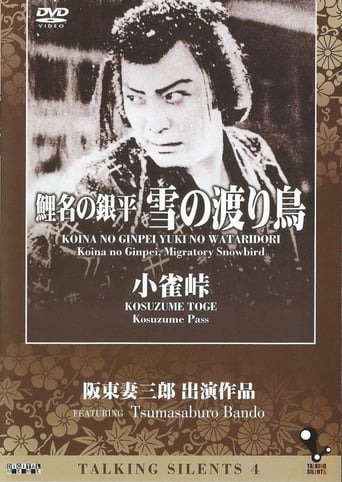
- Kosuzume Pass (1923)
Notes
- Shinpei Takagi is associated with the silent era, when many Japanese films were performed with live benshi narration in theaters.
- His surviving filmography information is extremely limited, which is common for lesser-documented performers of the 1920s.
- Kosuzume Pass (1923) is the key film tied to his name in available records.
- Many Japanese silent films from Takagi's era are lost, making cast credits especially important for film historians.
- His career history illustrates how many early cinema workers are known today only through fragmentary archival references.
- He is not widely documented in modern popular biographies, suggesting he was likely a working character or supporting actor rather than a major star.
Questions
Who was Shinpei Takagi?
Shinpei Takagi was a Japanese actor active in the silent film era, best known from surviving records for appearing in Kosuzume Pass (1923). He is one of many early cinema performers whose names survive in cast listings even though detailed biographical information is scarce. His career is an example of the many artists who helped establish Japanese screen acting in the 1920s.
What films is Shinpei Takagi best known for?
He is best known for Kosuzume Pass (1923), which is the principal film associated with his surviving filmography. No broader list of major surviving credits is readily documented in commonly available sources. Because of that, Kosuzume Pass remains the key reference point for his career.
When was Shinpei Takagi born and when did he die?
His birth and death dates are not readily available in the surviving reference material commonly used for classic-cinema research. This means his exact lifespan cannot be stated with confidence from accessible sources. He remains a historically documented but biographically obscure silent-era actor.
What awards did Shinpei Takagi win?
No awards or formal honors are currently documented for Shinpei Takagi in accessible reference sources. This does not necessarily mean he received none, only that no verifiable records have been found in the available material. For many early silent-era actors, awards documentation was not systematically preserved.
What was Shinpei Takagi's acting style?
No specific contemporary description of his acting style has been widely preserved. As a silent-era Japanese actor, his work would have depended on expressive physical performance, facial expression, and the conventions of early screen drama. Beyond that general context, more precise claims would be speculative.
What is Shinpei Takagi's legacy in film history?
His legacy is primarily archival and historical: he represents the many early Japanese actors whose work helped build silent cinema, even if their individual careers are only partially documented today. His surviving credit in Kosuzume Pass contributes to the reconstruction of Japan's film history. That makes him important to researchers studying the formation of the country's early screen culture.