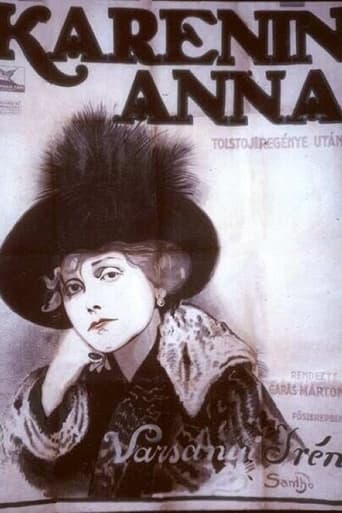
Irén Varsányi
Actor
- Active
- 1918-1918
Films 1
About Irén Varsányi
Irén Varsányi was a Hungarian actress of the silent era whose surviving screen credit places her among the early performers of Hungary's pre-sound film period. She is documented as appearing in the 1918 adaptation of Anna Karenina, a production that connects her to one of the most ambitious literary screen subjects of the era. Beyond that film, reliable biographical detail is scarce, which is not unusual for Central European silent-era performers whose careers were often only lightly documented in surviving trade sources and film reference works. Her known screen activity falls within 1918, suggesting either a very brief film career or a career whose records have not fully survived in accessible archives. Because her filmography is extremely limited in the surviving record, she is best understood as a minor but historically valuable figure in early Hungarian cinema. She represents the many stage and screen artists whose work helped establish national film industries during the silent period, even when their personal histories have largely been lost to time. No verified evidence has been found in standard reference sources for a later film career, stage career, or detailed personal biography.
More about Irén Varsányi
On screen
No detailed critical descriptions of Irén Varsányi's acting style have been found in accessible surviving sources. As a silent-era performer, her screen work would have relied on facial expression, gesture, and physically legible emotion rather than spoken dialogue. Any assessment beyond that would be speculative, since contemporary reviews and performance analyses tied specifically to her appear to be unavailable in standard references.
In film history
Irén Varsányi's cultural importance lies less in a large surviving body of work than in what her credit reveals about early Hungarian cinema. Her participation in Anna Karenina places her within the silent-era tradition of adapting major world literature for the screen, a strategy that helped legitimize film as a serious artistic medium in Europe. Even with limited biographical visibility, performers like Varsányi contributed to the development of national film culture at a time when the medium was still defining its artistic language. Her name also serves as a reminder of how much early cinema history remains incomplete, especially for women whose careers were recorded unevenly and whose films may be lost. For researchers and database users, she is a useful example of an actor whose historical presence is confirmed, even if the surrounding details of her life have not survived.
Later reputation
Irén Varsányi's lasting legacy is as a documented participant in Hungary's silent-film heritage rather than as a widely known star with a large surviving filmography. Her name endures through archival listings and film-history references, preserving a trace of the many performers who worked in the industry during its earliest decades. In film history terms, such figures are significant because they help establish the personnel networks and performance traditions that shaped regional cinema before the sound era. Her association with Anna Karenina also links her to a prestige literary adaptation, a format that remained central to European silent filmmaking. Although she is not a household name, her surviving credit contributes to a fuller and more accurate record of early cinema.
Influence
There is no documented evidence of Irén Varsányi exerting a broad, traceable influence on later actors or directors in the way major stars did. Her influence is more archival and historical than stylistic: she exemplifies the generation of early screen performers whose work supported the growth of national cinema but who were not always preserved in later publicity or critical canonization. In that sense, she indirectly influences modern film scholarship by representing the under-recorded labor of silent-era artists. Her surviving credit encourages continued archival recovery and research into Hungarian film history.
Off screen
No verified information was found regarding Irén Varsányi's personal life, including family background, marriage, children, residence, or later-life activities. This lack of data is common for many silent-era performers from smaller national film industries, whose lives were not always profiled in surviving newspapers, studio records, or retrospective histories. Until archival evidence emerges, her private biography must remain largely undocumented.
Credits
- Appeared in the 1918 silent film Anna Karenina, the best-documented surviving credit associated with her name
- Was active during the formative period of Hungarian silent cinema, when literary adaptations were an important prestige genre
- Represents one of the many early screen performers whose work survives primarily through filmographies and archival references rather than extensive biographical records
Roles
- Anna Karenina (1918) - specific character attribution not verified in available sources
Films
- Anna Karenina (1918)
Notes
- Irén Varsányi is best documented for a single known film credit: Anna Karenina (1918).
- Her career falls entirely within the silent era, before synchronized sound became standard in cinema.
- She is associated with Hungarian cinema, a national film tradition that was still developing during the late 1910s.
- Because surviving sources are sparse, her exact roles, training, and personal background remain difficult to verify.
- Her filmography suggests either a very short screen career or incomplete archival preservation of her work.
- The literary source for her best-known film, Leo Tolstoy's Anna Karenina, was a popular adaptation subject for silent-era filmmakers.
- She is an example of a historically important but lightly documented actress from early European cinema.
Questions
Who was Irén Varsányi?
Irén Varsányi was a Hungarian silent-era actress best known from her 1918 appearance in Anna Karenina. She is one of the many early cinema performers whose names survive in film records even though detailed biographical information is scarce.
What films is Irén Varsányi best known for?
She is best known for Anna Karenina (1918), which is the principal surviving credit associated with her name. No additional verified film credits were found in the available record used for this profile.
When was Irén Varsányi born and when did she die?
Her birth and death dates have not been verified in the available sources. At present, only her period of documented screen activity in 1918 can be confirmed with confidence.
What awards did Irén Varsányi win?
No awards or formal honors have been documented for Irén Varsányi in the available sources. This may reflect the limited surviving record rather than the absence of recognition during her lifetime.
What was Irén Varsányi's acting style?
No contemporary critical description of her style has been located in accessible sources. As a silent-film actress, her performance would have depended on expressive gesture, facial expression, and visual storytelling typical of the era.
What is Irén Varsányi's legacy in film history?
Her legacy is primarily historical: she is part of the documented personnel of early Hungarian silent cinema. Even with sparse surviving information, her credit helps preserve the memory of the performers who helped build national film culture in the 1910s.