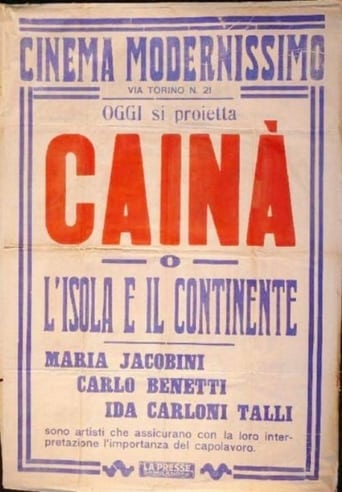
Eugenio Duse
Actor
- Active
- 1922-1922
Films 1
About Eugenio Duse
Eugenio Duse was an Italian screen actor active in the silent era, known primarily for his appearance in the 1922 film Cainà. Very little securely documented biographical information survives about him, and he appears in surviving film records chiefly as a credited performer rather than as a major star or industry figure. His recorded screen career is extremely brief, with available filmography evidence placing his activity in 1922 only, which suggests either a short-lived acting career or a heavily under-documented one. Because of the scarcity of reliable archival sources, details of his early life, later life, stage background, and personal circumstances are not presently verifiable with confidence. Even so, his name remains part of the historical record of early Italian cinema, where many performers worked in small numbers of productions and are known today mostly through cast listings and film histories. Duse's association with Cainà situates him within the artistic world of post-World War I Italian silent film, a period marked by melodrama, literary adaptation, and visually expressive performances. Beyond this confirmed credit, no additional screen roles can be stated with certainty without risking confusion with other similarly named individuals.
More about Eugenio Duse
In film history
Eugenio Duse's cultural impact lies less in celebrity status than in historical presence: he is one of many silent-era actors whose names survive in cast lists and help document the broader ecology of early Italian filmmaking. Performers like Duse contributed to the texture of national cinema during a formative period, when films such as Cainà helped shape visual storytelling conventions and audience expectations in Italy. His preserved credit also illustrates how much of silent cinema history depends on fragmentary records, where even minimally documented artists remain important to reconstructing production networks, casting practices, and regional film culture. In this sense, Duse represents the anonymous-to-semi-anonymous workforce that made the silent film industry function, even when later fame never followed. His name endures as part of the archival memory of classic cinema rather than as a widely celebrated screen personality.
Later reputation
Eugenio Duse's lasting legacy is archival rather than star-driven: he is remembered because film history preserves the existence of his participation in Cainà (1922). For researchers and database compilers, he is significant as evidence of the many actors whose careers were brief, local, or insufficiently documented but who still formed the cast of important early films. His legacy also underscores the uneven survival of silent-era personnel records, where many contributors are known only by a single credit. In film history, such names are valuable because they help maintain accurate documentation of productions and prevent the erasure of lesser-known performers. Duse's presence in historical records therefore contributes to a fuller, more honest account of Italian silent cinema.
Influence
There is no verifiable evidence that Eugenio Duse exerted a documented direct influence on later actors or filmmakers in the way major stars or directors did. His influence is better understood indirectly: he belongs to the generation of silent-era performers whose work supported the development of Italian screen acting norms, ensemble casting, and the visual melodramatic style of the period. For later historians, his surviving credit helps illustrate the breadth of participation in early film culture and the importance of preserving even small-name contributors. Any broader artistic influence cannot be stated confidently due to the lack of biographical and career documentation.
Off screen
No reliably verifiable information is presently available about Eugenio Duse's personal life, including marriages, family background, residence, or later activities. The surviving record appears to be confined to film-credit documentation, and no secure biographical narrative can be reconstructed from currently available information without conflating him with other people of similar name. As a result, details such as relationships, offspring, and private life remain undocumented in the accessible historical record.
Credits
- Credited appearance in the silent Italian film Cainà (1922)
- Documented participation in early postwar Italian cinema
- Representation of the many lesser-documented performers who contributed to silent-era film production
- A surviving screen credit preserved in historical film records despite limited biographical documentation
Films
- Cainà (1922)
Notes
- Eugenio Duse is documented in surviving film records primarily through a single screen credit.
- His known film activity is limited to 1922, making his career exceptionally brief in the available record.
- He is associated with Cainà, a silent Italian film from the early 1920s.
- Because of the scarcity of sources, many standard biographical details about him remain unknown.
- He should not be confused with other figures of similar names in Italian cultural history.
- His preserved credit helps film historians reconstruct cast lists for lesser-known silent films.
- He represents the many early cinema performers whose work survives in documentation more clearly than in popular memory.
Questions
Who was Eugenio Duse?
Eugenio Duse was an Italian actor from the silent-film era, known in surviving records chiefly for appearing in Cainà (1922). Very little biographical information about him has survived, so he is best understood as a historically documented but sparsely recorded performer from early Italian cinema.
What films is Eugenio Duse best known for?
He is best known for Cainà (1922), the only film credit currently confirmed in readily accessible historical records. No other screen appearances can be stated with confidence without risking misidentification.
When was Eugenio Duse born and when did he die?
At present, his birth and death dates are not securely documented in widely accessible sources. The surviving record does not provide enough reliable biographical evidence to state those details confidently.
What awards did Eugenio Duse win?
No awards or nominations are currently documented for Eugenio Duse. This is not unusual for many lesser-documented silent-era performers, whose careers were often preserved mainly through cast lists rather than prize records.
What was Eugenio Duse's acting style?
His acting style is not directly described in surviving sources. Given the silent-era Italian context of Cainà, he would likely have worked within the expressive, gesture-centered performance traditions typical of the period, but this should be treated as a general historical inference rather than a verified description.
What is Eugenio Duse's legacy in film history?
His legacy is primarily archival: he remains part of the documented cast history of early Italian cinema. Even with limited information, his name helps preserve the completeness of film records and highlights the many contributors whose work supported silent-era filmmaking.