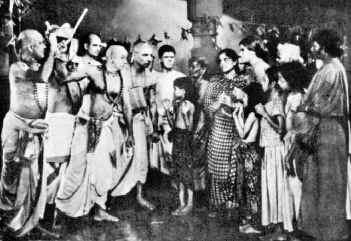
K. Subrahmanyam
Director
Born: April 20, 1904 in Papanasam, Thanjavur district, Madras Presidency, British India (now Tamil Nadu, India) Died: October 12, 1971 Active: 1934-1956 Birth Name: Krishnaswami Subrahmanyam
Films
1 film
About K. Subrahmanyam
Indian film director, producer, and screenwriter who revolutionized Tamil cinema during its formative years. Born in 1904 in Papanasam, Tamil Nadu, he began his career in the film industry in the early 1930s and quickly established himself as a filmmaker with a strong social conscience. His 1939 masterpiece 'Thyagabhoomi' became films in Indian cinema history, addressing controversial themes like widow remarriage and caste discrimination. Throughout his career spanning three decades, Subrahmanyam directed over 20 films, many of which were adaptations of literary works and carried strong social messages. He was instrumental in launching the careers of numerous actors and technicians, and his production company, Madras United Artists, became a launching pad for socially relevant cinema. Subrahmanyam's films were known for their technical excellence, compelling narratives, and progressive themes that challenged traditional societal norms. He continued making films through the 1940s and 1950s, cementing his legacy as one of Indian cinema's earliest and most important social reformers through the medium of film.
The Craft
Behind the Camera
K. Subrahmanyam's directing style was characterized by strong social consciousness, narrative clarity, and technical innovation. He was known for his meticulous attention to detail and his ability to weave complex social themes into engaging commercial cinema. His films often featured realistic portrayals of social issues while maintaining entertainment value, using cinema as a medium for social reform and education. Subrahmanyam employed sophisticated storytelling techniques, including non-linear narratives and symbolic imagery, to convey his progressive messages. His visual style combined traditional Indian artistic sensibilities with modern cinematic techniques, creating a unique aesthetic that influenced generations of Indian filmmakers.
Milestones
- Directed 'Thyagabhoomi' (1939),
- Founded Madras United Artists production company
- Pioneered socially relevant cinema in Tamil film industry
- Launched careers of numerous prominent actors and technicians
- Adapted major literary works into successful films
Best Known For
Must-See Films
Accolades
Won
- Padma Shri (1960) - India's fourth highest civilian award for contributions to arts
- Kalaimamani (1960) - Tamil Nadu state's highest arts award
- Dadasaheb Phalke Award (1963) - India's highest award in cinema
Nominated
- Filmfare Award for Best Director (1954) - Nomination
- National Film Award for Best Feature Film (1955) - Nomination
Special Recognition
- Dadasaheb Phalke Award recipient (1963)
- Padma Shri awardee (1960)
- Kalaimamani award recipient (1960)
- Honored at International Film Festival of India multiple times
- Postal stamp issued by India Post in his honor (2004)
- K. Subrahmanyam Memorial Award established in his name
Working Relationships
Worked Often With
Studios
Why They Matter
Impact on Culture
K. Subrahmanyam's impact on Indian cinema and society was profound and multifaceted. Through films like 'Thyagabhoomi,' he challenged entrenched social practices and sparked conversations about widow remarriage, caste discrimination, and women's education at a time when such topics were taboo. His films were often banned by the British colonial government for their nationalist sentiments, yet they found ways to reach audiences and inspire social change. Subrahmanyam's work laid the foundation for socially relevant cinema in India, demonstrating that films could be both commercially successful and socially meaningful. He was instrumental in elevating the status of regional cinema and proving that Tamil films could compete with Bollywood productions in terms of quality and impact. His emphasis on literary adaptations helped bridge the gap between classical literature and popular cinema, bringing sophisticated themes to mass audiences.
Lasting Legacy
K. Subrahmanyam's legacy endures as one of the architects of socially conscious Indian cinema. He is remembered as a pioneer who used the medium of film as a tool for social reform, setting a precedent that continues to influence Indian filmmakers today. His production company Madras United Artists became a model for independent filmmaking in South India. Many of his films, particularly 'Thyagabhoomi,' are studied in film schools for their innovative narrative techniques and social relevance. The Dadasaheb Phalke Award he received in 1963 cemented his status as one of Indian cinema's founding fathers. Several institutions and awards have been established in his memory, including the K. Subrahmanyam Award for Excellence in Cinema. His approach to blending entertainment with social messages became a template for subsequent generations of Indian filmmakers who sought to make meaningful cinema.
Who They Inspired
K. Subrahmanyam influenced generations of Indian filmmakers through his approach to socially relevant cinema. Directors like Satyajit Ray, Adoor Gopalakrishnan, and Mani Ratnam have acknowledged his influence on their work, particularly in terms of using cinema as a medium for social commentary. His technique of adapting literary works for the screen inspired many directors to explore regional literature as source material. Subrahmanyam's success in launching new talent through his production company created a model for talent development that many production houses later adopted. His films' technical innovations, particularly in sound and cinematography, set new standards for Indian cinema. The way he balanced commercial viability with artistic integrity became a benchmark for serious filmmakers in India. Many contemporary Tamil directors who make socially relevant films, including Vetri Maaran and Pa. Ranjith, trace their cinematic lineage back to Subrahmanyam's work.
Off Screen
K. Subrahmanyam was married to Meenakshi and had four children. He came from a traditional Brahmin family but was progressive in his outlook, which reflected in his films. His family was supportive of his career in cinema despite it being considered unconventional in those times. He maintained strong connections with literary and cultural figures throughout his life and was known for his intellectual pursuits beyond filmmaking. Subrahmanyam was also actively involved in social reform movements and used his influence to promote education and women's rights.
Education
Annamalai University - Bachelor's degree in Arts; Additional training in film production from Bombay
Family
- Meenakshi (1927-1971)
Did You Know?
- 'Thyagabhoomi' (1939) was the first Indian film to be banned by the British government for its nationalist content
- The film was also the first Indian movie to be dubbed into another language (Telugu)
- Subrahmanyam — close associate of Indian independence movement leaders
- He discovered and launched the career of Carnatic singer M.S. Subbulakshmi in films
- His production company was one of the first in South India to produce films in multiple languages
- Subrahmanyam was instrumental in establishing the Film Directors' Association in South India
- He wrote extensively about cinema and film theory in various publications
- Many of his films were based on works by famous Tamil writers like Kalki Krishnamurthy
- He was one of the first Indian filmmakers to shoot on location rather than entirely in studios
- Subrahmanyam's films were among the first to address women's issues seriously in Indian cinema
In Their Own Words
Cinema is not merely entertainment; it is a powerful weapon for social reform and national awakening.
A film should educate while it entertains, and uplift while it engages.
The camera is more powerful than the sword in the fight against social injustice.
We must make films that our children will be proud of, not just films that make us money.
Art without social consciousness is like a body without a soul.
Every frame of a film should carry the weight of our cultural heritage and the hope of our future.
Frequently Asked Questions
Who was K. Subrahmanyam?
Indian on YTB.my. He was known for making socially relevant films that addressed issues like caste discrimination, women's rights, and social reform, with his 1939 film 'Thyagabhoomi' becoming.
What films is K. Subrahmanyam best known for?
Titles linked here include Thyagabhoomi (1939), Sevasadanam (1938).
When was K. Subrahmanyam born and when did he die?
Born April 20, 1904; died October 12, 1971.
What awards did K. Subrahmanyam win?
K. Subrahmanyam received several prestigious awards including the Padma Shri in 1960, the Kalaimamani award in 1960, and the Dadasaheb Phalke Award in 1963, which is India's highest award in cinema. He was also honored with multiple nominations at the Filmfare Awards and National Film Awards.
What was K. Subrahmanyam's directing style?
K. Subrahmanyam's directing style was characterized by strong social consciousness, narrative clarity, and technical innovation. He specialized in weaving complex social themes into engaging commercial cinema, using realistic portrayals of social issues while maintaining entertainment value. His films combined traditional Indian artistic sensibilities with modern cinematic techniques, creating a unique aesthetic that influenced generations of filmmakers.