Films
1 film
About Violet Drew
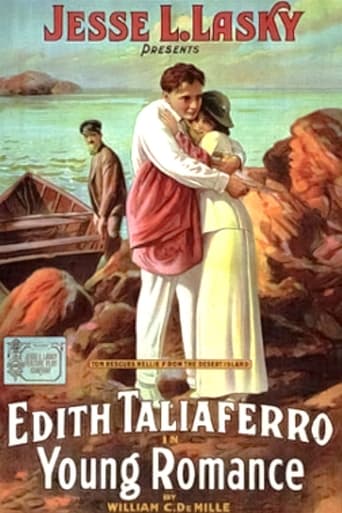
The 1915 film Young Romance is the only title linked here for Violet Drew. She is primarily recognized for her supporting role as the telegraph operator in the 1915 silent romance 'Young Romance,' a production of the Jesse L. Lasky Feature Play Company. During this era, the Lasky company was a prestigious outfit that would eventually merge to form Paramount Pictures, and Drew worked alongside notable figures such as director George Melford and screenwriter William C. DeMille. Her performance in 'Young Romance' placed her in a cast featuring Broadway star Edith Taliaferro and future character actor Raymond Hatton. Like many performers of the 1910s, Drew's film career appears to have been brief, possibly transitioning from or returning to the stage, as was common for actors during the transition of the industry to Los Angeles. While her documented filmography is limited to this single significant feature, her participation in a Lasky production marks her as part of the foundational fabric of early American cinema.
The Craft
On Screen
Drew's acting style was characteristic of the early silent era, which often relied on clear, pantomimic gestures to convey narrative information in the absence of sound. In her role as a telegraph operator, she likely employed the 'naturalistic' approach favored by the Lasky studio, which sought to move away from the exaggerated theatricality of 19th-century stage acting. This style emphasized situational realism and character-driven reactions suitable for the intimate medium of the camera.
Milestones
- Cast in the Jesse L. Lasky Feature Play Company production 'Young Romance' (1915)
- Worked under the direction of George Melford, a prolific director of the silent era
- Appeared in a film written by William C. DeMille, brother of Cecil B. DeMille
- Performed alongside Broadway actress Edith Taliaferro in her film debut
- Participated in the early Paramount Pictures distribution network
Best Known For
Iconic Roles
Must-See Films
Working Relationships
Worked Often With
Studios
Why They Matter
Impact on Culture
Violet Drew represents the 'working actor' of the 1910s, a period when the film industry was rapidly expanding and required a vast pool of talent for the hundreds of one-reelers and early features being produced. Her involvement in a William C. DeMille project highlights the intersection of theater and film during this decade, as playwrights and stage actors began to see the 'flickers' as a legitimate artistic medium. Though her screen time was limited, performers like Drew were essential in populating the realistic urban and rural environments that defined the early American cinematic aesthetic.
Lasting Legacy
Drew's legacy is preserved through the survival of 'Young Romance' (1915), which is one of the few extant films featuring the Taliaferro sisters and an early example of the Lasky studio's high production values. As a member of the supporting cast, she contributes to the historical record of the Jesse L. Lasky Feature Play Company, which laid the groundwork for the modern studio system. Her presence in the film serves as a primary source for researchers studying the casting practices and social archetypes—such as the working-class 'telegraph girl'—prevalent in early 20th-century media.
Who They Inspired
While she did not have a direct influence on later acting techniques, Drew's career path reflects the early 20th-century trend of stage-to-screen transition that influenced thousands of performers. She was part of the generation that helped define the 'Lasky look,' a style of filmmaking that prioritized narrative clarity and professional ensemble acting, which eventually became the standard for Hollywood's Golden Age.
Off Screen
Little is recorded regarding the private life of Violet Drew, as was common for supporting players of the early silent period whose careers did not extend into the 'star system' era of the 1920s. It is probable that she was a professional stage actress who sought opportunities in the burgeoning motion picture industry in New York or Los Angeles before the industry fully consolidated.
Did You Know?
- She appeared in 'Young Romance' at a time when the film's 'Director General' was the legendary Cecil B. DeMille.
- Her film 'Young Romance' was based on a stage play by William C. DeMille, who also wrote the screenplay.
- The film she appeared in is one of the few surviving works of lead actress Edith Taliaferro.
- She was part of the Jesse L. Lasky Feature Play Company during its first two years of operation.
- The role of a telegraph operator was a common 'modern' female archetype in 1915 cinema.
- Her film was distributed by Paramount Pictures, which was then a newly formed distribution exchange.
Frequently Asked Questions
Who was Violet Drew?
American actress active during the silent film era, specifically known for her work with the Jesse L. Lasky Feature Play Company in 1915.
What is Violet Drew's most famous film?
She is best known for the 1915 silent film 'Young Romance,' where she played the role of a telegraph operator.
Which famous directors did Violet Drew work with?
She worked under director George Melford and the supervision of 'Director General' Cecil B. DeMille on the set of 'Young Romance'.
What was Violet Drew's role in 'Young Romance'?
She portrayed a telegraph operator, a key supporting character in the film's plot involving mistaken identities and romance.
Is Violet Drew's work still available to watch today?
Yes, 'Young Romance' (1915) is an extant film and has been preserved in various archives, including the Library of Congress and UCLA Film & Television Archive.