Tamatarô Ichikawa
Actor
- Active
- 1923-1923
Films 1
About Tamatarô Ichikawa
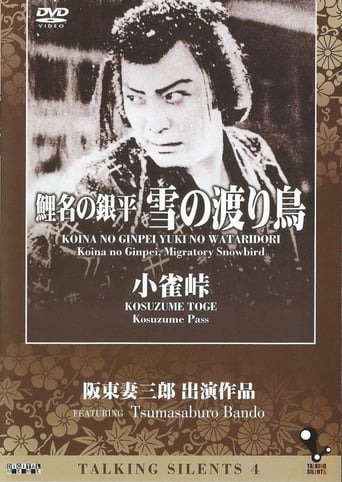
Tamatarô Ichikawa was a Japanese actor active during the silent-film era, with documented screen work dating to 1923. He is known from surviving film records primarily for his appearance in Kosuzume Pass (1923), a title that places him within the early development of Japanese cinema when historical dramas and literary adaptations were central to studio production. Because the surviving public record on Ichikawa is extremely sparse, his broader life story, training, and later career trajectory are not well documented in readily accessible English-language sources. What can be said with confidence is that he belonged to a generation of performers working in a formative period of Japanese screen acting, when theatrical traditions, benshi narration, and studio conventions were shaping a distinct cinematic style. His filmography as currently identifiable suggests a brief or at least minimally preserved screen career, and he remains a little-known figure to modern audiences. Even with limited surviving data, his presence in a 1923 feature preserves his place in the historical record of early Japanese silent cinema.
More about Tamatarô Ichikawa
On screen
No detailed contemporary descriptions of Tamatarô Ichikawa's acting style have been found in accessible sources. As a performer in the Japanese silent era, his work would have been shaped by the conventions of the period, which often balanced stage-derived expression with the more restrained visual storytelling of film. His screen presence would likely have depended on physical expressiveness, gesture, and clarity of emotion rather than dialogue, as films of this period were silent and frequently accompanied by benshi narration. Beyond that, specific stylistic characteristics cannot be verified from surviving records.
In film history
Tamatarô Ichikawa's cultural impact is modest in terms of surviving documentation, but he is part of the foundational fabric of early Japanese cinema. Performers like him helped populate the silent-era screen at a time when the Japanese film industry was defining its artistic language, its star system, and its relationship to theater and popular literature. Even when individual biographical details are lost, the preservation of names in film histories and databases matters because it helps reconstruct the collaborative networks that made early cinema possible. His record is especially valuable to historians interested in recovering the many lesser-known actors who contributed to national film heritage without becoming major stars.
Later reputation
Ichikawa's legacy lies less in fame than in historical presence: he is one of the many early performers whose names survive as evidence of Japan's silent-film era. In film history, such figures are important because they reveal how broad and populous the early studio workforce was, even when only a small fraction of its members later became well known. His surviving credit in Kosuzume Pass (1923) anchors him to a specific moment in cinematic development and preserves his contribution to a now-distant body of work. For researchers, his name is a reminder of the incompleteness of archival survival and the importance of cataloging even the most obscure contributors to early film culture.
Influence
There is no documented evidence that Tamatarô Ichikawa directly trained, mentored, or broadly influenced later generations of actors or directors. His influence is therefore best understood indirectly, as part of the collective performance culture of early Japanese cinema. Actors of his generation helped establish expectations for screen presence in the silent era, where gestures, facial expression, and theatrical discipline were essential. While his individual influence cannot be specifically traced, he contributed to the early professional environment from which later Japanese screen acting evolved.
Off screen
No reliable public information has been found regarding Tamatarô Ichikawa's personal life, including family background, marriages, or descendants. Likewise, there is no verified biographical material available in the accessible historical record concerning his upbringing, private interests, or post-film career. Because the surviving information is so limited, any speculation about his personal circumstances would be unreliable. He appears in modern reference contexts primarily as a film-credit name rather than as a widely documented public figure.
Credits
- Appeared in the 1923 silent-era film Kosuzume Pass
- Worked as a screen actor during the formative years of Japanese cinema
- Represents one of the many early performers whose careers are preserved chiefly through fragmentary filmographies and studio records
Roles
- Role in Kosuzume Pass (1923)
Films
- Kosuzume Pass (1923)
Notes
- He is documented as appearing in Kosuzume Pass (1923), which is the main surviving credit associated with his name.
- His known screen activity currently spans only a single year in available filmography records.
- He belongs to the silent-film era of Japanese cinema, before synchronized sound became standard.
- No widely accessible English-language biographical profile appears to exist for him, making him a notably obscure historical figure.
- His surviving record illustrates how many early film performers remain known mainly through cast lists rather than fuller biographies.
- Because of the scarcity of documentation, he is of particular interest to archivists and film historians reconstructing lost or fragmentary Japanese film history.
Questions
Who was Tamatarô Ichikawa?
Tamatarô Ichikawa was a Japanese actor from the silent-film era, known from surviving records for appearing in Kosuzume Pass (1923). Very little biographical information has survived about him, so he is best understood today as a little-documented contributor to early Japanese cinema. His name remains important primarily because it preserves his place in film history.
What films is Tamatarô Ichikawa best known for?
He is best known for Kosuzume Pass (1923), which is the principal surviving film credit associated with him. No other confidently verified titles were found in the accessible record provided here. As a result, Kosuzume Pass stands as his signature screen appearance.
When was Tamatarô Ichikawa born and when did he die?
His birth date and death date are not currently documented in the accessible historical record used here. Likewise, his birthplace and death details are not reliably available. He survives in film history chiefly through a limited set of screen credits rather than a full biographical profile.
What awards did Tamatarô Ichikawa win?
No awards or formal honors are currently documented for Tamatarô Ichikawa. This is not unusual for performers from the silent era, especially those whose careers were brief or poorly archived. The absence of awards information reflects the limitations of surviving records rather than a definitive statement about his career stature.
What was Tamatarô Ichikawa's acting style?
There are no surviving detailed contemporary descriptions of his personal acting style. As a silent-era Japanese performer, his work would have relied on visual expression, gesture, and the theatrical conventions of the time. Beyond that general context, specific stylistic traits cannot be verified.
What is Tamatarô Ichikawa's legacy in film history?
His legacy lies in representing the many early Japanese film performers whose names survive even when their full biographies do not. He is a small but real part of the silent-era record, helping historians reconstruct the cast networks and production culture of early Japanese cinema. In that sense, his importance is archival as much as artistic.