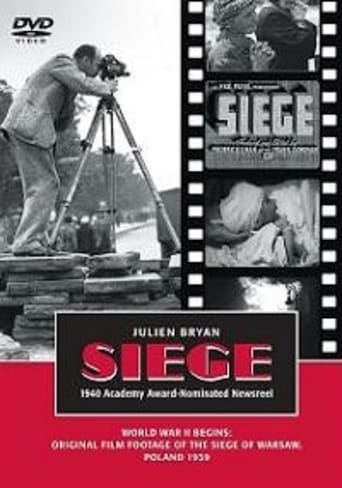
Julien Bryan
Actor & Director
Born: May 23, 1899 in Titusville, Pennsylvania, USA Died: October 20, 1974 Active: 1930s-1970s Birth Name: Julien Hequembourg Bryan
Films
1 film
About Julien Bryan
Julien Hequembourg Bryan — American documentary filmmaker, photographer, and lecturer who gained international recognition for his courageous wartime documentation. Born in Pennsylvania in 1899, Bryan developed a passion for visual storytelling and international affairs early in life. He founded the International Film Foundation in 1935 with the mission of creating educational documentaries that would foster global understanding. His most famous work, 'Siege' (1940), documented the brutal Nazi invasion of Warsaw in September 1939, making him one of the few Western journalists to capture these events firsthand. Bryan's footage provided the world with some of the earliest and most comprehensive visual evidence of the horrors of World War II. Throughout his career, he traveled to over 40 countries, creating documentaries that focused on human rights, cultural understanding, and social justice. His work was not only cinematic but also educational, as he frequently lectured at universities and institutions worldwide, using his films as tools for promoting peace and international cooperation.
The Craft
Behind the Camera
Bryan's directing style was characterized by its observational, cinéma vérité approach long before the term was coined. He believed in minimal intervention, allowing events to unfold naturally while maintaining a strong humanistic perspective. His camera work was intimate yet respectful, focusing on the human element within larger historical events. Bryan often served as his own cinematographer, creating a personal connection with his subjects that translated into powerful, emotionally resonant footage.
Milestones
- Founded International Film Foundation (1935)
- Documented Nazi invasion of Warsaw (1939)
- Created 'Siege' (1940) - groundbreaking war documentary
- Served as war correspondent during WWII
- Produced over 100 documentary films
- Lectured at universities worldwide
- Received Academy Award nomination for Best Documentary
Best Known For
Iconic Roles
Must-See Films
Accolades
Won
- Academy Award Honorary Certificate (1941) for 'Siege'
- Peabody Award for journalism
- National Education Association Award
- International Documentary Association Lifetime Achievement Award (posthumous)
Nominated
- Academy Award nomination for Best Documentary Short Subject (1941)
Special Recognition
- Named one of Time Magazine's '100 Most Influential People' (1940)
- Honorary doctorates from multiple universities
- Polish government recognition for wartime documentation
- United Nations citation for humanitarian work
Working Relationships
Worked Often With
Studios
Why They Matter
Impact on Culture
Julien Bryan's work fundamentally changed how the world understood war and its human consequences. His footage from Warsaw provided the first visual evidence to many Americans of Nazi brutality, helping shift public opinion about U.S. Involvement in WWII. His documentaries established a new standard for war correspondence, emphasizing authenticity and human perspective over propaganda. Bryan's approach influenced generations of documentary filmmakers and journalists, establishing principles of observational filmmaking that would become central to the cinéma vérité movement. His work also demonstrated the power of documentary film as an educational tool, leading to increased use of films in schools and universities worldwide.
Lasting Legacy
Julien Bryan's legacy extends far beyond his filmography. He is remembered as a pioneer who risked his life to document truth during humanity's darkest moments. The International Film Foundation he established continues to support documentary filmmakers committed to social justice. His archives, housed at the University of Texas, remain an invaluable resource for historians and filmmakers. Bryan's philosophy of using film to promote understanding rather than division has influenced countless documentarians who followed. His work in Poland during WWII earned him recognition as.
Who They Inspired
Bryan influenced documentary filmmaking through his emphasis on authenticity, his technical innovations in field recording, and his ethical approach to documenting human suffering. His work inspired the Direct Cinema movement of the 1960s and influenced war correspondents like Edward R. Murrow. Contemporary documentarians such as Ken Burns and Barbara Kopple have cited Bryan as an influence for their humanistic approach to storytelling. His techniques for gaining trust with subjects and capturing intimate moments in dangerous situations became standard practices in documentary journalism.
Off Screen
Julien Bryan was deeply committed to using his work for educational and humanitarian purposes. He married twice, first to Mildred Bryan, with whom he had two children, and later to Frances Bryan. His family often accompanied him on his international travels, and his children later became involved in his documentary work. Bryan was known for his pacifist beliefs and his dedication to promoting international understanding through visual media. He maintained homes in both New York and Connecticut, using them as bases for his global documentary projects.
Education
Princeton University (graduated 1921), studied at the University of Vienna, attended the Sorbonne in Paris for postgraduate work in international relations
Family
- Mildred Bryan (1920s-1950s)
- Frances Bryan (1950s-1974)
Did You Know?
- Was one of only three American journalists in Warsaw when Nazi Germany invaded Poland in 1939
- His footage from 'Siege' was used as evidence in the Nuremberg Trials
- Smuggled his film out of Poland by sewing it into his coat lining
- Spoke seven languages fluently, which helped him gain access to subjects worldwide
- Was arrested multiple times by various governments for his investigative work
- His camera equipment was destroyed during the Warsaw bombing, but he managed to save the film
- Taught documentary filmmaking at Columbia University for over 20 years
- Was friends with Albert Einstein, who supported his educational film work
- His son John later became an Oscar-winning film editor
- Received death threats from Nazi sympathizers for his work
In Their Own Words
A camera is not just a machine, it's a passport to the human soul.
In war, truth is the first casualty, but it's also the most important thing to preserve.
I don't make films to show how clever I am; I make them to help people understand each other.
The greatest danger in documentary work is not the bullets flying around you, but the temptation to manipulate the truth.
Every frame of film is a responsibility to the people who trusted you with their image.
Frequently Asked Questions
Who was Julien Bryan?
American documentary filmmaker, photographer, and war correspondent best known for his courageous documentation of the Nazi invasion of Warsaw in 1939. He founded the International Film Foundation and created over 100 documentary films focused on human rights and international understanding throughout his career.
What films is Julien Bryan best known for?
Titles linked here include Siege (1940), The Earth Is Their Home (1940).
When was Julien Bryan born and when did he die?
Born May 23, 1899; died October 20, 1974.
What awards did Julien Bryan win?
Bryan received an Academy Award Honorary Certificate in 1941 for 'Siege' and was nominated for Best Documentary Short Subject. He also won a Peabody Award for journalism, received multiple honorary doctorates, and was posthumously honored with the International Documentary Association Lifetime Achievement Award.
What was Julien Bryan's directing style?
Bryan's directing style emphasized observational authenticity and humanistic perspective. He practiced a form of cinéma vérité before the term existed, often serving as his own cinematographer to maintain intimate connections with subjects. His approach focused on capturing real events with minimal intervention while highlighting the human element within historical circumstances.