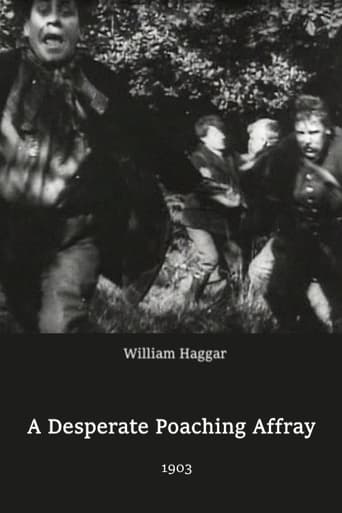
Walter Haggar
Actor
- Active
- 1903-1903
Films 1
About Walter Haggar
Walter Haggar is a very obscure early film performer whose surviving credit is associated with the 1903 British production Desperate Poaching Affray. Very little biographical information has survived about him in standard film-reference sources, and he appears to have worked during the earliest period of narrative cinema, when many performers were not yet widely credited by studios or trade publications. Because of that, his documented screen career is extremely limited, and his name is primarily preserved through early filmography records rather than through a developed public biography. The available evidence suggests that he was active at the dawn of the silent era, when filmmaking was still experimental, short-form, and often made by small companies or pioneers outside the later studio system. No reliable records have been found to confirm his birth date, place of birth, death date, family background, or later life. He is therefore best understood as one of the many early cinematic participants whose work survives in fragments and whose contribution is known largely through archival listing rather than detailed contemporary publicity. His place in film history lies in representing the anonymous or lightly documented performers who helped establish motion-picture acting in the medium's formative years.
More about Walter Haggar
On screen
No detailed descriptions of Walter Haggar's acting style survive in the historical record. Based on the era in which he worked, his performance would likely have relied on clear physical expression, simplified gesture, and theatrical readability suited to silent, short-form cinema. Early film acting typically emphasized movement and immediate visual clarity over subtle facial nuance, especially in outdoor action comedies and chase films like Desperate Poaching Affray. Any specific assessment beyond that would be speculative, as no reviews or performance analyses reliably attached to him have been located.
In film history
Walter Haggar's cultural impact is indirect but still meaningful within the broader history of cinema. He is part of the thinly documented workforce of early film performers who helped bring moving pictures from novelty attractions toward narrative entertainment, especially in the first years of the twentieth century. Even when individual biographies are lost, these performers contributed to the evolution of screen acting, stunt staging, and visual storytelling in films that influenced later production methods. His association with Desperate Poaching Affray also places him within the early British film tradition, a crucial branch of world cinema that developed alongside the more widely documented American industry. For researchers and archivists, names like his are important because they remind us that film history was built not only by famous stars and directors but also by many near-anonymous participants whose work survives only in titles and production records.
Later reputation
Walter Haggar's legacy is essentially archival: his name endures as a trace of cinema's earliest generation of screen performers. He exemplifies the many actors from the silent era whose careers cannot be reconstructed in full because records were incomplete, credit practices were inconsistent, and many films themselves have been lost. In film history, such figures are significant because they help establish the scale and collaborative nature of early production, showing that the medium depended on a much broader community than the surviving star system suggests. His documented presence in a 1903 film makes him part of the foundational era of narrative motion pictures, and that alone secures him a small but real place in early cinema studies. For modern databases, his legacy lies in being preserved as evidence of the people who stood at the beginning of screen performance.
Influence
No direct influence on later actors or directors can be verified from the available record. Any influence he may have had would have been local, immediate, and undocumented, typical of early film performers whose work shaped set practice and performance norms without being formally credited in later histories. His broader influence is therefore historical rather than personal: he belongs to the generation whose collective labor established the physical, expressive acting conventions that silent cinema relied upon. In that sense, his contribution is part of the foundation on which later film acting developed.
Off screen
No reliable information has been located about Walter Haggar's personal life, including marriage, family, residence, education, or activities outside film. He appears in surviving records primarily as a name connected to an early motion-picture credit rather than as a documented public figure. This kind of scarcity is common among performers from the first years of cinema, when employment records were inconsistent and many participants did not receive the kind of press coverage later studio-era actors would obtain. As a result, his private life remains undocumented in the available historical record.
Credits
- Appeared in the 1903 silent short Desperate Poaching Affray
- Represents one of the early credited or recorded performers from British cinema's formative years
- Associated with a landmark period when narrative filmmaking was still developing its grammar and performance style
Roles
- Performer in Desperate Poaching Affray (1903)
Films
- Desperate Poaching Affray (1903)
Notes
- Walter Haggar is known in surviving film records chiefly for a single 1903 credit.
- His documented filmography currently points to the earliest phase of British narrative cinema.
- No verified birth or death information has surfaced in standard public film references.
- He is an example of the many early silent-era performers whose careers are visible only through film titles and archival listings.
- His surviving credit comes from a short film produced when cinema was still less than a decade old as a commercial medium.
- Because early films were often short and not all cast members were consistently credited, many details of performers like Haggar have been lost.
- Researchers may encounter his name in filmographies, but not in the richer biographical sources available for later stars.
Questions
Who was Walter Haggar?
Walter Haggar was an early silent-era film actor known from surviving records for appearing in Desperate Poaching Affray (1903). Very little biographical information has survived about him, so he is primarily remembered as part of the earliest generation of screen performers.
What films is Walter Haggar best known for?
He is best known for Desperate Poaching Affray (1903), which appears to be his only surviving documented screen credit. His filmography is otherwise extremely limited in the available record.
When was Walter Haggar born and when did he die?
His birth date, death date, and places of birth and death are not currently documented in reliable public sources. He remains an obscure early cinema figure whose life details have not been preserved.
What awards did Walter Haggar win?
No awards or formal honors are known for Walter Haggar. That is not unusual for performers from the earliest years of cinema, when awards culture had not yet developed in the modern sense.
What was Walter Haggar's acting style?
There are no surviving contemporary descriptions of his personal acting style. Given the period, his performance would likely have followed early silent-film conventions, relying on expressive movement, clear physical actions, and theatrical readability.
What is Walter Haggar's legacy in film history?
His legacy is mainly historical and archival: he represents the many early performers whose contributions helped shape silent cinema but whose personal biographies were not well preserved. His name survives as part of the record of cinema's formative years.