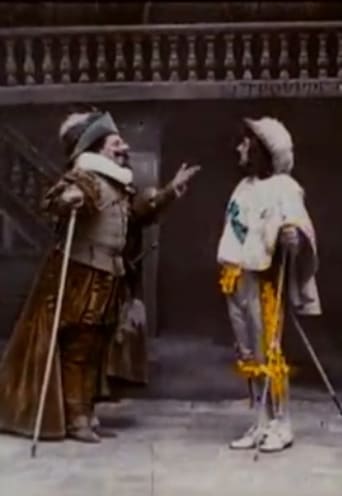
Benoit Constant Coquelin
Actor
Born: January 23, 1841 in Boulogne-sur-Mer, France Died: January 27, 1909 Active: 1860-1909 Birth Name: Benoît-Constant Coquelin
Films
1 film
About Benoit Constant Coquelin
Benoît-Constant Coquelin, known as Coquelin aîné (the elder), was French actors of the 19th century. Born into a modest family, he rose to become a member of the prestigious Comédie-Française in 1860, where he established himself excelled in both comedy and tragedy. His nearly five decades, during which he created numerous roles on the Parisian stage. Coquelin's most enduring legacy was his creation of the title role in Edmond Rostand's 'Cyrano de Bergerac' in 1897, which became his signature performance. In 1900, at the age of 59, he reprised this role for the short film adaptation, making him one of the earliest stage actors to transition to cinema. He was also a respected teacher and author, writing several books on acting technique. Coquelin continued performing until his death in 1909, leaving an indelible mark on French theatrical tradition and early cinema.
The Craft
On Screen
Coquelin was renowned for his powerful declamatory style and exceptional vocal control, characteristic of 19th-century French classical acting. He combined technical precision with emotional depth, particularly excelling in both comic and tragic roles. His approach emphasized clear diction, grand gestures, and a deep understanding of classical text. Coquelin believed in the actor as an interpreter who must serve the author's intentions while bringing personal insight to the role.
Milestones
- Joined the Comédie-Française in 1860
- Created the role of Cyrano de Bergerac in 1897
- Starred in the first film adaptation of Cyrano de Bergerac (1900)
- Published 'L'Art du Comédien' (The Art of the Actor) in 1884
- Toured extensively throughout Europe and America
- Established himself as one of France's greatest classical actors
Best Known For
Iconic Roles
Must-See Films
Accolades
Won
- Officer of the Legion of Honour (1889)
- Commander of the Legion of Honour (1900)
Special Recognition
- Member of the Comédie-Française (1860-1886)
- Honorary Member of the Comédie-Française (1886-1909)
- Considered one of the greatest French actors of the 19th century
- The Théâtre Coquelin in Paris was named in his honor
Working Relationships
Worked Often With
Studios
Why They Matter
Impact on Culture
Coquelin's portrayal of Cyrano de Bergerac established the definitive interpretation of the character that influenced all subsequent performances. His transition from stage to early cinema helped bridge the gap between theatrical tradition and the new medium of film. His writings on acting theory, particularly 'L'Art du Comédien,' became foundational texts for theatrical training. Coquelin represented the pinnacle of French classical acting at the turn of the century, embodying the cultural prestige of Parisian theater.
Lasting Legacy
Coquelin's legacy endures through his definitive interpretation of Cyrano de Bergerac, which remains the standard against which all performances are measured. His contributions to acting theory continue to influence performers today. The 1900 film of 'Cyrano' preserves one of the earliest examples of a great stage actor captured on film, providing invaluable documentation of 19th-century acting techniques. His name remains synonymous with French theatrical excellence, and the Théâtre Coquelin continues to honor his memory.
Who They Inspired
Coquelin influenced generations of French actors through his performances and writings. His emphasis on technical mastery combined with emotional truth became a model for classical training. His interpretation of Cyrano established performance conventions that actors still reference. His successful transition to early cinema demonstrated that theatrical techniques could be adapted to the new medium, influencing other stage actors to embrace film.
Off Screen
Coquelin came from a modest background; his father was a baker. He married Jeanne-Charlotte Émilie Delaunay in 1864, and they had three children. His younger brother, Ernest Alexandre Honoré Coquelin (known as Coquelin cadet), also became a famous actor. The family was deeply involved in French theatrical life, with both brothers achieving great success. Coquelin was known for his dedication to his craft and his professional integrity.
Education
Educated at the Lycée Bonaparte (now Lycée Condorcet) in Paris; later studied at the Conservatoire de Paris
Family
- Jeanne-Charlotte Émilie Delaunay (1864-1909)
Did You Know?
- He was nicknamed 'Coquelin aîné' (the elder) to distinguish him from his equally famous younger brother
- The 1900 'Cyrano' film was only 2 minutes long but was groundbreaking as an early sound film using the Chronophone system
- He was one of the first actors to write seriously about acting technique in his book 'L'Art du Comédien'
- Coquelin retired from the Comédie-Française in 1886 but continued to perform in other theaters
- His performance in 'Cyrano de Bergerac' was so acclaimed that Rostand wrote the role specifically for him
- He performed in both French and English during his American tours
- The film 'Cyrano de Bergerac' (1900) is considered one of the earliest examples of a synchronized sound film
- Coquelin was known for his meticulous preparation and would spend months studying each new role
- He was a vocal advocate for actors' rights and better working conditions
- His death in 1909 was mourned as a national loss in France
In Their Own Words
The actor must be the slave of the author, but a slave who knows how to make his master serve him.
To be an actor is to be a mirror that reflects not only what is shown, but what is hidden beneath.
The greatest art is to make the artificial seem natural, and the natural seem artistic.
In comedy, we laugh at what we recognize; in tragedy, we weep at what we fear.
Frequently Asked Questions
Who was Benoît-Constant Coquelin?
Benoît-Constant Coquelin, known as Coquelin aîné, was one of France's most celebrated 19th-century actors, renowned for his work at the Comédie-Française and his creation of the title role in 'Cyrano de Bergerac'. He was also a figure in early cinema, appearing in the 1900 film adaptation of the play.
What films is Benoît-Constant Coquelin best known for?
Titles linked here include Cyrano de Bergerac (1900), Le Duel d'Hamlet (1900).
When was Benoît-Constant Coquelin born and when did he die?
Born January 23, 1841; died January 27, 1909.
What awards did Benoît-Constant Coquelin win?
Coquelin was appointed Officer of the Legion of Honour in 1889 and promoted to Commander in 1900. He was also a member of the Comédie-Française and had a theater named in his honor in Paris.
What was Benoît-Constant Coquelin's acting style?
Coquelin was known for his powerful declamatory style, exceptional vocal control, and technical precision characteristic of 19th-century French classical acting. He combined mastery of classical text with emotional depth, emphasizing clear diction and grand gestures while maintaining authenticity in both comic and tragic roles.
How did Coquelin influence cinema?
Coquelin's appearance in the 1900 'Cyrano' film represented an important bridge between stage and screen, demonstrating how theatrical performance could be adapted to cinema. His participation helped legitimize film as an art form worthy of serious actors.
What was Coquelin's relationship with Edmond Rostand?
Edmond Rostand wrote the role of Cyrano de Bergerac specifically for Coquelin, recognizing his unique talents. Their collaboration resulted in.