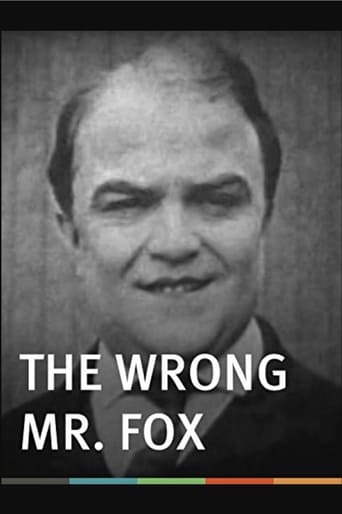
Harry Jackson
Director
- Active
- 1917-1917
Films directed 1
About Harry Jackson
Harry Jackson is a very obscure early silent-era film director whose surviving credit presently identifies him chiefly through the 1917 short The Wrong Mr. Fox. Available historical records do not provide a reliable portrait of his life beyond this single credited directing assignment, and he should not be confused with later figures of the same name, including the much better documented sculptor and actor Harry Jackson. As with many filmmakers from the 1910s, especially those who worked on shorts, his career appears to have been brief or at least sparsely documented in surviving studio and trade-paper records. The Wrong Mr. Fox places him in the active period of American silent comedy-drama production during the 1910s, when many directors worked anonymously or with limited on-screen credit. No dependable biographical details such as birth date, death date, birthplace, education, family life, or broader filmography have been confirmed from the surviving information associated with this exact person. Because of the scarcity of records, his historical significance lies less in a known body of work and more in his presence among the many early cinema craftsmen whose contributions helped build the silent film industry.
More about Harry Jackson
Behind the camera
No detailed critical descriptions of Harry Jackson’s directing approach have survived in accessible historical sources. Based on the era and the nature of his known credit, his work would have been shaped by silent-film storytelling conventions: clear visual staging, concise narrative construction, and economy suited to short subjects. Any assessment of a personal stylistic signature would be speculative, because only one credited film is presently tied to his name with confidence. He should therefore be understood as a working silent-era director rather than as a filmmaker whose individual style has been well documented by film historians.
In film history
Harry Jackson’s cultural impact is difficult to measure directly because the surviving record preserves only a minimal trace of his career. Nonetheless, he is part of the foundational generation of silent-film directors who helped establish the grammar of cinematic storytelling in the 1910s, a period when short subjects and one-reel or two-reel productions were central to moviegoing culture. Even relatively obscure directors contributed to the expansion of screen comedy, melodrama, and lightweight narrative forms that trained audiences to read film visually. His presence in the historical record is also valuable because it underscores how much of early cinema remains partially lost, with many practitioners known only through fragmentary filmographies and trade references.
Later reputation
Jackson’s legacy is primarily archival: he stands as evidence of the many early filmmakers whose work has not been fully preserved or widely studied. For classic cinema historians, names like his help map the industrial and creative ecosystem of silent-era production, where countless directors, writers, actors, and technicians worked on short films that often survive only in catalog listings. If additional prints, paper records, or trade reviews were to surface, his importance could be better assessed, but for now his legacy is that of a documented participant in the silent film era rather than a widely celebrated auteur. His surviving credit ensures that he remains part of the historical record of 1910s American filmmaking.
Influence
Because there is no documented stylistic commentary or extended filmography, Jackson’s direct influence on later filmmakers cannot be established with confidence. His indirect influence, however, lies in the broader collaborative tradition of early silent cinema, where many modest productions contributed to the techniques later refined by more famous directors. The work of directors like Jackson helped normalize concise visual storytelling, comic timing, and the efficient use of intertitles and staging. In that sense, he belongs to the anonymous infrastructure of early film craft that made later cinematic developments possible.
Off screen
No reliable information has been found regarding Harry Jackson’s personal life, including marriages, children, residence, or family background. Early film personnel were often under-documented unless they later became major stars or studio executives, and Jackson appears to fall into that category of historical obscurity. As a result, any claim about his relationships or private life would be speculative and is not included here. Researchers may need to consult trade journals, studio records, or archival production documents to uncover more about him.
Credits
- Credited as director of the silent film The Wrong Mr. Fox (1917)
- Represents one of the many early American silent-era directors whose surviving documentation is extremely limited
- Associated with the period when short-form fiction films were a major part of studio production
- His credited work places him within the formative years of Hollywood’s studio-era filmmaking system
Films
- The Wrong Mr. Fox (1917)
Notes
- He is credited with directing only one known film title in surviving filmography references: The Wrong Mr. Fox (1917).
- He should not be confused with other notable people named Harry Jackson, especially later twentieth-century figures in other arts.
- His career falls entirely within the silent-film era, when many directors worked on shorts and left limited documentation behind.
- The sparse record surrounding him is typical of many early cinema professionals whose careers were not extensively archived.
- His known activity year, 1917, places him during the final years before feature-length filmmaking became even more dominant in American studios.
- Because his filmography is so limited in surviving sources, it is difficult to determine whether he continued in film under another name or in uncredited roles.
- He is a reminder of how many early directors are represented in history by only a single surviving credit.
- The title The Wrong Mr. Fox suggests the kind of light narrative or comic premise common in short silent-era productions.
Questions
Who was Harry Jackson?
Harry Jackson was an obscure silent-era film director known from surviving records for directing The Wrong Mr. Fox (1917). Very little biographical information has survived about him, so he is best understood as one of the many early cinema craftsmen whose careers are only partially documented.
What films is Harry Jackson best known for?
He is currently best known for The Wrong Mr. Fox (1917), the one confirmed directing credit associated with his name in the surviving filmography record. No broader, reliably documented body of work is presently available.
When was Harry Jackson born and when did he die?
His birth date and death date are not currently known from reliable surviving sources. The historical record tied to this exact Harry Jackson is too sparse to verify those personal details with confidence.
What awards did Harry Jackson win?
No awards or formal honors are known for Harry Jackson. His surviving record comes from early silent-film credits rather than from later public recognition or documented industry awards.
What was Harry Jackson's directing style?
No detailed critical description of his directing style survives. Given that he worked in 1917, his approach would likely have relied on the visual clarity and economy typical of silent short filmmaking, but any more specific claim would be speculative.
What is Harry Jackson's legacy in film history?
His legacy is mainly historical and archival: he represents the many early directors whose names survive even when their films and biographical details are mostly lost. For film historians, that makes him an important example of the incomplete record of silent cinema.