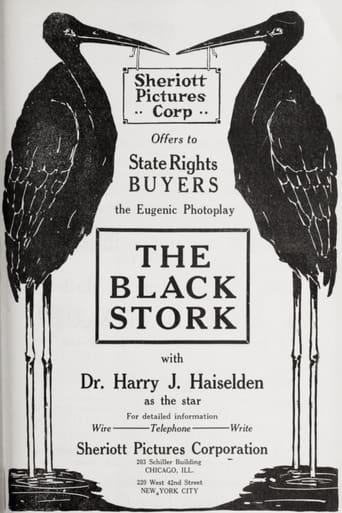
Harry J. Haiselden
Actor
Born: March 16, 1870 in Plano, Illinois, USA Died: June 18, 1919 Active: 1917 (Film active period) Birth Name: Harry John Haiselden
Films
1 film
About Harry J. Haiselden
Dr. Harry J. Haiselden — prominent Chicago surgeon who became controversial figures of the early 20th century due to his radical advocacy for eugenics. Born in 1870, he rose to become the Chief Surgeon at the German-American Hospital in Chicago, where he gained national notoriety in 1915 for refusing to perform life-saving surgery on a newborn with severe birth defects, known as 'Baby Bollinger.' Haiselden used the ensuing media firestorm to launch a public campaign promoting eugenic infanticide, arguing that 'defective' children should be allowed to die for the betterment of society. To further his cause, he co-wrote and starred as himself in the 1917 silent film 'The Black Stork,' a fictionalized propaganda piece based on the Bollinger case. Despite facing intense criticism and eventual expulsion from the Chicago Medical Society, Haiselden remained a vocal proponent of his views until his sudden death from a cerebral hemorrhage in 1919. His career remains a dark chapter in both medical and cinematic history, illustrating the intersection of early film propaganda and the American eugenics movement.
The Craft
On Screen
Haiselden's acting was largely non-professional and didactic, as he essentially played a dramatized version of himself. His performance in 'The Black Stork' was intended to project authority, medical expertise, and a cold, rationalist demeanor to persuade audiences of his eugenic arguments.
Milestones
- Appointed Chief Surgeon and President of the German-American Hospital in Chicago (1902)
- Sparked a national debate on eugenics with the 'Baby Bollinger' case (1915)
- Co-wrote and starred in the eugenic propaganda film 'The Black Stork' (1917)
- Acquitted by a coroner's jury regarding his refusal to operate on disabled infants
- Expelled from the Chicago Medical Society for his unethical use of media and film to promote his practices (1916)
Best Known For
Iconic Roles
Must-See Films
Working Relationships
Worked Often With
Studios
Why They Matter
Impact on Culture
Haiselden had a profound and disturbing impact on American culture by bringing the eugenics movement into the mainstream through mass media and cinema. His actions and the film 'The Black Stork' forced a national conversation on the value of human life, disability rights, and medical ethics. The film was one of the earliest examples of a feature-length motion picture being used as a tool for social engineering and political propaganda, predating more infamous examples from the 1930s.
Lasting Legacy
His legacy is primarily one of infamy, serving as a cautionary tale of how medical authority can be misused to promote discriminatory ideologies. 'The Black Stork' remains a significant artifact for film historians and bioethicists, documenting a period when eugenic theories were openly debated and even supported by prominent figures like Helen Keller and Clarence Darrow. The film continued to be shown in various forms until the 1940s, influencing public perception of disability for decades.
Who They Inspired
Haiselden influenced the eugenics movement by providing a 'heroic' medical face to passive euthanasia. His use of film influenced later propagandists who recognized the power of the medium to shape public morality and health policy.
Off Screen
Haiselden was the son of George W. Haiselden and Elizabeth Dickey. He was known to be extremely close to his mother throughout his life. Interestingly, despite his public stance on 'fitness,' he was the adoptive father of two children.
Education
University of Illinois College of Medicine (Graduated 1893)
Did You Know?
- The title 'The Black Stork' refers to a folk belief that black storks would kill their own unhealthy offspring.
- Haiselden allowed at least six infants to die by refusing surgery during his career.
- The film 'The Black Stork' features a scene where the soul of the deceased infant is received by Jesus Christ.
- Despite the controversy, the film was shown in theaters for over 25 years under various titles.
- Haiselden died while on vacation in Havana, Cuba.
- He was a vocal opponent of the institutionalization of the mentally ill, ironically using the poor conditions of asylums to justify his 'mercy killings.'
- The National Board of Review of Motion Pictures required 18 changes to the film before allowing its release.
In Their Own Words
God does not want this child to live. Medical science should save children from deformity, but not prolong useless, subnormal lives. (From 'The Black Stork')
This death came to me as the greatest victory of my career. I have never been able to regard Baby Bollinger as a human being. (Regarding the death of John Bollinger)
Frequently Asked Questions
Who was Harry J. Haiselden?
Chicago surgeon and eugenics advocate who became famous for refusing to operate on disabled infants. He is best known in film history for starring in the 1917 propaganda film 'The Black Stork,' which defended his controversial medical decisions.
What films is Harry J. Haiselden best known for?
Titles linked here include The Black Stork (1917), Are You Fit to Marry? (1918 re-release of The Black Stork).
When was Harry J. Haiselden born and when did he die?
Born March 16, 1870; died June 18, 1919.
What was the 'Baby Bollinger' case?
In 1915, Haiselden refused to perform a simple surgery on a newborn named John Bollinger who had multiple birth defects. He allowed the baby to die and used the case to publicly campaign for eugenic practices, sparking a massive national debate.
Was Harry J. Haiselden a professional actor?
No, he was a medical doctor. He appeared in 'The Black Stork' as a means of propaganda to promote his medical and social views to the general public.
What was the legacy of 'The Black Stork'?
The film is considered. It remains a key historical document for studying the intersection of early film, medical ethics, and the American eugenics movement.