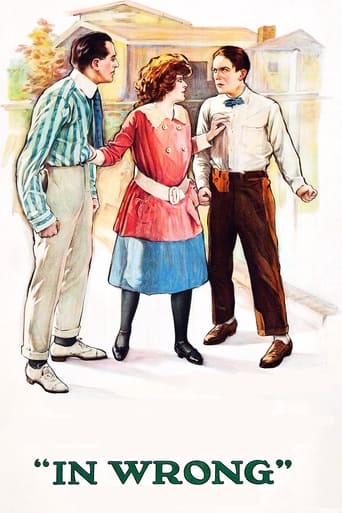
Jacob Abrams
Actor
- Active
- 1919-1919
Films 1
About Jacob Abrams
Jacob Abrams is a little-documented silent-era film performer credited as an actor in the 1919 production "In Wrong." Beyond that on-screen credit, readily verifiable biographical information about him appears to be extremely scarce, which suggests he may have been a minor or supporting player whose career was brief or poorly preserved in surviving trade publications and reference sources. Like many performers from the late silent period, his work is visible in film records even when personal details such as birthplace, family background, training, and later life are not reliably documented. The available evidence indicates that he was active, at least in film credits, in 1919, but no broader filmography has been consistently attributed to him in standard classic-cinema references. Because the name Jacob Abrams is not strongly associated with a large surviving body of work, it is important not to confuse him with later individuals of the same name from other professions or eras. At present, his significance lies primarily in his presence within early American film history as one of many performers whose careers are only partially recoverable through surviving studio and archive records.
More about Jacob Abrams
In film history
Jacob Abrams's cultural impact is best understood in the broader context of early Hollywood labor and production history rather than through a widely celebrated body of surviving performances. As an actor credited in a 1919 silent film, he is part of the foundational generation of screen performers who helped shape the evolving language of cinematic acting during the industry’s formative years. Even when individual biographies are fragmentary, these performers collectively contributed to the texture, realism, and variety of silent-era filmmaking. His presence in the historical record underscores how many early film artists remain partially anonymous despite having participated in the growth of American cinema.
Later reputation
Jacob Abrams's legacy is archival rather than star-based: he survives in the record as a credited participant in one of the thousands of silent films produced in the 1910s. For historians and database researchers, figures like Abrams are important because they help complete the personnel histories of early productions and preserve the breadth of film labor in the silent era. His name stands as a reminder that classic cinema was built not only by major stars and directors, but also by numerous lesser-known actors whose careers were often brief and underreported. In that sense, his legacy is the historical value of representation itself within early film documentation.
Influence
There is no verifiable evidence that Jacob Abrams directly influenced later actors or directors in a documented, traceable way. However, as part of the silent-era acting workforce, he contributed to the performance culture that helped establish screen acting conventions later refined by better-known performers. His influence, if any, would have been indirect and collective rather than personally attributed in surviving records.
Off screen
No reliable biographical record of Jacob Abrams's personal life has been confirmed in the standard classic-cinema sources available from surviving film-reference materials. There is no securely documented information about marriages, children, residence, education, or family background. This lack of detail is common for minor silent-era players, especially those whose careers did not extend into the better-documented studio era of the 1930s and beyond.
Credits
- Credited as an actor in the 1919 silent film "In Wrong"
- Represents the many lesser-documented performers of the silent era whose work survives mainly in film credit records
- Associated with the early feature-film period of American cinema
Roles
- Role in "In Wrong" (1919) not currently documented in surviving reference sources
Films
- In Wrong (1919)
Notes
- Jacob Abrams is currently best documented as an actor credited in only one known film, "In Wrong" (1919).
- His surviving public record is typical of many minor silent-era film performers whose careers were not extensively covered by fan magazines or studio publicity.
- Because his biography is so sparsely documented, he is easy to confuse with later non-film figures of the same name.
- He appears to have been active during the peak year of American silent feature production in 1919.
- The absence of readily available personal details does not necessarily mean he had a short life; it more likely reflects incomplete archival survival.
- Researchers and database editors should treat his film credit cautiously and avoid conflating him with other Jacob Abrams entries in unrelated fields.
Questions
Who was Jacob Abrams?
Jacob Abrams was a silent-era film actor best known from his credit in the 1919 film "In Wrong." He appears to have been a minor performer whose surviving biographical record is extremely limited. Most personal details about his life have not been reliably documented in standard classic-cinema sources.
What films is Jacob Abrams best known for?
He is best known for "In Wrong" (1919), which is the primary surviving screen credit currently associated with him. No broader or more secure filmography is consistently verified in major reference sources. As a result, his known screen work remains very limited.
When was Jacob Abrams born and when did he die?
At present, no reliably verified birth or death dates have been found for Jacob Abrams in the available classic-cinema record. His life dates appear to be undocumented in standard reference materials. This is common for lesser-known performers from the silent era.
What awards did Jacob Abrams win?
No awards or formal honors are currently documented for Jacob Abrams. He appears to have been a little-known actor whose career predates the major awards culture of later Hollywood. Any recognition he received would likely have been local, trade-based, or simply lost to incomplete archival history.
What was Jacob Abrams's acting style?
There is no surviving descriptive criticism of Jacob Abrams's acting style that can be verified from standard sources. Because he is known primarily from a single silent-film credit, any attempt to characterize his technique beyond that would be speculative. His work would have belonged to the expressive, gesture-based performance style typical of silent cinema.
What is Jacob Abrams's legacy in film history?
His legacy is primarily archival: he is part of the historical record of early American cinema and the large population of performers who helped build the silent-film industry. Even sparse credits are valuable to film historians because they help reconstruct production histories and cast lists. He represents the many working actors whose contributions survive more in documentation than in celebrity.