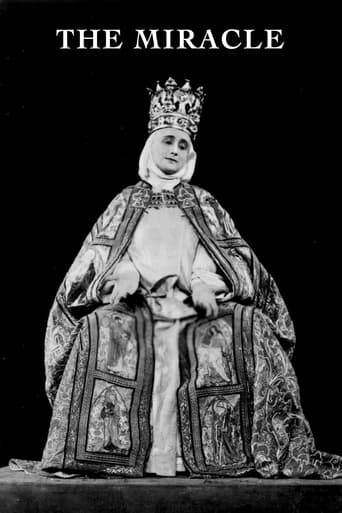
Florence Winston
Actor
- Active
- 1912-1912
Films 1
About Florence Winston
Florence Winston is a very obscure early silent-era film performer whose documented screen work is limited to the 1912 film The Miracle. Surviving reference sources provide only minimal information about her life, and she appears to belong to the large group of early motion-picture players whose careers were briefly recorded in studio and trade-paper listings but who left little biographical trace. Because of the scarcity of surviving credits and the lack of authoritative personal documentation, it is difficult to reconstruct a full career arc with confidence. What can be said is that she was active during the formative years of American cinema, when actors were often unbilled or inconsistently credited and many performances have been lost or remain difficult to verify. Her surviving association with The Miracle places her within the silent-film culture of the early 1910s, a period when short subjects and stage-derived melodramatic productions were common. No reliable evidence has been found for later film work, long-term studio association, or a public career outside this brief screen credit. As a result, Florence Winston is best understood today as a historically documented but poorly preserved participant in the earliest era of film performance.
More about Florence Winston
In film history
Florence Winston's cultural impact is primarily archival and historical rather than celebrity-based. She stands as an example of the many women who participated in the first decades of motion pictures but whose work has been largely obscured by incomplete records, lost films, and inconsistent crediting practices. Her presence in The Miracle links her to the early silent-film world, when the medium was still shaping performance conventions and audience expectations. Although she does not appear to have left a traceable public persona or a large body of surviving work, her documentation contributes to a fuller understanding of the breadth of early cinema labor and the anonymous or semi-anonymous artists who helped build the industry.
Later reputation
Florence Winston's legacy lies in the historical record itself: she is part of the long list of early film performers whose names endure even when detailed life stories do not. For film historians and database researchers, figures like Winston are important because they illuminate the incompleteness of silent-era documentation and the fragile survival of early screen history. Her surviving credit in The Miracle preserves evidence of women's participation in cinema at a time when the medium was still establishing its artistic and industrial identity. While she does not appear to have become a widely recognized star, her inclusion in filmographies ensures that her contribution remains part of the broader story of silent cinema.
Influence
No direct influence on later actors or filmmakers can be reliably documented for Florence Winston. Her significance is indirect: she is representative of the early screen performers whose work helped normalize filmed acting and supported the growth of narrative cinema. By appearing in an early silent production, she participated in a performance culture that influenced later screen acting through its emphasis on gesture, physical expression, and visual clarity. Because so little is known about her personal methodology or later career, any stronger claims about influence would be speculative.
Off screen
No reliable biographical records have been located for Florence Winston's personal life. Information about marriage, family background, residence, and later life is not currently documented in the surviving film-history references available for this early screen performer. As with many silent-era actors who worked briefly or in uncredited capacities, the historical record preserves little beyond a name attached to a film credit.
Credits
- Appeared in the 1912 silent film The Miracle, the only reliably documented screen credit currently associated with her
- Represents one of the many early cinema performers whose work survives mainly through fragmentary filmographies and trade references
- Participated in the rapidly developing American silent-film industry during the formative pre-World War I period
Roles
- Role in The Miracle (1912) is the only known credited screen performance currently associated with Florence Winston
Films
- The Miracle (1912)
Notes
- Florence Winston's known filmography is extremely limited, with The Miracle (1912) being the only documented screen credit currently associated with her.
- She is part of the large population of silent-era performers whose careers are difficult to reconstruct because many early records were incomplete or lost.
- Her name survives mainly through film-reference listings rather than through a widely preserved body of publicity material.
- No verified photographs, interviews, or personal memoirs have been located in the available reference record for her.
- Because she worked in 1912, she belongs to the earliest generation of screen actors, before standardized star systems and comprehensive screen credits were common.
- Her obscurity makes her a useful example of how much early film history remains undocumented or only partially documented.
- There is no reliable evidence that she continued acting after 1912.
- No confirmed connection has been established between Florence Winston and other better-known performers of the period.
Questions
Who was Florence Winston?
Florence Winston was an early silent-film actor known from surviving film-credit references, most notably for appearing in The Miracle (1912). Very little else about her life or career has survived in readily verifiable sources, which is common for performers from the earliest years of cinema.
What films is Florence Winston best known for?
She is currently best known for The Miracle (1912), which appears to be her only documented screen credit. No additional confirmed film appearances have been reliably established from the available historical record.
When was Florence Winston born and when did she die?
Her birth and death dates are not currently documented in the available reference sources. In other words, reliable biographical records identifying her birth place, birth date, death date, or later life have not been confirmed.
What awards did Florence Winston win?
No awards or nominations are currently known for Florence Winston. This is not unusual for performers from the silent era, especially those whose careers were brief or only partially recorded.
What was Florence Winston's acting style?
Her specific acting style is not documented in surviving sources. Since she worked in the silent-film era, her performance would likely have relied on the visual expressiveness typical of early screen acting, but any more detailed description would be speculative.
What is Florence Winston's legacy in film history?
Her legacy is mainly historical and archival: she represents the many early film performers whose names remain in filmographies even when personal details are lost. For researchers, she is a reminder of how much early cinema history is still incomplete and how important fragmentary credits are to preserving the record.