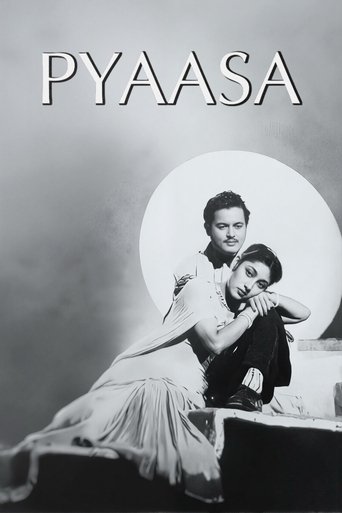
Radheshyam
Actor
- Active
- 1957-1957
Films 1
About Radheshyam
Radheshyam is a very obscure credited screen performer associated with Indian cinema in the 1950s, best known today for appearing in the landmark Hindi film Pyaasa (1957). Available reference sources provide extremely limited biographical information, and he does not appear to have had a widely documented career in the way major stars and character actors of the era did. Because of this, his life story, training, and broader filmography are not well preserved in commonly accessible public records. What can be stated with confidence is that he was active as a film actor in 1957, at least in connection with Pyaasa, one of the most celebrated films in Hindi cinema history. His presence in such a canonical title places him within the ecosystem of mid-1950s Bombay film production during the peak years of post-independence Hindi cinema. Beyond that, detailed information about his personal background, later career, and life outside the screen remains unavailable in standard film reference materials. He is therefore remembered more as a small but legitimate part of a major classic rather than as a widely documented star.
More about Radheshyam
In film history
Radheshyam’s cultural significance comes primarily from his association with Pyaasa, a film that became a defining work of Hindi cinema and is regularly cited among the greatest Indian films ever made. Even performers with brief or lightly documented screen time in such a production become part of the historical fabric of cinema because the film itself has endured as a touchstone for criticism, restoration, retrospectives, and film education. His contribution illustrates how classic films were collective works shaped not only by stars and auteurs but also by numerous supporting and background performers whose names often survive only in credits. In that sense, Radheshyam represents the many under-documented working actors who helped create the texture and realism of studio-era Indian filmmaking.
Later reputation
Radheshyam’s legacy is tied almost entirely to Pyaasa and to the preservation of that film within the canon of world cinema. While he does not appear to have left behind a large documented body of work or a public persona with extensive archival traces, his credited presence in an iconic film ensures that his name remains part of Hindi film history. For database and archival purposes, he is important as an example of a performer whose survival in the historical record is largely through film credits rather than biography. His case also underscores the gaps in documentation that affect many mid-century character actors and non-star performers in South Asian cinema.
Influence
There is no evidence that Radheshyam exerted a documented influence on later actors or filmmakers in the sense of a recognized stylistic school or public mentorship. His influence is therefore indirect and archival: he remains part of the cast history of a film that shaped generations of Indian filmmakers, critics, and audiences. Through Pyaasa, his name is preserved within a work that influenced social drama, poetic realism, and the use of cinema as cultural critique in Hindi film. Any broader influence would be attributable to the film’s enduring fame rather than to a separately recorded personal career.
Off screen
No reliable public biographical material is readily available regarding Radheshyam’s family background, marital status, household life, or personal relationships. Standard film references and widely used databases do not provide verifiable details about marriages, children, or private life. He appears to have been one of many lesser-documented working actors whose off-screen identity has not been preserved in accessible historical sources. As a result, any further personal detail would be speculative and is not included here.
Credits
- Appeared in Pyaasa (1957), one of the most critically acclaimed and historically important films in Hindi cinema
- Worked during the influential mid-1950s period of post-independence Indian filmmaking
- Maintained a screen credit in a major classic despite having a very limited surviving public record
Roles
- Supporting role in Pyaasa (1957)
Films
- Pyaasa (1957)
Notes
- Radheshyam is chiefly documented today because of his credit in Pyaasa (1957).
- He appears to have had an extremely brief or at least poorly documented screen career in surviving public records.
- His name is shared by several other Indian individuals, so film databases must be careful not to confuse him with unrelated people of the same name.
- Being associated with Pyaasa places him in one of the most studied films in Indian cinema history.
- He is an example of a classic-era supporting performer whose identity survives mainly through the film credits rather than through biographies or interviews.
- No reliably published information about his birth, death, family, or education is readily available in standard film references.
Questions
Who was Radheshyam?
Radheshyam was an Indian film actor known primarily for appearing in Pyaasa (1957). Very little verified biographical information about him survives in standard public film reference sources, so he is best understood as an obscure supporting performer from classic Hindi cinema.
What films is Radheshyam best known for?
He is best known for Pyaasa (1957), one of the most important films in the history of Hindi cinema. No other widely documented film credits are readily available in common reference sources.
When was Radheshyam born and when did he die?
His birth date and death date are not publicly documented in the standard sources commonly used for classic cinema research. At present, those details remain unavailable rather than verified.
What awards did Radheshyam win?
No awards or formal honors are readily documented for Radheshyam in available public reference material. His historical significance comes from his credited role in a major classic film rather than from a decorated public career.
What was Radheshyam's acting style?
There is no surviving critical description of his individual acting style that can be verified from accessible sources. Since his documented screen career is extremely limited, any assessment of style would be speculative.
Why is Radheshyam still mentioned in film history?
He remains part of film history because he appeared in Pyaasa, a landmark film that is still studied, screened, and discussed internationally. Even lesser-documented cast members of such works remain important to the historical record.