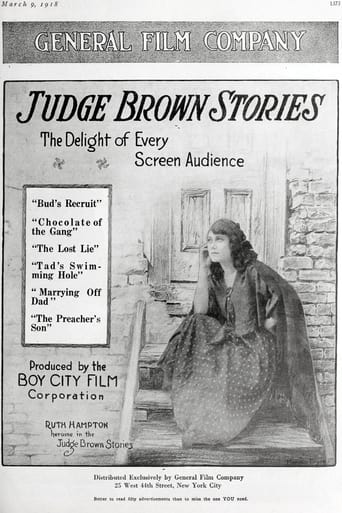
Judge Willis Brown
Actor
- Active
- 1918-1918
- Birth name
- Willis Brown
Films 1
About Judge Willis Brown
Judge Willis Brown was an American juvenile-court judge and social reformer who became briefly associated with silent-era motion pictures as a screen personality and subject of filmic publicity, rather than as a long-term career actor. He is credited in the film Bud's Recruit (1918), a title that places him within the world of Progressive Era reform cinema, where questions of youth, discipline, civic responsibility, and moral uplift were frequently dramatized. Brown was best known in real life for his work with troubled and underprivileged boys, and his name was already familiar in reform circles before his screen credit appeared. His connection to film appears to have been part of a broader campaign to use motion pictures as a vehicle for social education and juvenile-welfare advocacy. Because his screen work was very limited and his historical footprint is tied more to reform than to Hollywood stardom, surviving biographical details about his early life, personal relationships, and later years are sparse in readily available film histories. He remains notable as one of the many early twentieth-century public figures who crossed into cinema during the silent era, when social causes and moving pictures often intersected. For movie databases, he should be understood primarily as a real-world reform figure with a documented film appearance, not as a conventional career actor.
More about Judge Willis Brown
On screen
No substantial acting career is documented, so no established performance style can be responsibly described. In the limited context of his screen appearance, he would more accurately be considered a nonprofessional public figure appearing in or associated with a reform-minded silent film. Any screen presence would likely have emphasized sincerity, authority, and civic credibility rather than theatrical technique.
In film history
Judge Willis Brown's significance in film history lies less in celebrity acting than in the early twentieth-century practice of borrowing real civic figures to lend moral authority to silent films. During the Progressive Era, cinema often overlapped with social reform campaigns, and Brown's presence in Bud's Recruit (1918) reflects that educational and propagandistic impulse. His name would have carried weight with audiences interested in juvenile welfare, discipline, and the reform of young lives, helping a film claim authenticity and public purpose. As such, he is a representative figure in the history of reform cinema, where the boundary between public service and entertainment was intentionally blurred.
Later reputation
His legacy is that of a reform-minded public official who momentarily entered film history through a single documented screen credit. While he did not build a recognizable acting career, he remains useful to historians studying the relationship between silent cinema and Progressive Era social advocacy. Figures like Brown demonstrate how early films sometimes depended on real-world authorities to validate narratives about morality, youth, and civic responsibility. In that sense, his legacy is embedded in the broader tradition of socially conscious motion pictures rather than in star performance or studio fame.
Influence
Judge Willis Brown likely influenced film indirectly by lending real-life authority to reform-oriented cinematic projects. His example fits a broader silent-era pattern in which judges, educators, ministers, and activists appeared in or inspired films to strengthen public trust in the message being presented. He did not appear to influence later actors in a direct artistic sense, but he did contribute to a mode of screen culture that valued authenticity and social purpose. That model persisted in documentary, educational film, and issue-driven cinema well beyond the silent era.
Off screen
Reliable film-reference sources provide very little detailed personal information about Judge Willis Brown beyond his public identity as a judge and reformer. His private life, including marriage, children, and family background, is not well documented in standard classic-cinema references. What is clear is that his public reputation was built around juvenile justice and social betterment, which likely shaped both his career and his brief connection to film. Because he was not primarily a motion-picture professional, surviving entertainment histories tend to record his public work more than his personal affairs.
Education
Not readily documented in standard classic-cinema reference sources.
Credits
- Credited for an appearance in the silent film Bud's Recruit (1918)
- Known in Progressive Era reform circles for work involving boys, youth discipline, and juvenile welfare
- Represents the intersection of social reform and early motion-picture propaganda or educational filmmaking
- One of the public reform figures whose reputation extended into silent-era screen culture
- Documented as a historical personality connected to film during the 1910s rather than a sustained film career
Roles
- Appearance in Bud's Recruit (1918)
Films
- Bud's Recruit (1918)
Notes
- He is better documented as a judge and reformer than as a film actor.
- His screen credit is associated with Bud's Recruit (1918), a silent-era title.
- He appears to have been active in film only very briefly, if at all beyond this single credit.
- His career is an example of how early cinema frequently drew on real public officials for moral authority.
- Standard classic-cinema references provide limited personal data on him, which is why many biographical fields remain undocumented.
- He is not to be confused with any later entertainer or person of a similar name.
- His historical importance is tied to juvenile reform and Progressive Era social work.
- The surviving record suggests he was part of an educational or socially conscious film context rather than mainstream stardom.
Questions
Who was Judge Willis Brown?
Judge Willis Brown was an American juvenile-court judge and social reformer who is credited with an appearance in the silent film Bud's Recruit (1918). He is remembered more for his public work on behalf of boys and juvenile welfare than for a traditional acting career. In film history, he represents the kind of civic figure occasionally brought into early movies to add realism and moral authority.
What films is Judge Willis Brown best known for?
He is primarily known for Bud's Recruit (1918), which appears to be his documented screen credit in classic-cinema references. There is no evidence of a broader acting filmography in standard sources. His film association is therefore very limited and closely tied to one silent-era title.
When was Judge Willis Brown born and when did he die?
Reliable film-reference sources do not provide confirmed birth and death dates for Judge Willis Brown. His exact birthplace and life dates are not consistently documented in readily available classic-cinema references. Because of that, those details should be treated as currently unavailable rather than guessed.
What awards did Judge Willis Brown win?
No acting awards or film-industry honors are documented for Judge Willis Brown in standard reference sources. His recognition appears to have come from his work as a judge and reformer rather than from the motion-picture industry. As a result, award lists for him are effectively empty in classic-cinema databases.
What was Judge Willis Brown's acting style?
There is no established acting style to describe, since he was not a career performer with a documented body of screen work. His screen presence would best be understood as that of a real public figure appearing in a silent-era reform context. Any performance would likely have emphasized authority, sincerity, and credibility rather than theatrical technique.
What is Judge Willis Brown's legacy in film history?
His legacy lies in the early twentieth-century overlap between reform movements and motion pictures. He is an example of how silent films sometimes used real judges, educators, and social workers to strengthen the moral weight of their stories. That makes him a small but revealing figure in the history of socially conscious cinema.