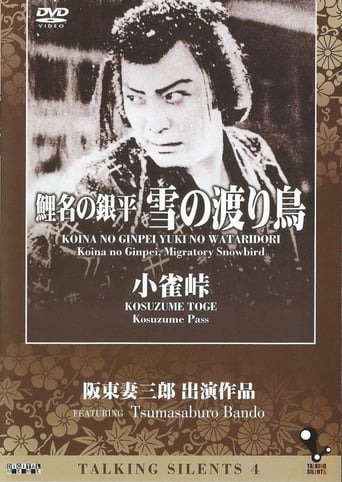
Shoko Ichikawa
Actor
- Active
- 1923-1923
Films 1
About Shoko Ichikawa
Shoko Ichikawa is a very obscure Japanese screen performer from the silent-film era, best documented for appearing in the 1923 film Kosuzume Pass. Surviving public records available in widely indexed film references are extremely limited, and little biographical detail has been preserved about her early life, training, or later career. She appears to have worked during a brief window in the Japanese cinema of the early 1920s, a period when many performers moved between stage and screen and when film documentation was often incomplete or lost. Because of the scarcity of surviving archival material, it is not currently possible to reconstruct a full career arc with confidence beyond her known screen credit. Her surviving filmography suggests she was part of the generation of performers active during Japan's silent era, when many films have since been lost and many credits survive only in fragmentary form. No reliable evidence has surfaced regarding her birth, death, family background, or later professional activities. As a result, Shoko Ichikawa remains a name of historical interest primarily to researchers of early Japanese cinema and lost-film era performers.
More about Shoko Ichikawa
In film history
Shoko Ichikawa's cultural significance lies less in a widely documented star persona and more in what her surviving credit represents: the vast, under-recorded workforce of early Japanese silent cinema. Performers like Ichikawa helped populate the national film culture of the 1920s, an era in which many productions are now lost and many artists are only faintly visible through scattered credits. Her presence in the historical record underscores how much of early Japanese screen history depends on partial documentation, period trade references, and surviving filmographies. For researchers, she is an example of the many actors whose contributions shaped the era even when their individual biographies were not preserved.
Later reputation
Shoko Ichikawa's legacy is archival and historical rather than celebrity-driven. She belongs to the category of early Japanese film performers whose names survive in catalogs and databases even when detailed life records do not. Her documented participation in Kosuzume Pass makes her part of the broader preservation story of silent cinema, reminding modern audiences that film history is built not only from celebrated stars but also from many lesser-known contributors. In that sense, her name remains valuable to scholars tracing cast lists, production networks, and the social history of Japanese silent film.
Influence
There is no documented direct influence attributable to Shoko Ichikawa on later actors or filmmakers, and no evidence that she served as a widely recognized mentor or stylistic model. Her influence is best understood indirectly: by appearing in an early 1920s Japanese production, she contributed to the body of work that defined silent-era performance norms in Japan. Her surviving credit helps illustrate the collaborative nature of the period, in which many now-obscure performers participated in the development of screen acting conventions before sound cinema transformed the industry.
Off screen
No reliable, publicly verifiable information is currently available about Shoko Ichikawa's personal life. Her marriages, family background, education, and post-film career are not documented in the accessible standard references commonly used for classic cinema research. Because of the surviving record's fragility, it is safest to treat most personal details as unknown rather than infer them from name similarity or era conventions.
Credits
- Screen credit for the 1923 silent-era Japanese film Kosuzume Pass
- Representation of early 1920s Japanese cinema performers whose work survives only in fragmentary documentation
- Association with the silent-film period, when many Japanese productions and cast records were not fully preserved
Roles
- Performer in Kosuzume Pass (1923)
Films
- Kosuzume Pass (1923)
Notes
- She is chiefly identified through a single known film credit, Kosuzume Pass (1923).
- Her career falls entirely within the silent-film era.
- She is a good example of how many early Japanese screen actors are known only through partial archival records.
- No widely verified biography, birth record, or death record is readily available in standard reference sources.
- Her obscurity reflects the historical loss of many silent-era Japanese films and production records.
- She is sometimes encountered in film databases as a cast-name entry rather than as a fully documented biographical figure.
Questions
Who was Shoko Ichikawa?
Shoko Ichikawa was a Japanese actor from the silent-film era, best known from the 1923 film Kosuzume Pass. Very little biographical information has survived, so she is primarily known through her film credit rather than a well-documented personal history.
What films is Shoko Ichikawa best known for?
She is best known for Kosuzume Pass (1923), which is the principal surviving credit associated with her name. No other reliably verified screen appearances are currently documented in the available reference material.
When was Shoko Ichikawa born and when did she die?
Her birth and death dates are not currently verified in accessible classic-cinema reference sources. At present, both her birth date and death date must be treated as unknown.
What awards did Shoko Ichikawa win?
No awards or formal nominations are currently documented for Shoko Ichikawa. This is not unusual for many silent-era performers whose careers were only partially recorded.
What was Shoko Ichikawa's acting style?
Her specific acting style is not documented in surviving sources. Since she worked in the silent era, her performance would have relied on visual expressiveness and gesture, but any more precise description would be speculative.
What is Shoko Ichikawa's legacy in film history?
Her legacy is mainly historical and archival: she represents the many early Japanese performers whose names survive even when most biographical details have been lost. She is part of the preserved record of silent-era Japanese cinema and its incomplete but important history.