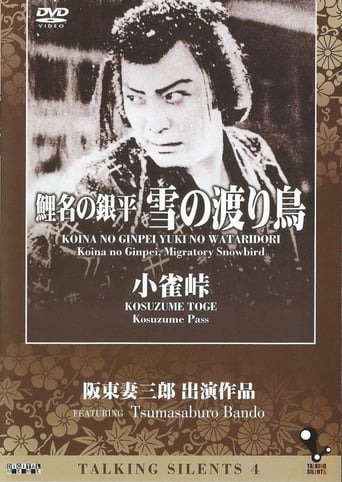
Hataya Ichikawa
Actor
- Active
- 1923-1923
Films 1
About Hataya Ichikawa
Hataya Ichikawa is a Japanese silent-era film actor whose surviving screen credit indicates activity in the early 1920s, including the 1923 film Kosuzume Pass. Beyond this documented appearance, readily verifiable biographical information about his life, training, and later career is extremely scarce, which is common for many performers from Japan's silent-film period whose records were never fully preserved. He appears to have worked during a formative era of Japanese cinema, when studios were rapidly developing genre films, period dramas, and star systems, and when many actors' careers were recorded only intermittently in surviving filmographies. Because available sources do not securely preserve his birth details, family background, or extended filmography, his significance is best understood through his presence in early 1920s Japanese screen history rather than through a large body of surviving credits. His known association with Kosuzume Pass places him among the early screen performers contributing to the silent film tradition in Japan. No reliable evidence currently confirms whether he continued acting beyond 1923, and no authoritative biographical record has yet established his later life or death. As a result, Hataya Ichikawa remains an obscure but historically relevant figure of the silent era, representing the many artists whose work formed the foundation of Japanese cinema even when their personal histories were not extensively documented.
More about Hataya Ichikawa
On screen
No detailed contemporary critical descriptions of Hataya Ichikawa's acting style have survived in readily verifiable sources. As a silent-era performer, his screen work would have relied on physical expression, gesture, facial nuance, and stage-influenced presentation typical of the period. Any more specific characterization of his technique would be speculative without surviving reviews, production notes, or preserved film evidence.
In film history
Hataya Ichikawa's cultural importance lies less in an extensive celebrity profile than in what he represents: the large number of early Japanese film performers whose work helped establish the country's silent cinema tradition. His documented presence in a 1923 film places him within a crucial transitional moment when Japanese studios were refining narrative film language, period storytelling, and star-centered production. Even when an individual actor's biography has not survived, participation in early films contributes to the historical fabric of national cinema and to the study of how the industry developed its performance styles and casting practices. For researchers and databases, such names are valuable because they help reconstruct production networks, cast lists, and the broader ecology of silent-era filmmaking. In that sense, Ichikawa's legacy is archival and historical as much as performative.
Later reputation
Hataya Ichikawa's lasting legacy is the documentary trace of his involvement in early Japanese cinema, especially the silent-film era of the 1920s. He stands as one of many performers whose careers are only partially visible today, yet whose work contributed to the growth of film culture in Japan. For film historians, such figures are essential because they help illuminate the breadth of talent active during the industry's formative years, even when surviving records are incomplete. His name persists as part of the historical record attached to Kosuzume Pass, preserving a small but meaningful link to silent-era production history.
Influence
There is no documented evidence that Hataya Ichikawa directly mentored later actors or directors, or that he became a major public influence in the way larger stars did. His influence is therefore best understood indirectly: as part of the generation of performers whose work established performance norms for Japanese silent cinema. The cumulative effect of such actors shaped audience expectations, studio casting practices, and the aesthetic vocabulary of early screen acting in Japan.
Off screen
No reliable, verifiable information is currently available regarding Hataya Ichikawa's personal life, including his family background, marriages, children, or post-film career. Like many silent-era Japanese performers, he may have left little public documentation, or the relevant records may not have survived in accessible archives. Until primary-source documentation emerges, any claims about his private life would be speculative.
Credits
- Appeared in the 1923 silent film Kosuzume Pass
- Represents the early silent-era Japanese screen actors whose work survives primarily through partial filmographic records
- Contributed to Japanese cinema during a period of rapid studio growth and stylistic development in the early 1920s
Roles
- Role in Kosuzume Pass (1923) - specific character name not currently documented
Films
- Kosuzume Pass (1923)
Notes
- Hataya Ichikawa's surviving screen history is extremely limited, which is common for many silent-era Japanese performers.
- His known film credit, Kosuzume Pass, dates to 1923, placing him in the early Japanese silent-film era.
- No widely accessible record currently confirms his birth date or death date.
- Because records from early Japanese cinema are often incomplete, his name may appear only in filmographies rather than in extensive biographical profiles.
- He is an example of how many silent-era actors contributed to film history without becoming widely documented stars.
- His filmography may have been broader than currently verifiable, but only one credit is securely associated with him in the available data.
- He is primarily of interest to film historians, archivists, and database researchers seeking to reconstruct early Japanese cast lists.
Questions
Who was Hataya Ichikawa?
Hataya Ichikawa was a Japanese silent-era film actor known from surviving records for appearing in the 1923 film Kosuzume Pass. Very little biographical information has survived, so he is chiefly remembered as part of the early history of Japanese cinema rather than as a widely documented star.
What films is Hataya Ichikawa best known for?
He is best known for Kosuzume Pass (1923), the only securely documented screen credit currently associated with him in readily available sources. Additional films may have existed, but they are not well preserved in accessible records.
When was Hataya Ichikawa born and when did he die?
His birth date and death date are not currently available in reliable, publicly accessible sources. This lack of biographical data is common for many performers from the silent era, especially in early Japanese film history.
What awards did Hataya Ichikawa win?
No awards or formal honors are currently documented for Hataya Ichikawa. Surviving records focus mainly on his film credit rather than on later recognition or institutional awards.
What was Hataya Ichikawa's acting style?
There are no detailed critical descriptions of his personal acting style that survive in accessible sources. As a silent-film performer, his work would have depended on physical expression, facial communication, and the performance conventions of early Japanese cinema.
What is Hataya Ichikawa's legacy in film history?
His legacy is primarily historical and archival: he is one of the many early Japanese actors whose names help reconstruct the silent-film era. Even with limited surviving information, his documented presence in a 1923 film contributes to our understanding of the period's cast lists and production history.