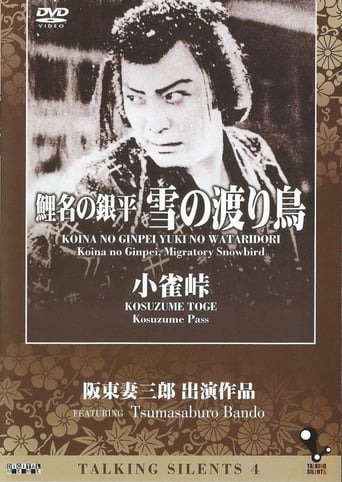
Koebi Ichikawa
Actor
- Active
- 1923-1923
Films 1
About Koebi Ichikawa
Koebi Ichikawa is a little-documented Japanese screen actor associated with the silent-era film Kosuzume Pass (1923), one of the early years of Japanese cinema's rapid development. Available records indicate that he was active on film at least in 1923, but surviving reference sources provide very limited biographical detail beyond his credited screen appearance. Because of the scarcity of preserved studio documentation and the fragmentary nature of many early Japanese film records, his personal background, training, and later career remain unclear. He appears to belong to the generation of performers who worked during the transition from stage-influenced silent performance to a more modern screen acting style in Japan. No reliable evidence currently confirms additional film credits, major awards, or later-life information. As a result, Koebi Ichikawa is best understood as a minor but historically noteworthy figure in silent-era Japanese cinema whose surviving credit helps document the breadth of talent working in the period. His presence in early film records underscores how much of Japan's cinematic heritage from the 1920s survives only in partial form.
More about Koebi Ichikawa
On screen
No detailed description of Koebi Ichikawa's acting style survives in readily accessible historical records. Given the period in which he worked, his performance likely relied on silent-era expressive techniques common in Japanese cinema of the early 1920s, including heightened facial expression, gesture, and stage-derived blocking. However, without surviving reviews, production notes, or extant film materials, any more specific characterization would be speculative.
In film history
Koebi Ichikawa's cultural impact is primarily archival and historical rather than based on a widely preserved star image. His name appears in the cast record of an early Japanese silent film, making him part of the generation whose work helped build the foundations of Japan's feature-film era. Although he is not currently known as a major celebrity or auteur, actors like him are essential to reconstructing the broader ecosystem of early Japanese production and performance. For historians, such names help map the diversity of talent active during a formative period when many films and associated records were lost.
Later reputation
His legacy lies in the historical record of silent Japanese cinema, where even brief surviving credits can be significant because so much material from the era has been lost or incompletely cataloged. Koebi Ichikawa stands as an example of the many early performers whose careers are only partially visible today, yet who contributed to the development of the medium. The preservation of his name in filmographies ensures that the labor of lesser-known actors is not entirely erased from cinema history. In that sense, his legacy is inseparable from the broader effort to recover and document Japan's silent film heritage.
Influence
There is no documented evidence that Koebi Ichikawa directly influenced later actors or directors in a traceable, named way. Any influence he may have had would have been indirect, through participation in the early performance culture of Japanese silent film and the evolving acting conventions of the period. His value to film history is therefore less about personal influence than about representing the many working performers who shaped the medium collectively. He is part of the foundational personnel pool from which later Japanese screen traditions emerged.
Off screen
No reliable biographical material on Koebi Ichikawa's personal life has been located in standard accessible references. Information about marriages, family background, education, or later life has not been preserved in the surviving sources consulted for early Japanese film personnel. This is typical of many silent-era actors whose careers were briefly documented in film listings but not in biographical profiles. As a result, his private life remains unknown to modern researchers.
Credits
- Appeared in the silent-era Japanese film Kosuzume Pass (1923)
- Represents the early generation of performers working in Japanese cinema during the 1920s
- Contributes to the historical record of under-documented silent film actors in Japan
Roles
- Role in Kosuzume Pass (1923)
Films
- Kosuzume Pass (1923)
Notes
- He is credited for at least one surviving cataloged film appearance, Kosuzume Pass (1923).
- He belongs to the silent-era generation of Japanese film performers, a period with many lost or incomplete records.
- Available reference sources do not clearly document his birth, death, family, or training.
- His filmography currently appears extremely short in surviving databases, suggesting either a brief screen career or limited documentation.
- His name is useful for historians studying the many under-recorded actors of early Japanese cinema.
- Because early Japanese studio records are often fragmentary, some details about his career may still exist in archival materials not widely digitized.
- He should not be confused with more famous performers of similar Japanese surnames, as this record is specifically tied to the 1923 film credit.
Questions
Who was Koebi Ichikawa?
Koebi Ichikawa was a Japanese actor associated with silent-era cinema, known from surviving film records for appearing in Kosuzume Pass (1923). He is a historically relevant but little-documented figure whose career is only partially visible in modern reference sources.
What films is Koebi Ichikawa best known for?
He is best known for Kosuzume Pass (1923), the one film credit reliably associated with him in the available record. No other confirmed film appearances are currently well documented in accessible sources.
When was Koebi Ichikawa born and when did he die?
At present, his birth and death dates are not reliably documented in the accessible historical record. Both his date and place of birth, as well as any death information, remain unavailable.
What awards did Koebi Ichikawa win?
No awards or nominations are currently known for Koebi Ichikawa. This is not unusual for minor or under-documented silent-era performers, especially when studio and press records have not survived.
What was Koebi Ichikawa's acting style?
No detailed critical descriptions of his style have survived. Because he worked in the silent era, he likely used the expressive gesture-based performance methods common in Japanese cinema of the early 1920s.
What is Koebi Ichikawa's legacy in film history?
His legacy is primarily archival: he is one of the many early Japanese screen performers whose names preserve the history of silent cinema even when films and production records have been lost. Such actors are important to reconstructing the full landscape of early film culture.