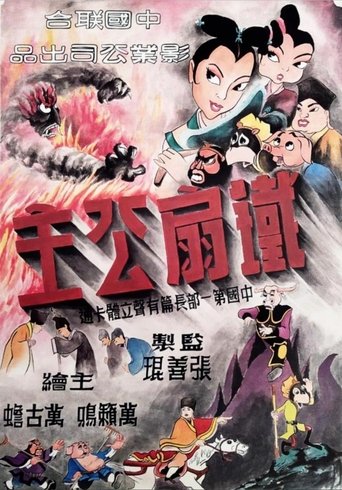
Films
1 film
About Guanxiang Liu
Chinese actor who worked during the early era of Chinese cinema, specifically known for his involvement in the 1941 animated feature 'Princess Iron Fan.' As a performer during one of China's most tumultuous periods, Liu contributed to the film industry during the Japanese occupation of Shanghai, when Chinese filmmakers faced immense challenges and restrictions. His participation in 'Princess Iron Fan' placed him at the forefront of Chinese animation history, as this was the first full-length animated feature produced in China. The film itself was a remarkable achievement, created under difficult circumstances by the Wan brothers and their team at the Xinming Film Company. Liu's career appears to have been brief, with records primarily showing his work in 1941, though this may reflect the scarcity of surviving documentation from this era rather than the full scope of his professional activities. Like many artists of his generation, his story represents the resilience and creativity of Chinese cultural workers during wartime, when cinema served both as entertainment and as a subtle form of cultural resistance.
The Craft
Milestones
- Voice acting in China's first animated feature film 'Princess Iron Fan' (1941)
- Contributed to wartime Chinese cinema during Japanese occupation
Best Known For
Iconic Roles
Must-See Films
Working Relationships
Worked Often With
Studios
Why They Matter
Impact on Culture
Guanxiang Liu's contribution to 'Princess Iron Fan' places him within the foundational history of Chinese animation. As one of the voice actors in China's first animated feature film, he participated in a landmark achievement that demonstrated Chinese cultural resilience during wartime. The film itself was significant not only for its technical innovation but also for its use of the classic story 'Journey to the West' to subtly convey themes of Chinese unity and resistance against foreign invasion. Liu's work, along with that of the entire production team, helped establish a tradition of animated storytelling in China that would influence generations of animators and filmmakers.
Lasting Legacy
Guanxiang Liu's legacy is tied to his role in Chinese animation through 'Princess Iron Fan.' While detailed records of his career are limited, his participation in this historic film ensures his place in the annals of Chinese cinema history. The film itself remains a significant cultural artifact, studied by film historians as an example of how Chinese artists used traditional stories to maintain cultural identity during periods of foreign occupation. Liu's contribution, though perhaps small in scope, represents the collaborative spirit of early Chinese filmmakers who worked under extremely difficult conditions to create art that would endure.
Who They Inspired
As an early voice actor in Chinese animation, Guanxiang Liu was part of the foundational generation that established voice acting as an essential component of animated filmmaking in China. His work on 'Princess Iron Fan' helped demonstrate that animation could be a serious medium for storytelling in Chinese cinema, paving the way for future generations of voice actors and animators. The techniques and approaches developed during this early period, including the integration of voice performance with animation, would influence Chinese animation for decades to come.
Off Screen
Very little is known about Guanxiang Liu's personal life, which is common for many supporting actors and voice artists from early Chinese cinema. The scarcity of personal details reflects both the limited documentation of the era and the challenging circumstances under which Chinese filmmakers worked during the 1940s war period.
Did You Know?
- 'Princess Iron Fan' was China's first animated feature film, released 16 years before Disney's 'Snow White and the Seven Dwarfs' reached Chinese audiences
- The film was created under Japanese occupation, making its production an act of cultural resistance
- The entire animation team for 'Princess Iron Fan' consisted of just 23 people working for 16 months
- The film was based on a chapter from the classic Chinese novel 'Journey to the West'
- Despite being made during wartime, the film was exported to other Asian countries, including Japan
- The Wan brothers used rotoscoping techniques, filming live actors first and then tracing over their movements
- The film's success led to a sequel, 'Havoc in Heaven,' though Liu's involvement in subsequent films is not documented
- Original prints of 'Princess Iron Fan' were believed lost for decades until copies were rediscovered in archives
Frequently Asked Questions
Who was Guanxiang Liu?
Chinese with credits in this catalog. He was one of the voice actors who helped bring this groundbreaking animation to life during a difficult period in Chinese history.
What films is Guanxiang Liu best known for?
Titles linked here include Princess Iron Fan (1941).
When was Guanxiang Liu born and when did he die?
Unfortunately, specific birth and death dates for Guanxiang Liu are not available in historical records, which is common for many supporting actors from early Chinese cinema, especially from the wartime period when many documents were lost or destroyed.
What awards did Guanxiang Liu win?
There are no documented awards or nominations for Guanxiang Liu, which reflects both the limited scope of formal recognition systems in Chinese cinema during the 1940s and the scarcity of surviving records about his career.
What was Guanxiang Liu's acting style?
Specific details about Guanxiang Liu's acting style are not documented in available sources. As a voice actor in early Chinese animation, he would have been part of voice performance techniques in a medium that was still developing in China at the time.
What was the significance of 'Princess Iron Fan'?
'Princess Iron Fan' was historically significant as China's first animated feature film, created during Japanese occupation as an act of cultural resistance. It demonstrated Chinese technical and artistic capabilities in animation and used traditional stories to maintain cultural identity during wartime.