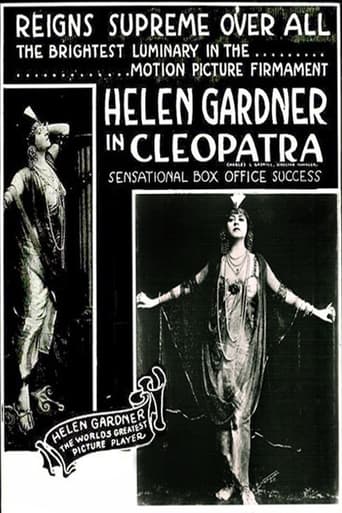
Films
1 film
About Charles L. Gaskill
Early American film director who worked during the years of cinema. His most notable and perhaps only directorial credit was the 1912 silent film 'Cleopatra,' which was produced during a period when the film industry was still establishing its artistic and technical foundations. Gaskill emerged as part of the first generation of filmmakers who helped shape the language of cinema during the transition from short novelty films to feature-length narratives. His work on 'Cleopatra' demonstrated the early ambitions of American filmmakers to tackle epic historical subjects, predating the more famous 1917 version starring Theda Bara. Unfortunately, like many early cinema pioneers, much of Gaskill's career details have been lost to time, with his directorial work appearing to be concentrated primarily in the year 1912. His contribution, though brief, represents an important chapter in the evolution of American silent cinema and the early attempts to bring classical literature to the silver screen.
The Craft
Behind the Camera
Early silent era directorial approach focused on theatrical staging and visual storytelling typical of the period
Milestones
- Directed 'Cleopatra' (1912)
- Early pioneer in adapting classical literature to film
Best Known For
Must-See Films
Why They Matter
Impact on Culture
Charles L. Gaskill's work on the 1912 'Cleopatra' represents an early attempt by American cinema to tackle epic historical subjects, predating the more famous adaptations that would follow. His contribution, though brief, is part of the foundation upon which Hollywood's historical epics would be built. The 1912 version of Cleopatra that he directed helped establish the precedent for bringing classical antiquity to American audiences through the emerging medium of film, a trend that would become increasingly popular throughout the silent era and beyond.
Lasting Legacy
While Charles L. Gaskill may not be as well-remembered as some of his contemporaries, his work as an early film director represents the experimental and spirit of the 1910s cinema. His 'Cleopatra' (1912) stands as an example of the early ambitions of American filmmakers to create sophisticated narrative films based on literary and historical sources. Gaskill's career, though seemingly brief, is representative of many early directors who helped establish the basic techniques and approaches that would evolve into the classical Hollywood style.
Who They Inspired
As an early pioneer, Gaskill's work would have contributed to the developing language of cinema during a crucial formative period. His approach to directing historical material in 1912 would have been part of the collective learning process that influenced subsequent filmmakers who tackled similar subjects, including the directors of later Cleopatra adaptations.
Off Screen
Very little is documented about Charles L. Gaskill's personal life, which was common for many early film industry pioneers whose records were not as meticulously preserved as later Hollywood figures.
Did You Know?
- The 1912 'Cleopatra' directed by Gaskill predates the more famous 1917 version starring Theda Bara by five years
- Gaskill's active period appears to be concentrated entirely in the year 1912, suggesting either a very brief career or incomplete historical records
- His 'Cleopatra' was part of the early wave of films adapting classical literature for the silver screen
- The film was produced during a period when American cinema was transitioning from one-reel shorts to longer feature films
- Like many early silent films, Gaskill's 'Cleopatra' is likely lost, as was common with films from this era
- The choice to direct Cleopatra in 1912 demonstrated early American cinema's ambition to compete with European historical epics
Frequently Asked Questions
Who was Charles L. Gaskill?
Early American on YTB.my.' He was part of the first generation of filmmakers who helped establish cinema as a narrative art form in the United States.
What films is Charles L. Gaskill best known for?
Titles linked here include Cleopatra (1912).
When was Charles L. Gaskill active in filmmaking?
Charles L. Gaskill was active as a director in 1912, with his career appearing to be concentrated in this single year. This was during the period of American cinema when the industry was still establishing its foundations.
What was significant about Gaskill's 'Cleopatra' (1912)?
Gaskill's 'Cleopatra' was significant as an early American attempt to adapt classical literature to film, predating more famous versions by several years. It represented the growing ambitions of American filmmakers to tackle epic historical subjects.
Why is so little known about Charles L. Gaskill?
Limited information about Charles L. Gaskill is common for many early cinema pioneers, as record-keeping in the film industry was not as systematic during the 1910s. Many films and records from this period have been lost, making comprehensive documentation of early filmmakers challenging.