Sid Griffiths
Actor
- Active
- 1903-1903
Films 1
About Sid Griffiths
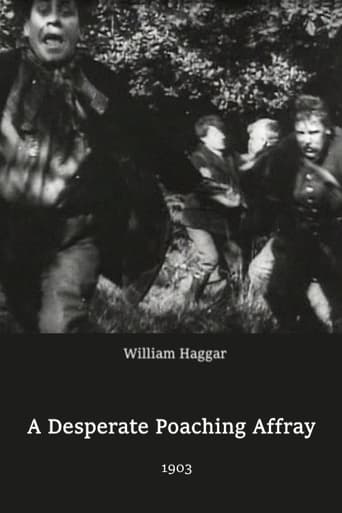
Sid Griffiths is a very obscure early British film performer credited in the surviving record for appearing in Desperate Poaching Affray (1903), one of the landmark chase films associated with the earliest years of narrative cinema. Beyond that single on-screen credit, reliable biographical documentation about him is extremely limited, and he appears to belong to the category of short-lived or poorly documented performers whose names survive mainly through production records and filmographies rather than extensive studio publicity. He should not be confused with later or similarly named individuals, as the available evidence places his screen activity in the formative period of motion pictures rather than the feature-film era. Because of the scarcity of contemporary trade-paper coverage and surviving personal records, details such as his birth, death, education, family life, and broader acting career are not currently verifiable from standard reference sources. His significance lies less in a long documented career than in his participation in one of the foundational examples of early screen storytelling and action editing. As with many pioneers of the silent era, his legacy is tied to the fragility of early film history, where many contributors remain partially anonymous despite having taken part in cinema's first experiments.
More about Sid Griffiths
On screen
No detailed description of Sid Griffiths's acting style survives in the available historical record. Given the period and the type of film in which he appeared, his performance would likely have relied on broad, legible physical expression, clear gesture, and exaggerated movement suitable for the silent screen and the chase-film format. Early 1900s actors often performed in a theatrical manner because films were short, static, and dependent on immediate visual readability, and Griffiths likely worked within that tradition. However, any more specific assessment would be speculative because no surviving reviews or performance analyses have been located for him.
In film history
Sid Griffiths's cultural impact is best understood in the context of cinema's formative years rather than as the result of a large body of individually documented work. His participation in Desperate Poaching Affray places him within one of the early screen traditions that demonstrated how motion pictures could convey pursuit, movement, and comic or dramatic tension across multiple shots. Films like this helped advance editing, location shooting, and the chase structure that would become central to popular cinema, making even unheralded participants part of a larger historical breakthrough. Although Griffiths himself is not a widely recognized name, his surviving credit contributes to the documentary record of how early British filmmaking developed its cast of performers and visual storytellers.
Later reputation
Sid Griffiths's legacy is that of an early, largely unrecorded actor whose name persists because film historians and databases preserve the credits of cinema's beginnings. He is part of the foundational layer of screen history, when many contributors worked in brief productions that were rarely promoted with the kind of individual star branding that came later. His existence in the record reminds researchers that the silent era was built not only by famous directors and stars, but also by lesser-known players whose performances supported experimental storytelling and technical innovation. For historians of early film, his credit is valuable as evidence of the people who populated the first decades of motion-picture production and helped shape the medium before celebrity culture fully developed.
Influence
There is no evidence that Sid Griffiths directly influenced major later actors or directors in a documented, identifiable way. His influence is therefore indirect and historical: by participating in early cinematic production, he contributed to the body of work from which later performers and filmmakers learned the possibilities of screen acting. The broader influence comes from the film itself and the era it represents, since early chase pictures established rhythms and visual strategies that later filmmakers refined. In that sense, Griffiths belongs to the generation whose collective work influenced the language of cinema even when individual names were not widely remembered.
Off screen
No dependable biographical information about Sid Griffiths's personal life has been located in standard classic-cinema references. There is no verified record here of marriages, children, residences, or family background, and any attempt to supply such details would be speculative. Like many performers from the very earliest years of film, he appears in the historical record primarily through a cast credit rather than through surviving memoirs, interviews, or studio biographies. His life outside the single known film credit remains undocumented in the sources available for this database entry.
Credits
- Appeared in Desperate Poaching Affray (1903), an early chase film of major historical importance in the development of cinematic action and narrative pacing
- Represents one of the many performers whose participation helped establish the grammar of early silent cinema in Britain
- His credit survives in film historical references despite the limited preservation of personal details from the period
- Connected to the earliest surviving phase of screen performance, when film acting was still adapting from stage conventions to camera-based storytelling
Roles
- Unnamed role in Desperate Poaching Affray (1903)
Films
- Desperate Poaching Affray (1903)
Notes
- Sid Griffiths is known from a very small surviving paper trail, which is typical for many performers from the first years of cinema.
- His only clearly documented screen appearance in the supplied filmography is Desperate Poaching Affray (1903).
- Desperate Poaching Affray is historically important as an early example of the chase film, a genre that would become a staple of silent cinema.
- Because he worked in 1903, Griffiths belongs to the era before feature-length films and before the full rise of the Hollywood studio star system.
- No verified information has been found here about his birth, death, family, or broader career, making him one of the many elusive early film figures.
- His surviving credit helps historians reconstruct cast lists for films that may otherwise be remembered mainly for their technical or historical significance.
- Early British film performers like Griffiths often went uncredited in contemporary publicity, which is one reason so many details about them are lost.
- He is not to be confused with later personalities who may share a similar surname or nickname.
Questions
Who was Sid Griffiths?
Sid Griffiths was an early British film actor known from the surviving record for appearing in Desperate Poaching Affray (1903). He is one of many obscure silent-era performers whose names are preserved mainly through historical film credits rather than extensive biographical documentation.
What films is Sid Griffiths best known for?
He is best known for Desperate Poaching Affray (1903), the film in which his name survives in the cast record. No other verified screen credits are currently available from the information provided.
When was Sid Griffiths born and when did he die?
His birth and death dates are not currently verifiable from the available classic-cinema record. As a result, both his birth date and death date remain unknown in this entry.
What awards did Sid Griffiths win?
No awards or formal honors are documented for Sid Griffiths in the available historical record. This is not unusual for early film performers, especially those whose work predates the modern awards culture of later cinema.
What was Sid Griffiths's acting style?
No direct critical description of his style survives, but as an early silent-era performer he would likely have used expressive physical gesture and broad visual clarity. That approach was typical of films from the early 1900s, when acting had to read instantly on screen without spoken dialogue.
What is Sid Griffiths's legacy in film history?
His legacy is tied to the earliest years of screen performance and to the preservation of cinema's origins. Even though little is known about his personal life, his credit helps document the cast of one of the formative films of the chase genre and the early evolution of motion-picture storytelling.