
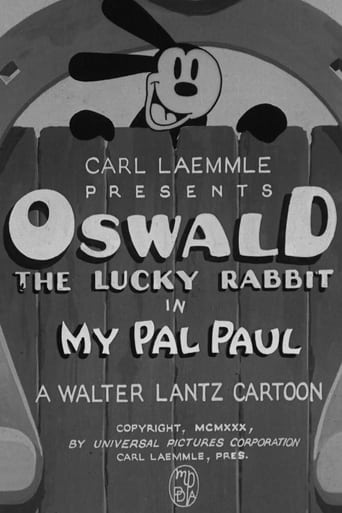
Africa
"Oswald is riding on a camel."
Keys: Space play/pause · ←/→ 10s · F fullscreen · M mute · </> speed
About this film
Oswald is riding on a camel; he defeats an attacking lion, using the camel's humps as cannonballs. In Cairo, he meets a queen and sings her his theme song; the sphinx and a couple pyramids join in, but the king isn't as happy.
Cast & crew
More films like this
More Animation films
View all →


More from William Nolan
View all →
More about this film
About the production
Release dateDecember 1, 1930
BudgetApproximately $5,000 - $10,000 (Estimated for early 1930s Universal shorts)
ProductionUniversal Cartoon Studios, Walter Lantz Productions
Filmed inUniversal Studios, Universal City, California (Animation Studio)
This short was produced during the transitional 'Lantz Era' of Oswald the Lucky Rabbit after Universal took the character back from Charles Mintz. It was one of the earliest Oswald shorts to feature fully synchronized dialogue and a dedicated musical score. The production utilized a 'rubber hose' animation style, which allowed for the surreal physical gags like the camel's humps being used as projectiles. The film is notable for being the 31st short produced by Walter Lantz and the 84th overall in the Oswald series.
Themes
Adventure and ExplorationMusical JoyResourcefulnessJealousy and Consequences
Themes & topics
Oswald the Lucky RabbitEgyptMechanical CamelLion FightSinging SphinxPharaohOasisCrocodiles
Historical background
Exhibitors around 1930 slotted Africa into mixed bills where shorts, newsreels, and features shared the same program.
Why this film matters
Historians treat Africa as evidence of what typical 1930 audiences could see in a program slot.
Making of
The production was led by Walter Lantz and Bill Nolan, who had recently taken over the character from Walt Disney's former distributor. Bill Nolan was known for his 'rubber hose' style, which is evident in the fluid, boneless movements of the characters in 'Africa'. The studio was under pressure to compete with Disney's 'Mickey Mouse' and 'Silly Symphonies', leading to a heavy emphasis on musical numbers and synchronized sound. Pinto Colvig not only provided the voice but also contributed to the gags and story development during this period.
What critics said
Specialist critics today emphasize preservation when a viewable copy of Africa survives.
Did you know?
- This film marks the very first time Oswald the Lucky Rabbit's famous theme song is heard on screen.
- Pinto Colvig, the voice of Oswald in this short, would later become famous as the original voice of Disney's Goofy.
- The animation team included a young Tex Avery, who would later revolutionize the industry at Warner Bros. and MGM.
- Some animation sequences were reused or inspired by the 1930 musical 'King of Jazz', which featured a similar African segment.
- The mechanical camel's internal pistons are a surreal visual gag typical of the Bill Nolan era of animation.
- The lyrics to the theme song encourage children to 'read and write' and 'not be scrappy' to be lucky.
- The short features a rare appearance of a 'Queen' character as a romantic interest for Oswald, predating his more consistent pairing with Ortensia.
- The film was released exactly one year before the character began wearing his iconic white gloves in 'Shipwreck' (1931).
Visual style
The film uses high-contrast black-and-white animation with a focus on 'squash and stretch' techniques. The 'camera' movements are simulated through background panning, particularly during the desert trek sequence. The visual style is characterized by Bill Nolan's signature 'circular' character designs and fluid, rhythmic motion.
Innovations
The film is a prime example of early 'Mickey Mousing', where the music and sound effects are perfectly timed to the visual action. It also successfully integrated a full vocal performance into a character that had been primarily silent during the Disney years. The use of mechanical-themed gags (the camel) showed an increasing sophistication in visual storytelling.
Music
The soundtrack features the original song 'Oswald the Lucky Rabbit', composed by James Dietrich with lyrics by Bernie Grossman. The score is heavily rhythmic, synchronized to the characters' movements (Mickey Mousing). The music was performed by a studio orchestra and features a mix of jazz-influenced melodies and Egyptian-themed motifs.
Famous quotes
Who me? Lucky Rabbit! That lucky Oswald Rabbit! Nicest rabbit that you ever knew!
Lucky habit, that lucky Oswald habit, if you want it, here's what you must do...
Tell me, sweetie, will you be my king?
Memorable scenes
- The opening sequence where Oswald pedals his mechanical camel across the desert sands.
- The battle with the lion where Oswald uses the camel's humps as cannonballs.
- The musical finale where the Sphinx and the Pyramids come to life to dance to Oswald's theme song.
What audiences thought
Audiences in 1930 responded positively to the high-energy slapstick and the novelty of a singing cartoon rabbit. The 'Oswald Habit' song became a recognizable jingle for children of the era. Today, the film is a favorite among animation collectors and historians for its fluid animation and historical 'firsts'.
Film connections
Influenced by
- The King of Jazz (1930)
- Vaudeville musical acts
- Early Mickey Mouse shorts like 'The Opry House'
This film influenced
- Alaska (1930) - which reused the theme song
- Later Walter Lantz 'Cartune' series
- Tex Avery's later surrealist works at Warner Bros.
Film restoration
The film is preserved and has been fully restored. It was included as a bonus feature on the Criterion Collection release of 'King of Jazz' (1930).
Where to watch
- Criterion Collection: King of Jazz (Blu-ray/DVD)
- Public Domain archives (YouTube/Internet Archive)
- The Walter Lantz Cartune Encyclopedia (Digital Archives)