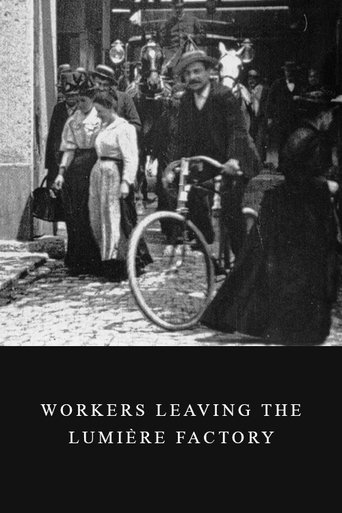
Bicyclist
"Doublier does bicycle tricks."
Keys: Space play/pause · ←/→ 10s · F fullscreen · M mute · </> speed
About this film
Francis Doublier does bicycle tricks in the street.
Cast & crew
More films like this
More Documentary films
View all →
More from Louis Lumière
View all →


More about this film
About the production
Release date1896
Box officeUnknown (early films were not commercially tracked in modern terms)
ProductionLumière Company
Filmed inLyon, France
Filmed using the Lumière Cinématographe, which served as both camera and projector. Francis Doublier was not a professional performer but rather a Lumière factory employee who demonstrated his natural cycling abilities for the camera. The film was shot in a single take on a street near the Lumière factory in Lyon, utilizing natural daylight as was common for early Lumière productions.
Themes
Technological progressHuman skill and achievementModern transportationEveryday life documentationMotion and movement
Themes & topics
Historical background
Production circa 1896 placed Bicyclist within the technical habits of its era—intertitles, studio sets, and regional distribution networks.
Why this film matters
Reference works on 1896 cinema cite Bicyclist when tracing genre habits and studio economics.
Making of
The making of 'Bicyclist' represents the informal, experimental nature of early cinema production. Louis Lumière likely set up his Cinématographe on a tripod outside the factory grounds and simply asked Doublier, who was known for his cycling skills, to perform for the camera. There was no script, no special lighting, and no retakes - if the shot didn't work, they would simply develop the film and try again another day. The production exemplifies the Lumière philosophy of capturing actualité (reality) rather than staging elaborate scenes. Doublier's natural performance, unburdened by acting experience, gives the film its authentic charm. The entire process from setup to filming probably took less than an hour, typical of the efficient production methods that allowed the Lumière company to produce hundreds of films in just a few years.
What critics said
Specialist writers today emphasize preservation and access when a viewable copy of Bicyclist survives.
Did you know?
- Francis Doublier was actually a mechanic at the Lumière factory who happened to be an accomplished cyclist
- This film is one of the earliest examples of sports documentation in cinema history
- The bicycle shown was likely a 'penny-farthing' or early safety bicycle, representing cutting-edge technology of the 1890s
- Like most Lumière films, it was originally shown as part of a program of 10-12 short films
- The film was shot on 35mm film at approximately 16 frames per second
- Doublier later became one of the Lumière company's most important cinematographers, filming around the world
- This film demonstrates the Lumière brothers' interest in capturing everyday activities and skills
- The static camera position was typical of early Lumière films, which often resembled theatrical proscenium views
- Bicycling was experiencing a massive boom in popularity in the 1890s, making this subject particularly relevant
- The film was hand-cranked during both filming and projection, meaning the exact speed could vary
Visual style
The cinematography represents the most basic approach of early Lumière films: a single static camera position, wide angle, capturing the action in its entirety. The framing is straightforward and functional, with the camera positioned to show Doublier and his bicycle clearly against the street background. Natural daylight illuminates the scene, creating high contrast typical of early film stocks. The composition follows theatrical conventions, with the performer centered in the frame as if on a stage. The stationary camera forces the viewer's attention to the subject's movement, making the cycling tricks the sole focus. This simplicity, while technically limited, creates a powerful sense of direct observation and authenticity.
Innovations
The film showcases the Lumière Cinématographe's ability to capture motion with remarkable clarity for its time. The single-take approach demonstrates early mastery of continuous filming. The film's preservation of complex human movement (bicycle tricks) was a significant technical achievement, proving that cinema could document rapid, coordinated actions. The use of natural lighting and static composition shows early understanding of exposure requirements. The film also represents an early example of capturing sports performance, establishing techniques that would evolve into modern sports cinematography.
Music
Silent film - no original soundtrack. During initial screenings, the film would have been accompanied by live piano music or orchestra, with the improvisational music typically matching the energetic movement on screen. Modern presentations often feature period-appropriate musical accompaniment.
Memorable scenes
- The entire film consists of one memorable scene: Francis Doublier expertly maneuvering his bicycle through various tricks and demonstrations, showcasing both his skill and the novelty of bicycle riding in the 1890s, all captured in a single, unbroken take that preserves the authentic performance for posterity.
What audiences thought
Original audiences in 1896 were reportedly fascinated by 'Bicyclist' and similar films, reacting with gasps and applause at the lifelike movement on screen. The novelty of seeing a familiar activity - cycling - reproduced with such realism was a source of wonder. The film was particularly popular with audiences who were themselves caught up in the cycling craze of the 1890s. Modern audiences viewing the film in retrospectives and archives appreciate it as a window into the past, marveling at both the historical content and the primitive yet effective filmmaking techniques. The film continues to be shown at film festivals and special screenings dedicated to early cinema.
Film connections
Influenced by
- Lumière brothers' philosophy of capturing reality
- Early photographic documentation
- Theatrical performance traditions
This film influenced
- Subsequent sports documentaries
- Early 20th century actuality films
- Modern cycling films and documentaries
Film restoration
Preserved - The film exists in the Lumière Institute archives and various film archives worldwide. It has been restored and digitized as part of efforts to preserve early cinema heritage. The film is considered part of the world's cinematic patrimony.
Where to watch
- Lumière Institute Museum in Lyon
- Various online archives specializing in early cinema
- Film history collections and educational platforms
- Special screenings at film museums and cinematheques
- Some public domain film websites