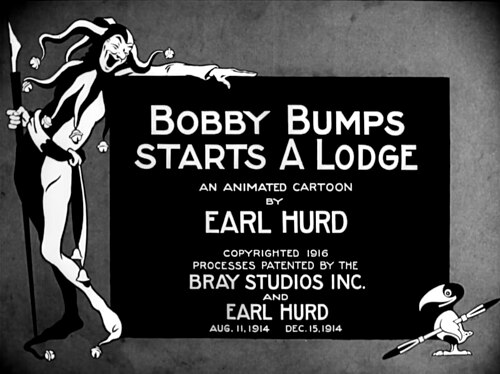
Bobby Bumps Adopts a Turtle
"No beloved spared"
Keys: Space play/pause · ←/→ 10s · F fullscreen · M mute · </> speed
About this film
A little boy and his beloved puppy find themselves in and out of mischief.
Cast & crew
More films like this

More Animation films
View all →


More from Earl Hurd
View all →
More about this film
About the production
Release dateNovember 1917
Box officeUnknown - box office tracking was not standardized for shorts in 1917
ProductionBray Productions, J.R. Bray Studios
Filmed inNew York, New York (Bray Studios)
Created using the cel animation technique pioneered by Earl Hurd and John Randolph Bray, which revolutionized the animation industry by allowing for more efficient production. The film was hand-drawn on paper and then transferred to celluloid sheets for coloring. This was part of the regular monthly Bobby Bumps series that was distributed to theaters nationwide.
Themes
Themes & topics
Historical background
Made in its country of production around 1917, Bobby Bumps Adopts a Turtle belongs to the silent era's formative years. Its story of a little boy and his beloved puppy find themselves in and out of mischief spoke to audiences of the day through familiar genres and topical settings.
Why this film matters
Archivists and historians still cite Bobby Bumps Adopts a Turtle when tracing how the silent era's formative years filmmakers staged little and beloved on screen.
Making of
Earl Hurd created the Bobby Bumps series while working at J.R. Bray Studios, the first dedicated animation studio in America. The production team was small, typically consisting of Hurd as the primary animator with one or two assistants. The cel animation process, which Hurd co-patented, involved drawing characters on transparent celluloid sheets and placing them over painted backgrounds, eliminating the need to redraw backgrounds for every frame. This innovation dramatically reduced production time from weeks to days. The voice of Bobby was not actually recorded in this silent era; instead, intertitles conveyed dialogue. The animation was shot on a modified rostrum camera built specifically for animation work.
What critics said
Reviews from 1917 weighed Bobby Bumps Adopts a Turtle on pacing, performance, and novelty. Later criticism reads its emphasis on little, beloved, puppy through modern standards of craft and representation.
Did you know?
- Bobby Bumps was one of the first recurring animated characters in film history, predating Felix the Cat by several years
- Director Earl Hurd co-patented the cel animation process in 1914, which became the industry standard for decades
- The Bobby Bumps series consisted of 15 shorts produced between 1915 and 1918
- was released during World War I, when animation was seen as a morale-boosting entertainment
- The puppy character, Fido, was based on Hurd's own family dog
- Original prints were hand-colored frame by frame, a laborious process that was later abandoned
- The series was distributed through Paramount Pictures as part of their weekly program offerings
- Bobby Bumps was one of the first child protagonists in animation history
- The turtle design was deliberately kept simple to ease the animation process
- This short was likely accompanied by live musical accompaniment in theaters, with specific cue sheets provided
Visual style
The film utilized black and white cinematography with occasional hand-tinted color elements. The animation was shot at 16 frames per second, standard for silent era films. The camera work was static, as was typical for early animation, with all movement created through the drawings themselves. The use of cels allowed for more complex layering of characters and backgrounds than earlier cutout animation techniques. The visual style featured clean lines, simplified character designs, and detailed backgrounds that created depth despite the technical limitations of the time.
Innovations
The primary technical achievement was the use of cel animation, which Earl Hurd co-patented with John Randolph Bray. This process involved drawing characters on transparent celluloid sheets, allowing animators to reuse backgrounds and create more fluid motion with less work. The film also demonstrated early attempts at character consistency and personality animation, moving beyond the mechanical movement of earlier cartoons. The production pipeline established at Bray Studios for this series became the model for future animation studios.
Music
As a silent film, no original soundtrack was recorded. Theaters would typically provide live musical accompaniment, either with a pianist, organist, or small orchestra. Distributors often provided cue sheets suggesting appropriate music for different scenes - typically upbeat, playful music for the comedy scenes and more dramatic themes for moments of tension. The music would have been drawn from popular songs of the era or classical pieces adapted for silent film accompaniment.
Famous quotes
(Intertitle) Bobby finds a new friend!
(Intertitle) Fido doesn't like turtles!
(Intertitle) What will Bobby do now?
Memorable scenes
- The opening scene where Bobby and his puppy first encounter the turtle in the grass, showcasing the character designs and establishing the outdoor setting
- The sequence where the puppy repeatedly tries to play with the turtle, only to have it retreat into its shell each time, creating a comedic rhythm
- The climax where Bobby attempts to teach the animals to get along, resulting in chaotic but harmless mayhem
What audiences thought
The Bobby Bumps series was popular with theater audiences of 1917, particularly children and families. The shorts were regularly booked as part of theater programs, indicating strong audience demand. The character of Bobby Bumps became recognizable to regular moviegoers of the era, making him one of the first animated stars with audience recognition. The combination of a relatable child protagonist, animal comedy, and simple moral lessons resonated with contemporary audiences seeking light entertainment during the difficult war years.
Film connections
Influenced by
- Earlier Winsor McCay animations like Gertie the Dinosaur
- Comic strips of the 1910s featuring child protagonists
- Vaudeville comedy routines
This film influenced
- Later Felix the Cat cartoons
- Disney's early Alice Comedies
- Paul Terry's Aesop's Fables series
Film restoration
The film survives in archives, with copies held at the Library of Congress and the UCLA Film & Television Archive. Some prints show deterioration typical of nitrate film from this era, though the basic content remains viewable. The film has been digitized as part of early animation preservation efforts.
Where to watch
- Available on various public domain animation compilation DVDs
- Can be viewed on YouTube through archive channels
- Included in some streaming services' classic animation collections
- Accessible through university film archives and library special collections