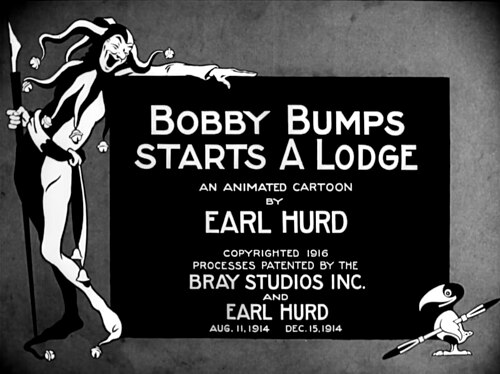
Bobby Bumps Gets a Substitute
"He astutely allows his pet dog to take over for him."
Keys: Space play/pause · ←/→ 10s · F fullscreen · M mute · </> speed
About this film
Restless young Bobby Bumps is forced by his dad to practice playing the piano. He astutely allows his pet dog to take over for him.
Cast & crew
More films like this

More Animation films
View all →



More from Earl Hurd
View all →
More about this film
About the production
Release dateOctober 1916
ProductionBray Productions, J.R. Bray Studios
Filmed inNew York, New York
Was created using Earl Hurd's patented cel animation technique, which he co-patented with J.R. Bray. The process involved drawing characters on transparent celluloid sheets and photographing them over static backgrounds, revolutionizing animation production efficiency. The Bobby Bumps series was one of the first successful recurring animated characters in American cinema, predating Felix the Cat by several years.
Themes
Childhood rebellionDeception and consequencesParent-child relationshipsCleverness vs. responsibilityHuman-animal relationships
Themes & topics
Historical background
Made in 1916, in United States, under Earl Hurd, Bobby Bumps Gets a Substitute belongs to animated short filmmaking amid the silent era's rapid stylistic experiments.
Why this film matters
Within animated short history, Earl Hurd's name attaches to the work; surviving prints help researchers study silent-era craft; 1916 animated short film directed by Earl Hurd.
Making of
The production of 'Bobby Bumps Gets a Substitute' exemplified the innovative techniques being developed at Bray Productions during the animation industry's formative years. Earl Hurd and his team would create each frame by hand-drawing the characters on celluloid sheets, then photographing them over painted backgrounds. The piano-playing sequence required particularly careful animation to convincingly show the dog's paws striking the keys in rhythm. Hurd was known for his attention to comedic timing, and he would often act out scenes himself before animating them to ensure the physical comedy translated well to the screen. The studio operated on an assembly-line system that was revolutionary for its time, with different artists handling different aspects of production from background painting to character animation.
What critics said
Contemporary reviews of Bobby Bumps Gets a Substitute are sparse in open sources; later catalog entries chiefly summarize plot and credits.
Did you know?
- Earl Hurd co-patented the cel animation process with J.R. Bray in 1914, which became the industry standard for decades
- The Bobby Bumps series consisted of 15 films produced between 1915 and 1917
- Bobby Bumps was one of the first animated characters with consistent personality traits across multiple films
- The series was notable for its use of intertitles with dialogue, making it one of the earliest animated series with spoken words
- Earl Hurd voiced the character of Bobby Bumps himself through the intertitles
- The dog character in this film was named Fido and appeared in several Bobby Bumps shorts
- Bray Productions was the first dedicated animation studio in the United States
- The film was distributed by Paramount Pictures as part of their weekly program
- Bobby Bumps was inspired by Hurd's own childhood experiences with piano lessons
- Short was considered technically advanced of the series due to its complex animation of both human and animal characters
Visual style
The cel animation technique developed by Hurd and Bray, which allowed for greater fluidity of movement and more complex compositions than earlier cut-out animation methods. The black and white cinematography featured careful attention to shading and cross-hatching to create depth and dimension. The animation of the piano-playing sequence required particularly sophisticated timing to synchronize the dog's movements with the implied musical rhythm.
Innovations
The film's primary technical achievement was its use of the patented cel animation process, which revolutionized the animation industry by allowing for more efficient production and smoother movement. The technique involved drawing characters on transparent celluloid sheets that could be layered over static backgrounds, eliminating the need to redraw entire scenes for each frame. This innovation also allowed for more complex compositions and greater depth in the animation.
Music
As a silent film, 'Bobby Bumps Gets a Substitute' would have been accompanied by live musical performance in theaters. Typical accompaniment might have included popular songs of the era, classical pieces, or improvisation by the theater's pianist or organist. The piano scenes would have been an opportunity for the accompanist to perform actual piano music, creating an interactive element between the on-screen action and the live performance.
Famous quotes
(Intertitle) 'I must practice piano lessons - oh dear!' - Bobby Bumps
(Intertitle) 'I know! I'll teach Fido to play!' - Bobby Bumps
(Intertitle) 'Father will never know the difference!' - Bobby Bumps
Memorable scenes
- The hilarious sequence where Bobby trains his dog Fido to play the piano by placing treats on the keys and encouraging the dog to paw at them, creating a cacophony that Bobby attempts to pass off as legitimate practice. The scene culminates with the father's discovery of the ruse when the dog begins enthusiastically chasing its tail on the piano bench instead of continuing the 'performance.'
What audiences thought
The Bobby Bumps films were popular with theater audiences of the 1910s, particularly children who related to the character's rebellious nature and clever schemes. The shorts were often used as audience-pleasing fillers between feature presentations. Audience response cards from the period indicate that the piano-playing dog sequence was particularly well-received and became remembered moments from the series.
Film connections
Influenced by
- Gertie the Dinosaur (1914)
- Little Nemo (1911)
- Winsor McCay's early animated works
This film influenced
- Felix the Cat series
- Mickey Mouse shorts
- Tom and Jerry cartoons
- Looney Tunes series
Film restoration
In archived form and has been preserved by the Library of Congress and the UCLA Film & Television Archive. Several prints have been restored and digitized as part of early animation preservation projects. The film is considered to be in good preservation condition for its age.
Where to watch
- Library of Congress National Screening Room
- UCLA Film & Television Archive
- YouTube (through official archive channels)
- Early animation compilation DVDs
- Museum of Modern Art film collection screenings