


Bride of the Monster
"the atom bomb explosions distorting the atmosphere"
Keys: Space play/pause · ←/→ 10s · F fullscreen · M mute · </> speed
About this film
In a stretch of woods, two hunters are caught in a thunderstorm. They decide to seek refuge in Willows House, supposedly abandoned and haunted. They find Willows House occupied, and the current owner, scientist Dr.
Cast & crew
More films like this
More Horror films
View all →
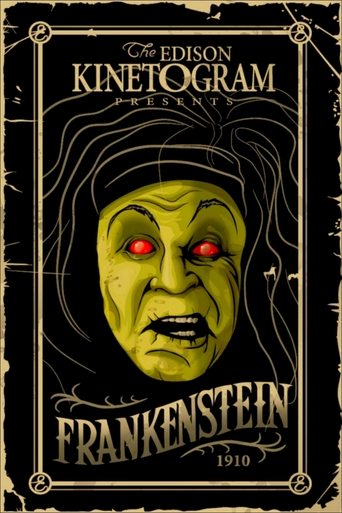

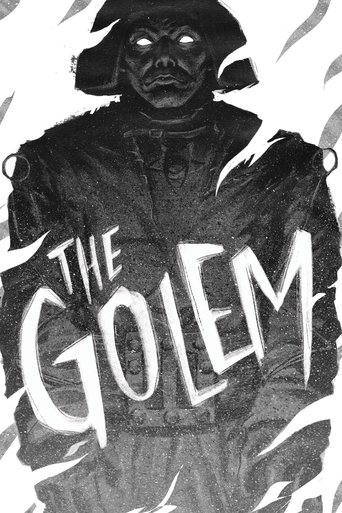
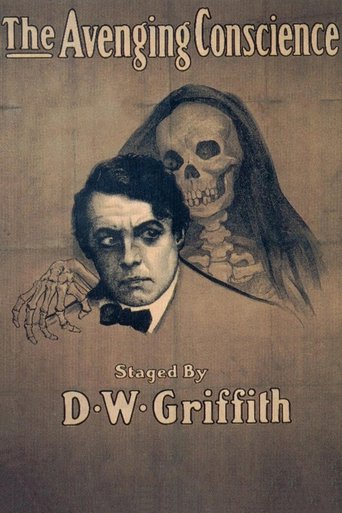

More from Edward D. Wood Jr.
View all →
More about this film
About the production
Release dateMay 11, 1955
Budget$67,000
Box officeUnknown - limited release
ProductionBanner Productions, Howco International
Filmed inLos Angeles, California, Griffith Park, Toluca Lake
Filmed in just six days on a minimal budget, the production was plagued by numerous problems including a malfunctioning octopus prop that had to be manually manipulated by crew members visible on camera. The film's budget was so tight that Bela Lugosi's cape was one he owned personally, and many props were borrowed or improvised. The infamous octopus was actually a prop from a previous film that no longer worked, forcing the actors to wrestle with it while making it appear to move. The laboratory set was built in a small studio space with limited lighting, contributing to the film's distinctive atmospheric quality.
Themes
Scientific hubris and the dangers of atomic energyThe corruption of scientific knowledge for personal gainNature versus technologyThe monster as victim of circumstanceThe outsider in society
Themes & topics
mad scientistatomic radiationmonster creationlaboratory experimentswamp settingreporter investigationgiant octopustransformationhorrorscience fictioncult classicB-movie
Historical background
Bride of the Monster (1955) emerged during postwar international cinema. In a stretch of woods, two hunters are caught in a thunderstorm. Archival records and catalog entries help place the work within film-history surveys of the period.
Why this film matters
Preserved under Wikidata ID Q367216, Bride of the Monster is valued as a screen drama within catalog and archive collections. Wikipedia's "Bride of the Monster" entry connect it to broader histories of cinema exhibition and restoration.
Making of
The making of 'Bride of the Monster' epitomized Edward D. Wood Jr.'s resourcefulness in the face of extreme budget constraints. Wood wrote the screenplay specifically for his idol Bela Lugosi, incorporating elements that played to Lugosi's strengths as a horror icon. The production was characterized by Wood's typical approach of using whatever resources were available - the octopus prop was non-functional, leading to the infamous scene where actors visibly struggle with the rubber tentacles. Tor Johnson's casting as Lobo was a stroke of serendipity; Wood discovered the Swedish wrestler at a wrestling match and immediately cast him, deciding to make the character mute to avoid Johnson's thick accent. The film's brief six-day shooting schedule required Wood to work efficiently, often completing scenes in single takes regardless of technical flaws. Despite the numerous production challenges, Wood maintained his characteristic enthusiasm, believing he was creating a serious horror film that would stand alongside the Universal monster classics.
What critics said
Trade and archival sources offer limited day-one review coverage for Bride of the Monster. Modern reception rests on its availability in collections, repertory screenings, and reference works that document 1955 cinema.
Did you know?
- This was Bela Lugosi's final speaking role before his death in 1956, though it was released after his penultimate film 'Plan 9 from Outer Space' which was filmed later but released earlier
- The giant octopus prop was stolen from the Republic Studios prop department and no longer worked, requiring two crew members to hide under the water and manually manipulate the tentacles during filming
- Tor Johnson, who played Lobo, was a Swedish professional wrestler who couldn't speak English well, which is why his character was mute
- The film was originally titled 'Bride of the Atom' but was changed to 'Bride of the Monster' to capitalize on the monster movie craze
- Edward D. Wood Jr. reportedly financed part of the film by convincing a local meat company to invest in exchange for product placement
- The police uniforms worn by Tony McCoy were authentic uniforms borrowed from the LAPD
- During the laboratory explosion scene, a real fire broke out on set, but Wood kept the cameras rolling to capture the authentic footage
- The film's distributor went bankrupt shortly after release, limiting its theatrical run
- Lugosi was addicted to methadone during filming due to his chronic pain, which affected his performance
- The film was part of a double feature with 'Phantom of the Rue Morgue' during its initial theatrical run
Awards & recognition
- Golden Turkey Award for Worst Director (Edward D. Wood Jr.) - 1980
- Golden Turkey Award for Worst Film (retrospective) - 1980
Visual style
The cinematography, handled by William C. Thompson, was characterized by dramatic low-angle shots and heavy use of shadow to create a gothic atmosphere despite the limited budget. Thompson employed numerous techniques to mask the film's budgetary constraints, including tight framing to hide inadequate set dressing and extensive use of fog machines to obscure details. The lighting was often harsh and inconsistent, creating unintentionally dramatic effects that have contributed to the film's cult status. The famous laboratory scenes feature dramatic backlighting that creates silhouettes of the characters, a technique that would become a Wood trademark. The underwater sequences were particularly challenging, with the crew using a combination of stock footage and poorly lit studio tanks, resulting in the famously murky octopus attack scenes.
Innovations
While not technically innovative in the traditional sense, 'Bride of the Monster' is notable for its creative problem-solving in the face of extreme budget constraints. The film's special effects, particularly the octopus attack sequence, have become for their visible artifice and the creative solutions employed to make them work. Wood's use of stock footage, particularly for the laboratory explosion, was an early example of cost-effective filmmaking that would become common in low-budget productions. The film also featured some early attempts at creating radiation effects using simple optical techniques, including colored filters and double exposures. The makeup effects, while primitive by modern standards, attempted to create transformation sequences that were ambitious for the budget level. The film's sound recording techniques, while flawed, demonstrated Wood's determination to capture dialogue despite challenging on-set conditions.
Music
The musical score was composed by Gerald Fried, who would later become known for his work on 'Star Trek' and other television series. The soundtrack featured dramatic, sweeping orchestral pieces that often felt mismatched with the on-screen action, contributing to the film's unintentional humor. Fried incorporated elements of classical horror motifs, using pipe organ sounds and dramatic string sections to create a gothic atmosphere. The music was recorded on a minimal budget, with Fried reportedly using a small ensemble and recording the entire score in a single session. Despite the limited resources, the score attempted to emulate the style of classic Universal horror films, with leitmotifs for different characters and situations. The sound effects were equally problematic, with many being poorly synchronized or obviously created in post-production.
Famous quotes
Home? I have no home. Hunted... despised... living like an animal. The jungle is my home. But I shall show the world that I can be its master.
I am a scientist! I have discovered the secret of life!
You fools! I will destroy you all!
The atom is a source of unlimited power. I will harness it for my own purposes.
One day, all the world will know the name of Dr. Eric Vornoff!
Memorable scenes
- The infamous octopus attack scene where two crew members are visible under the water manually manipulating the rubber tentacles while the actors struggle to make it appear menacing
- Dr. Vornoff's laboratory explosion sequence, which accidentally became a real fire that Wood kept filming
- The transformation scene where a victim is exposed to radiation with visible sparks and smoke effects
- Lobo's introduction, where Tor Johnson silently carries a victim through the swamp
- The final confrontation in the laboratory where Vornoff delivers his maniacal speech about atomic power
What audiences thought
Initial audience reception was lukewarm, with the film performing poorly during its limited theatrical run. Many contemporary viewers found the film unintentionally humorous, with audiences reportedly laughing during serious scenes. However, the film's reputation grew over time, particularly after its inclusion in 'The Golden Turkey Awards' and the release of 'Ed Wood' in 1994. Modern audiences often seek out the film specifically for its camp value, with midnight movie screenings becoming popular events. The film has developed a dedicated cult following, with fans appreciating its earnest attempt at serious horror despite its numerous technical flaws. Online film communities frequently cite it as a favorite example of 'so bad it's good' cinema, with many viewers hosting viewing parties to celebrate its unintentional humor.
Film connections
Influenced by
- Frankenstein (1931) - mad scientist theme
- The Beast from 20,000 Fathoms (1953) - atomic monster theme
- Dracula (1931) - Lugosi's horror persona
- The Wolf Man (1941) - transformation themes
- Godzilla (1954) - atomic monster concept
This film influenced
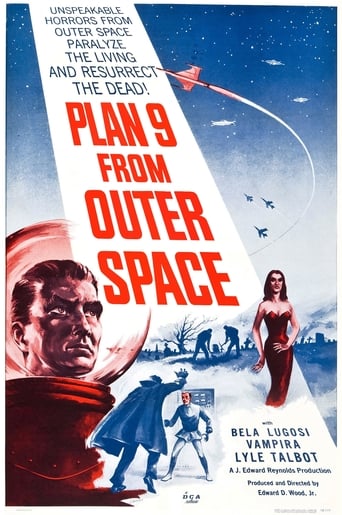
- Plan 9 from Outer Space (1959) - Wood's next film
- The Brain from Planet Arous (1957) - similar low-budget sci-fi horror
- The Giant Claw (1957) - similar monster movie approach
- Night of the Ghouls (1959) - Wood's spiritual sequel
Film restoration
The film has been preserved through various home video releases and digital restorations. While the original negatives have deteriorated over time, multiple 35mm prints exist in private collections and film archives. The film entered the public domain, which has actually helped its preservation through numerous releases by different companies. The Criterion Collection released a restored version as part of their 'Ed Wood' collection, featuring improved picture and sound quality. The Library of Congress maintains a copy in their motion picture collection, recognizing its cultural significance as an example of 1950s B-movie cinema. Digital restoration efforts have cleaned up much of the original film damage while preserving the distinctive low-budget aesthetic that makes the film notable.
Where to watch
- Available on Blu-ray from The Criterion Collection
- Streaming on Amazon Prime Video
- Available on DVD from various public domain distributors
- Can be rented or purchased on iTunes
- Available for free viewing on Internet Archive (public domain)
- Included in various Edward D. Wood Jr. box sets
- Occasionally airs on Turner Classic Movies
- Available on YouTube through official channels