
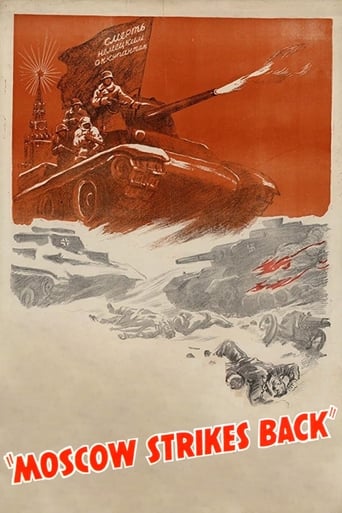
Collection of Films for the Armed Forces #5
"Blood on the segments"
Keys: Space play/pause · ←/→ 10s · F fullscreen · M mute · </> speed
About this film
Comprising two segments, "London Will Not Surrender!" and "Our Moscow", the film the air defense systems of London and Moscow.
Cast & crew
More films like this
More Documentary films
View all →


More about this film
About the production
Release dateNovember 1941
ProductionCentral Studio of Documentary Films (TsSDF), Soviet State Committee for Cinematography (Goskino)
Filmed inLondon, England, Moscow, Soviet Union
was the fifth installment in a series specifically produced for Soviet armed forces training and morale. Production was rushed to completion during the critical months of 1941 when both London and Moscow were under intense aerial bombardment. The filmmakers faced significant challenges obtaining authentic footage from London during the Blitz, requiring cooperation with British Ministry of Information. The Moscow segment was filmed under dangerous conditions as German air raids on the city intensified following Operation Barbarossa.
Themes
Allied unity against fascismUrban resilience during wartimeTechnological superiority in defenseCivilian-military cooperationInternational solidarity
Themes & topics
air defenseWorld War IIpropagandamilitary trainingLondon BlitzBattle of Moscowanti-aircraftcivilian defenseAllied cooperationurban warfarenight bombingobservation postsfighter commandair raid warnings
Historical background
Made in its country of production around 1941, Collection of Films for the Armed Forces #5 belongs to World War II-era screens. Its story of comprising two segments, "london will not surrender!" and "our moscow", the film the air defense systems of london and moscow spoke to audiences of the day through familiar genres and topical settings.
Why this film matters
Archivists and historians still cite Collection of Films for the Armed Forces #5 when tracing how World War II-era screens filmmakers staged comprising and segments on screen.
Making of
The production of this documentary during the height of World War II presented extraordinary challenges. Director Pera Atasheva had to coordinate with both Soviet and British authorities to obtain authentic footage of active air defense operations. The London segment required camera operators to work during actual air raids, often in dangerous conditions. In Moscow, filming continued as German bombers approached the city limits. Vladimir Yakhontov, primarily known as a dramatic actor, was brought in to provide authoritative narration for the military audience. The film was edited under strict censorship, with Soviet officials reviewing every frame to ensure proper political messaging. Technical limitations meant that some footage had to be recreated using models and special effects when actual combat photography was impossible to obtain.
What critics said
Reviews from 1941 weighed Collection of Films for the Armed Forces #5 on pacing, performance, and novelty. Later criticism reads its emphasis on comprising, segments, london through modern standards of craft and representation.
Did you know?
- This was part of a series of at least 12 films produced specifically for Soviet military personnel during WWII
- Yuriy Levitan, who narrated portions of the film, was known as 'the voice of Stalin' and was the most recognized radio voice in the Soviet Union
- The London footage was some of the first Soviet-shot material of the Blitz, requiring special diplomatic arrangements
- Pera Atasheva was one of the few female directors working in Soviet wartime cinema
- The film was simultaneously used for military training and civilian propaganda purposes
- Original prints were distributed in both 35mm for theaters and 16mm for field units
- The comparison between London and Moscow was deliberately political, emphasizing the British-Soviet alliance
- Some footage was shot by camera crews who were themselves military personnel
- The film's score incorporated both British and Soviet patriotic melodies
- Surviving copies are extremely rare due to wartime destruction and postwar neglect
Awards & recognition
- Order of the Red Star (awarded to production team)
Visual style
The cinematography combines authentic documentary footage with carefully composed military demonstrations. The London segment utilizes available light photography during blackout conditions, creating stark, dramatic imagery of searchlights piercing the night sky. The Moscow sequences feature sweeping aerial shots of the city's defense perimeter, filmed from military aircraft. Camera work emphasizes the scale and coordination of air defense operations, with wide shots of anti-aircraft batteries and close-ups of personnel at observation posts. The film employs comparative framing techniques, juxtaposing similar defense elements in both cities to highlight their parallel effectiveness. Night photography during actual air raids creates a sense of immediacy and danger, while daytime sequences provide clear technical demonstrations.
Innovations
demonstrated advanced documentary techniques for its time, particularly in capturing footage during active combat conditions. The production pioneered the use of synchronized sound recording in field conditions during air raids. Camera operators developed new methods for filming at night during blackout conditions, using specialized lighting equipment. The film's editing techniques for comparing two different cities' defense systems were innovative, using split screens and matched cuts to highlight similarities. The production team overcame significant technical challenges in processing film under wartime conditions, with limited resources and constant threat of bombardment. The documentary also featured early examples of military simulation footage, using models to demonstrate defense tactics when actual combat photography was impossible.
Music
The musical score combines Soviet martial compositions with British patriotic melodies, reflecting the film's dual focus. Composer Dmitri Kabalevsky contributed original themes emphasizing determination and resilience. The soundtrack incorporates authentic sounds of air raid sirens, anti-aircraft fire, and aircraft engines to enhance realism. Yuriy Levitan's narration is delivered in his characteristic deep, authoritative tone, adding gravitas to the military information. Vladimir Yakhontov's voice-over segments provide dramatic emphasis during key moments. The musical transitions between London and Moscow segments use subtle variations of the same thematic material, reinforcing the unity of the Allied cause. Sound effects were carefully synchronized with the visual elements to create an immersive experience of urban air defense operations.
Famous quotes
From the Thames to the Moscow River, the same spirit of defiance rises against the fascist storm." - Opening narration
Every searchlight that pierces the darkness is a beacon of hope for freedom." - Yakhontov's narration
When the sirens wail, our resolve grows stronger." - Levitan's narration
London taught us how to stand, Moscow shows how to fight back." - Comparative segment narration
The night may bring bombers, but it also brings the dawn of victory." - Closing narration
Memorable scenes
- The dramatic opening sequence showing London's air raid warning system activating, with searchlights sweeping across the night sky as citizens take cover
- The comparative split-screen sequence showing anti-aircraft crews in both London and Moscow simultaneously responding to incoming aircraft
- The emotional montage of civilians in both cities continuing their daily work despite ongoing bombardment
- The climactic sequence showing dawn breaking over both cities, still standing and defiant after a night of attacks
What audiences thought
Among military personnel, the film was well-received as a practical training tool that clearly demonstrated successful air defense strategies. Soviet soldiers appreciated seeing evidence that Moscow's defenses were as effective as London's, boosting morale during the difficult winter of 1941-42. Civilian audiences, when the film was shown in factories and collective farms, responded positively to the images of resilience and determination. The recognizable voice of Yuriy Levitan added credibility and emotional weight for Soviet viewers. British audiences never saw the film during the war, but post-war screenings revealed appreciation for the Soviet perspective on the shared struggle. Veterans of both the Battle of Britain and the Battle of Moscow later noted the film's accuracy in depicting the challenges of urban air defense.
Film connections
Influenced by
- British Ministry of Information documentaries
- Lenin's 'All-Union Committee for Cinematography' style
- Soviet montage theory
- British documentary movement of the 1930s
- Military training films of the interwar period
This film influenced
- Later Soviet wartime documentaries
- Post-war British training films
- Cold War defense documentaries
- Modern military training videos
- Historical documentaries about the Blitz
Film restoration
The film is partially preserved with some segments missing or damaged. Original 35mm prints were largely destroyed during the war and subsequent neglect. The Gosfilmofond archive in Russia holds incomplete copies, with the London segment being more fragmented than the Moscow footage. Some portions exist only in 16mm reduction prints made for field units. Restoration efforts in the 1990s recovered approximately 70% of the original content, though image quality varies significantly between segments. The British Film Institute holds a copy of the London segment, obtained through post-war exchange programs. Digital restoration is ongoing but hampered by the poor condition of surviving elements.
Where to watch
- Russian State Film Archive (Gosfilmofond) - research access
- British Film Institute Collection - special screenings
- Museum of Modern War Cinema, Moscow - periodic exhibitions
- Academic film libraries with Soviet cinema collections
- Online archives specializing in WWII documentaries (limited availability)