
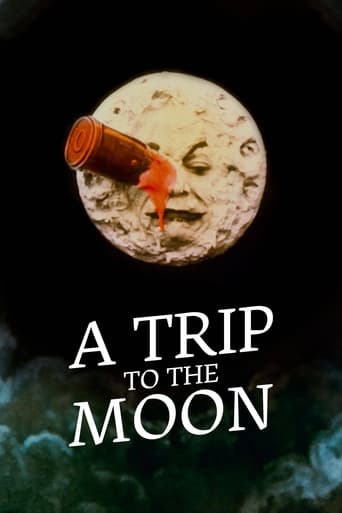
Excursion to the Moon
"Segundo de Chomón's remake of Georges Méliès' A Trip to the Moon."
Keys: Space play/pause · ←/→ 10s · F fullscreen · M mute · </> speed
About this film
Segundo de Chomón's remake of Georges Méliès' A Trip to the Moon.
Cast & crew
More films like this
More Comedy films
View all →







More from Segundo de Chomón
View all →

More about this film
About the production
Release date1908
Box officeUnknown - but commercially successful for Pathé Frères
ProductionPathé Frères
Filmed inParis, France
Segundo de Chomón created this as a direct response to Georges Méliès' 'A Trip to the Moon' (1902), using Pathé's superior resources and his own technical innovations. The film featured more sophisticated special effects than Méliès' original, including multiple exposures and hand-tinted coloring throughout. De Chomón was known for his meticulous attention to detail and often improved upon techniques pioneered by other filmmakers.
Themes
Space explorationScientific discoveryHuman curiosityThe unknownTechnological progress
Themes & topics
moonrocketastronomersspace travellunar inhabitantsspecial effectsfantasyadventurediscoveryreturn journey
Historical background
The 1908 release of Excursion to the Moon belongs to its era's exhibition habits rather than today's franchise model.
Why this film matters
Historians treat Excursion to the Moon as evidence of what typical 1908 audiences could see in a program slot.
Making of
Segundo de Chomón created this film while working as Pathé's primary special effects director. He was given significant resources to produce a film that could compete with Méliès' international success. The production involved elaborate stage sets constructed at Pathé's studio in Vincennes, with de Chomón personally supervising the complex special effects sequences. The filming required multiple exposures and careful matte work to create the illusion of space travel and lunar landscapes. De Chomón's wife, Julienne Mathieu, likely participated in the production, as she was a regular collaborator. The entire production would have taken several weeks, an unusually long time for films of this period, reflecting the complexity of the effects and the importance Pathé placed on competing with Méliès.
What critics said
Modern retrospectives screen Excursion to the Moon to illustrate 1908 pacing and camera norms.
Did you know?
- Segundo de Chomón was often called 'The Spanish Méliès' due to his similar fantastical style and technical prowess
- This film was part of Pathé's strategy to compete directly with Méliès' Star Film company
- De Chomón used a stencil coloring process that was more advanced than Méliès' hand-coloring techniques
- The film featured more elaborate sets and props than Méliès' original version
- De Chomón was married to actress Julienne Mathieu, who appeared in many of his films
- Pathé distributed this film internationally, helping establish de Chomón's reputation beyond France
- The rocket design was slightly different from Méliès' version, showing de Chomón's artistic interpretation
- This was one of many 'remakes' or homages de Chomón created of other filmmakers' successful works
- The film's success led to de Chomón becoming Pathé's chief special effects expert
- Unlike many films of the era, multiple copies survived due to Pathé's extensive distribution network
Visual style
The film employed sophisticated multiple exposure techniques to create the illusion of space travel and supernatural events. De Chomón utilized careful matte photography to composite different elements, creating seamless transitions between reality and fantasy. The camera work was static, as was typical of the era, but the compositions were carefully designed to maximize the theatrical effects. The film made extensive use of the stencil coloring process (Pathécolor), which allowed for more precise and vibrant colors than Méliès' hand-coloring techniques. The lighting was carefully manipulated to create dramatic shadows and highlights, enhancing the otherworldly atmosphere of the lunar sequences.
Innovations
The film showcased several technical innovations for its time, including advanced multiple exposure techniques that allowed for more complex visual effects than Méliès' original. De Chomón employed sophisticated matte photography and substitution splices to create smooth transitions between scenes. The stencil coloring process used by Pathé allowed for more consistent and detailed color application than manual methods. The film also featured more elaborate mechanical props and sets than were typical for the period. The special effects sequences demonstrated an understanding of perspective and scale that was advanced for 1908. These technical achievements helped establish new standards for visual effects in early cinema.
Music
Like all films of this period, Excursion to the Moon was originally silent. When screened in theaters, it would have been accompanied by live musical performance, typically a pianist or small orchestra. The music would have been selected to match the mood of each scene - dramatic for the launch, whimsical for the lunar adventures, and triumphant for the return. Some theaters may have used popular classical pieces or specially composed music. The exact musical accompaniment would have varied by venue and was not standardized as part of the film itself.
Famous quotes
No recorded dialogue - silent film with intertitles that would have varied by country of distribution
Memorable scenes
- The rocket launch sequence with smoke and fire effects
- The landing on the moon with the rocket embedded in the lunar surface
- The encounter with the moon's strange inhabitants
- The return journey with Earth growing larger in the distance
- The final celebration scene on Earth with the heroic astronomers
What audiences thought
Audiences in 1908 responded enthusiastically to the film's spectacular visuals and imaginative story. The film was a commercial success for Pathé, playing to packed houses in Europe and America. Viewers were particularly impressed by the elaborate special effects and the hand-colored sequences, which added to the film's magical quality. The familiar story structure, based on the popular Méliès film, made it immediately accessible to audiences who were already familiar with space travel fantasies. The film's success demonstrated that audiences had an appetite for increasingly sophisticated visual effects and longer narrative films. Contemporary audience reactions were recorded in trade papers as being full of wonder and excitement at the cinematic possibilities on display.
Film connections
Influenced by
- A Trip to the Moon (1902) by Georges Méliès
- Jules Verne's novels (From the Earth to the Moon)
- H.G. Wells' The First Men in the Moon
- Contemporary astronomical discoveries
- Stage magic traditions
This film influenced
- Later space travel films
- The Great Train Robbery (technical influence)
- Subsequent Pathé fantasy productions
- Early animated films (through visual effects techniques)
Film restoration
The film is preserved in several film archives worldwide, including the Cinémathèque Française and the Library of Congress. Multiple copies survive in various states of completeness, some with the original stencil coloring intact. The film has been digitally restored by several institutions and is available on various home video compilations of early cinema.
Where to watch
- Available on YouTube through various film history channels
- Included in early cinema collections on DVD/Blu-ray
- Accessible through streaming services specializing in classic films
- Available in some film archive digital collections
- Screened occasionally at film museums and special cinema events