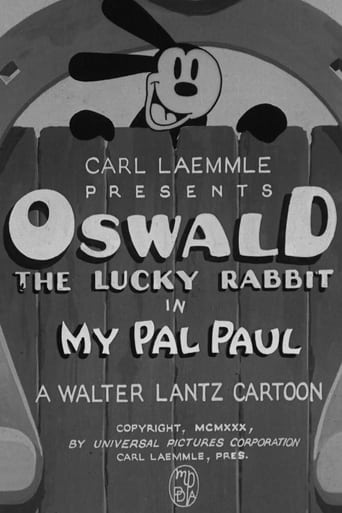
Hells Heels
"The sheriff runs Oswald the Rabbit out of town"
Keys: Space play/pause · ←/→ 10s · F fullscreen · M mute · </> speed
About this film
The sheriff runs Oswald the Rabbit out of town; but then Oswald finds the sheriff's infant son out in the desert.
Cast & crew
More films like this
More Animation films
View all →



More from Walter Lantz
View all →
More about this film
About the production
Release dateJune 2, 1930
ProductionUniversal Pictures, Walter Lantz Productions
Filmed inUniversal City, California (Animation Studio)
Hells Heels was the 20th Oswald the Lucky Rabbit short produced during the Walter Lantz era and the 72nd overall in the series. It was assigned production number 5194. This period was marked by a high-volume output, with the Lantz studio producing approximately 24 shorts in 1930 alone. The animation was handled by a team of future industry legends, including Bill Nolan and Manuel Moreno, who were tasked with maintaining the character's popularity after Universal took the rights from Walt Disney. The short is notable for its use of cycled animation and flat character designs, which were common cost-saving measures for the studio at the time.
Themes
Themes & topics
Historical background
Hells Heels (1930) circulated in studio-era and wartime programming. The sheriff runs Oswald the Rabbit out of town; but then Oswald finds the sheriff's infant son out in the desert. Contemporary trade papers and later preservation notes document its place among theatrical and archive releases.
Why this film matters
Hells Heels remains accessible to researchers and viewers as a screen title in museum, archive, and streaming collections. Programmers cite it when tracing regional production history and surviving early prints.
Making of
The production of Hells Heels occurred during a transitional phase for the Oswald series. After Walt Disney lost the rights to the character to Charles Mintz, and subsequently Carl Laemmle of Universal took production in-house, Walter Lantz was hand-picked to lead the new animation department. Lantz reportedly sought Disney's blessing before continuing the series. The animation team, led by Bill Nolan, worked under intense pressure to deliver a new short every two weeks. This led to the 'rubber hose' style of animation seen in the film, where limbs move without joints, and characters frequently survive impossible physical trauma, such as the bank explosion that turns the villains into skeletons.
What critics said
Day-one reviews for Hells Heels are sparse in digitized press archives; later criticism treats it as a reference point for 1930 cinema programming and preservation.
Did you know?
- The film is a direct parody of the 1929 Universal feature film 'Hell's Heroes', which was an early adaptation of the novel 'The Three Godfathers'.
- This is the first Oswald cartoon to feature the musical score of James Dietrich, who would become a regular composer for the series.
- It is the earliest Walter Lantz-produced Oswald cartoon to be fully restored for modern audiences.
- The short features the debut of the famous 'Boop-Oop-a-Doop' ending tune, which became a staple for the series.
- Some historical sources and film catalogs incorrectly list this cartoon under the title 'Nell's Yells', which is actually a 1939 Columbia cartoon.
- The voice of the infant in the film is surprisingly deep and gruff, a recurring gag in early sound animation.
- Oswald's design in this film still retains the 'black rabbit' look before his major redesign into a white rabbit in 1935.
- The film contains a 'radio' gag where turning the dial on a safe produces a time-signal broadcast instead of opening the lock.
Visual style
As a hand-drawn animated short, the 'cinematography' involves the use of layered cels and static backgrounds typical of the early 1930s. The visual style is characterized by the 'rubber hose' technique, where characters exhibit extreme elasticity. Notable visual sequences include the high-contrast desert scenes and the use of 'impact frames' during the bank explosion. The backgrounds are relatively simple, focusing the viewer's attention on the character movement and physical gags.
Innovations
The film is a notable example of early synchronized sound in animation, successfully integrating dialogue, sound effects, and a full musical score. It also features 'skeleton' animation that required detailed frame-by-frame drawing to maintain the characters' anatomical structure while they remained 'alive.' The restoration of the film involved cleaning the original nitrate prints to preserve the clarity of the black-and-white line work and the fidelity of the early optical audio track.
Music
The soundtrack features the first score for the series by James Dietrich. It utilizes a synchronized orchestral track that mimics the action on screen (a technique later known as 'Mickey Mousing'). The score includes Western-themed motifs and ends with the iconic 'Boop-Oop-a-Doop' vocal tag, which became the signature closing for the Lantz Oswald shorts. The voice work includes contributions from Pinto Colvig, who would later become the voice of Disney's Goofy.
Famous quotes
Radio Voice: When the gong rings it will be exactly one minute past!
Baby (in a deep voice): My daddy is the sheriff!
Memorable scenes
- The bank explosion scene where Oswald's two dog accomplices are instantly charred into walking, talking skeletons while Oswald remains dazed but unharmed.
- The 'Radio Safe' gag where Oswald tries to crack the safe but instead tunes into a radio broadcast.
- The ending sequence where the tough-talking baby forces the 'Lucky Rabbit' to carry him back across the desert to the sheriff.
What audiences thought
The film was well-received by 1930s audiences who were already familiar with the 'Three Godfathers' story. Oswald remained a popular 'A-list' cartoon star throughout the early 30s, and this short's blend of Western action and baby-related comedy was a crowd-pleasing formula. Today, it is a favorite among classic animation enthusiasts for its dark humor—specifically the skeleton gag—and its status as a restored classic.
Film connections
Influenced by
- Hell's Heroes (1929)
- The Three Godfathers (Novel by Peter B. Kyne)
- Felix the Cat (Visual Style)
This film influenced
- Mickey's Nightmare (1932)
- 3 Godfathers (1948)
- The Three Godfathers (1936)
Film restoration
The film is preserved and has been professionally restored. It is currently held in the Universal Pictures archive and was included in the 'Woody Woodpecker and Friends Classic Cartoon Collection' DVD set.
Where to watch
- The Woody Woodpecker and Friends Classic Cartoon Collection (DVD)
- Public Domain Animation Archives (Online)
- Rare Halloween Short Collections (due to the skeleton scenes)