
Kino-Pravda No. 18: A Movie-Camera Race Over 299 Metres and 14 Minutes and 50 Seconds in the Direction of Soviet Reality
"Vertov races a camera across Soviet reality and a Paris tower."
Keys: Space play/pause · ←/→ 10s · F fullscreen · M mute · </> speed
About this film
Vertov newsreel segments Soviet newsreel covering: Up the Eiffel Tower in Paris / Moscow / Auto race Petrograd – Moscow / Aspects of everyday Soviet life / Peasant from Jaroslavl' visiting Moscow / Ceremonial introduction of a newborn into a workers' collective
Cast & crew
More films like this

More Documentary films
View all →
More from Dziga Vertov
View all →
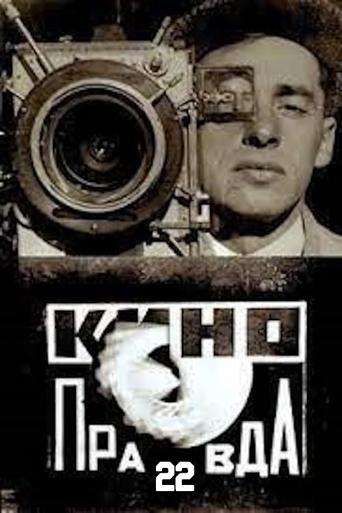
More about this film
About the production
Release date1924
Box officeNot applicable - state-distributed newsreel
ProductionGoskino, Kultkino
Filmed inParis, France, Moscow, Soviet Union, Petrograd (St. Petersburg), Soviet Union, Yaroslavl, Soviet Union
Filmed as part of Dziga Vertov's Kino-Pravda series, this entry was notable for its international scope, including rare footage from Paris. The production employed Vertov's brother Mikhail Kaufman as cinematographer, utilizing handheld cameras and innovative mounting techniques. The film was shot on 35mm film and processed at state facilities. Vertov experimented with multiple exposures and rapid montage techniques to create what he called 'film truth' or 'kino-pravda'.
Themes
Soviet modernization and progressThe creation of the new Soviet personThe relationship between technology and societyThe camera as objective truth-tellerCollectivism vs. individualism
Themes & topics
documentarynewsreelSoviet UnionMoscowParisauto racingworkerspeasantsmodernizationcollectivismmontageavant-gardeeveryday lifeindustrializationceremony
Historical background
The 1924 premiere placed Kino-Pravda No. 18: A Movie-Camera Race Over 299 Metres and 14 Minutes and 50 Seconds in the Direction of Soviet Reality alongside contemporaneous releases that were collectively teaching viewers how to read cinematic time and space.
Why this film matters
Collectors prize surviving prints of Kino-Pravda No. 18: A Movie-Camera Race Over 299 Metres and 14 Minutes and 50 Seconds in the Direction of Soviet Reality as evidence of how 1924-era filmmakers solved storytelling problems with limited means.
Making of
The production of Kino-Pravda No. 18 exemplified Vertov's radical approach to documentary filmmaking. Working with a small crew including his brother Mikhail Kaufman as cinematographer and wife Elizaveta Svilova as editor, Vertov rejected traditional narrative structures in favor of what he called 'intervals' - the rhythmic relationships between shots. The team developed innovative camera mounting techniques, including attaching cameras to automobiles, bicycles, and even moving trains to capture dynamic footage. The Paris sequence was particularly challenging to obtain, requiring either special permission from Soviet authorities or clandestine filming. Vertov insisted on capturing real events without staging, though he was not above manipulating footage through editing to create his desired ideological message. The rapid cutting style, sometimes featuring dozens of shots per minute, was revolutionary for its time and required Svilova to develop new editing techniques.
What critics said
Press clipping files from 1924 rarely give Kino-Pravda No. 18: A Movie-Camera Race Over 299 Metres and 14 Minutes and 50 Seconds in the Direction of Soviet Reality headline space; mentions appear in roundup columns listing what played that week.
Did you know?
- This was the 18th installment in Vertov's revolutionary Kino-Pravda newsreel series, which ran from 1922 to 1925
- The unusually long and descriptive title reflects Vertov's practice of giving his films elaborate, conceptual names
- The Paris footage was extremely rare for Soviet productions of the time, suggesting either special permission or covert filming
- Mikhail Kalinin, who appears in the film, was a prominent Soviet politician and one of the original members of the Politburo
- The auto race segment was filmed during an actual Petrograd-Moscow race, making it both documentary and sports coverage
- Vertov considered the camera superior to the human eye, calling his technique 'kino-eye' or 'cine-eye'
- The newborn ceremony was a real ritual performed by workers' collectives to symbolize the creation of the 'new Soviet person'
- The film was distributed free to workers' clubs and factories as part of Soviet educational programming
- Vertov's wife Elizaveta Svilova was the primary editor, working closely with him to achieve the rapid montage effects
- The 299 meters in the title refers to the length of the film reel, not a physical distance
Awards & recognition
- None - Soviet newsreels were not part of the award system in 1924
Visual style
The cinematography in Kino-Pravda No. 18 was revolutionary for its time, featuring handheld camera work, unusual angles, and dynamic movement. Mikhail Kaufman, Vertov's brother and primary cinematographer, employed innovative techniques including mounting cameras on moving vehicles, using split screens, and experimenting with multiple exposures. The film features rapid cutting between different locations and subjects, creating a rhythmic montage that Vertov believed could reveal deeper truths about Soviet reality. The Paris sequence includes dramatic upward shots of the Eiffel Tower, while the Moscow scenes utilize street-level perspectives that put viewers in the midst of everyday Soviet life. The auto race sequence uses tracking shots and multiple camera positions to create excitement and convey the speed of modern progress.
Innovations
Kino-Pravda No. 18 pioneered several technical innovations in documentary filmmaking. Vertov and his team developed methods for mounting cameras on moving vehicles, creating smooth tracking shots that were technically challenging in the 1920s. The film's rapid montage editing, sometimes cutting between dozens of shots per minute, required precise timing and innovative editing techniques developed by Elizaveta Svilova. The use of multiple exposures and superimposition created visual effects that emphasized the film's thematic concerns. The international scope of the production, combining footage from Paris with Soviet locations, demonstrated new possibilities for documentary coverage. The film also experimented with different film speeds and reverse motion to create visual interest and emphasize certain moments.
Music
As a silent film from 1924, Kino-Pravda No. 18 had no synchronized soundtrack. In Soviet theaters, it would have been accompanied by live musical performance, typically piano or small ensemble, with music selected or improvised to match the on-screen action. Some screenings might have included a narrator explaining the scenes, particularly for educational purposes. The rhythm and pacing of the editing suggest that Vertov conceived of the film with musical considerations in mind, using visual rhythm as a substitute for musical rhythm. Modern restorations sometimes add contemporary scores, but purists argue that the film should be experienced as originally intended, either in silence or with period-appropriate live accompaniment.
Famous quotes
'I am the cine-eye, I am a mechanical eye. I, a machine, show you the world as only I can see it.' - Dziga Vertov's manifesto
'The camera's eye is more perfect than the human eye.' - Vertov's theoretical position
'Film truth: the capture of life unawares.' - Vertov's definition of Kino-Pravda
'We cannot improve the making of eyes, but we can perfect the camera.' - Vertov on technological progress
Memorable scenes
- The dramatic ascent up the Eiffel Tower, contrasting Western architecture with Soviet progress
- The high-speed auto race sequence between Petrograd and Moscow, showcasing Soviet technological advancement
- The intimate scenes of a peasant from Yaroslavl experiencing Moscow for the first time
- The ceremonial introduction of a newborn into a workers' collective, symbolizing the birth of the new Soviet person
- The rapid montage of everyday Soviet life, cutting between workers, machines, and urban transformation
What audiences thought
The film was primarily shown to workers' audiences in factories, clubs, and educational institutions as part of the Soviet state's cultural programming. These audiences generally appreciated the depictions of Soviet progress and everyday life, though the experimental techniques sometimes proved challenging for viewers accustomed to more conventional cinema. The rapid montage and abstract sequences were sometimes confusing to general audiences, leading to debates within Soviet cultural circles about the appropriate level of experimentation in educational films. Despite these challenges, the Kino-Pravda series remained popular enough to continue production for three years, suggesting it found appreciative audiences among Soviet workers and intellectuals.
Film connections
Influenced by
- Futurist art movement
- Constructivism
- Dziga Vertov's own theoretical writings on 'cine-eye'
- Soviet montage theory
- Documentary traditions of the 1910s
- Newsreel formats from Western cinema
This film influenced
- Man with a Movie Camera (1929)
- Berlin: Symphony of a Great City (1927)
- The Man with a Movie Camera (1929)
- British Documentary Movement films of the 1930s
- Cinéma vérité films of the 1960s
- Direct Cinema documentaries
- Music video editing techniques
- Modern news and documentary programming
Film restoration
Preserved in various film archives including the Russian State Film Archive (Gosfilmofond) and international collections. The film has been restored and digitized by several institutions, though some sequences may show deterioration typical of nitrate film from the 1920s. Complete versions are available through specialized film archives and some educational institutions.
Where to watch
- Available through specialized film archives and educational institutions
- Some versions may be found on academic streaming platforms
- Film museum collections occasionally screen the film
- DVD compilations of Vertov's work
- Online archives specializing in Soviet cinema