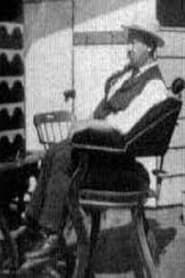
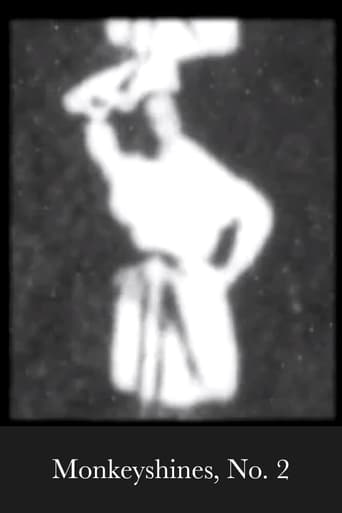
Monkeyshines, No. 1
"Edison's first flicker on American film"
Keys: Space play/pause · ←/→ 10s · F fullscreen · M mute · </> speed
About this film
Experimental film made to test the original cylinder format of the Kinetoscope and believed to be the first film shot in the United States. It shows a blurry figure in white standing in one place making large gestures and is only a few seconds long.
Cast & crew
More films like this
More Documentary films
View all →
More from William Heise
View all →
More about this film
About the production
Release dateJune 1889
ProductionEdison Manufacturing Company
Filmed inEdison Laboratory, West Orange, New Jersey
This film was created as a technical test for Edison's Kinetoscope, an early motion picture exhibition device. The production was conducted in complete secrecy at Edison's laboratory in West Orange, as the inventor was fiercely protective of his emerging technology. The film was shot using a horizontal-feed camera that exposed film at approximately 46 frames per second, much faster than later standard frame rates. The subject, Giuseppe Sacco Albanese, was a laboratory worker who was chosen for his availability rather than any acting ability. The entire production took place in a single session, with multiple takes likely filmed to test the equipment's capabilities.
Themes
Technological experimentationMotion captureVisual documentationScientific progressBirth of cinema
Themes & topics
experimentalsilentshort filmtest footagegesturelaboratorytechnical demonstrationprimitive cinemafirst American filmEdison
Historical background
Contemporary records classify Monkeyshines, No. 1 (1889) as 1889 and/or 1890 experimental short silent films shot by william k. l. dickson and william heise for the edison labs, placing it within the earliest years of projected motion pictures.
Why this film matters
Monkeyshines, No. 1 (1889) helps trace genre evolution, performer careers, and the material conditions of silent exhibition.
Making of
The creation of 'Monkeyshines, No. 1' was shrouded in secrecy within the walls of Thomas Edison's laboratory in West Orange, New Jersey. William Heise, who had been personally trained by Edison to operate the new motion picture camera, set up the equipment in a dark corner of the laboratory. Giuseppe Sacco Albanese, an immigrant worker from Italy who was employed at the lab, was chosen as the subject simply because he was available and willing. The filming process was rudimentary by modern standards - the camera was hand-cranked, lighting was minimal, and there was no concept of editing or multiple takes for artistic purposes. The entire sequence was filmed in one continuous take, with Albanese instructed simply to move around and make gestures to test whether the camera could capture motion. The development process was equally primitive, with the film having to be processed by hand in the laboratory's darkroom. Edison himself reportedly supervised the entire operation, eager to see if his investment in motion picture technology would pay off.
What critics said
Trade and revival screenings have kept Monkeyshines, No. 1 (1889) on the map for collectors and scholars rather than mass first-run promotion.
Did you know?
- This is widely considered the first film ever shot in the United States, marking the birth of American cinema.
- The film was created as a technical test rather than for public exhibition, with no commercial intent.
- William Heise was not just the director but also the camera operator, having been trained by Edison himself.
- The subject Giuseppe Sacco Albanese was one of Edison's laboratory employees, not a professional actor.
- The film was shot on 35mm film, which would become the industry standard for decades.
- Only one copy of the film is known to survive, preserved at the Museum of Modern Art in New York.
- The title 'Monkeyshines' was a colloquial term from the 19th century meaning 'mischief' or 'silly behavior'.
- The film was shot at approximately 46 frames per second, much faster than the 24 fps that would later become standard.
- Edison initially wanted to keep the technology secret, fearing competitors would steal his innovations.
- The blurry quality of the image was partially due to the slow film speed available in 1889 and the primitive lens technology.
Visual style
The cinematography of 'Monkeyshines, No. 1' represents the most basic form of motion picture photography, using the prototype Kinetograph camera developed by William Kennedy Laurie Dickson under Edison's supervision. The camera used a horizontal feed mechanism that advanced the film intermittently, allowing for brief exposures that created the illusion of motion when played back. The film was shot on 35mm celluloid with four perforations per frame, a format that would become the industry standard for over a century. The lighting was minimal, relying on available light in the laboratory, which resulted in the dark, shadowy appearance of the footage. The camera was stationary throughout filming, as tripods and camera movement technology had not yet been developed. The image quality is notably blurry and indistinct due to the primitive lens technology and the slow speed of the film stock available in 1889. Despite these limitations, the cinematography successfully captured the basic principle of motion pictures - the ability to record and reproduce movement.
Innovations
'Monkeyshines, No. 1' represents several groundbreaking technical achievements that laid the foundation for cinema as we know it. The film demonstrated the successful operation of Edison's Kinetograph camera, the first practical motion picture camera designed for commercial use. It proved that 35mm film with perforations could be used to capture sequential images, establishing a format that would dominate cinema for decades. The film showcased the horizontal-feed mechanism that allowed for smooth, continuous advancement of film through the camera. The production demonstrated that motion could be captured and reproduced, validating Edison's investment in motion picture technology. The film also proved the viability of celluloid as a medium for motion pictures, which was more durable and practical than earlier attempts using paper film. Additionally, the high frame rate of approximately 46 frames per second, while impractical for commercial use, demonstrated that smooth motion could be achieved through rapid sequential photography.
Memorable scenes
- The entire film consists of a single memorable scene: a blurry figure in white clothing standing in a dark space, making large, sweeping gestures with their arms while moving slightly from side to side. This brief sequence, lasting only seconds, captures the moment when motion pictures were born in America, with the subject's movements appearing ghostly and indistinct through the primitive lens of Edison's experimental camera.
What audiences thought
Originally, 'Monkeyshines, No. 1' had no audience reception whatsoever, as it was created as a private technical test within Edison's laboratory and never shown to the public. The film was not commercially exhibited until decades later, when it was discovered by film historians and included in retrospectives of early cinema. Modern audiences who have seen the film typically react with fascination at its historical significance rather than entertainment value. Viewers are often struck by how such a simple, brief sequence represents the birth of an art form that would come to dominate global culture. The film is now primarily viewed by film students, historians, and cinema enthusiasts who appreciate it as a historical artifact rather than entertainment. Its brief runtime and primitive quality make it challenging for general audiences, but those interested in film history find it captivating as a window into cinema's earliest moments.
Film connections
Influenced by
- Eadweard Muybridge's motion studies
- Étienne-Jules Marey's chronophotography
- Magic lantern shows
- Zoetrope and other optical toys
This film influenced
- Monkeyshines, No. 2
- Monkeyshines, No. 3
- Edison Kinetoscopic Record of a Sneeze
- Blacksmith Scene
- All subsequent American films
Film restoration
The film is preserved at the Museum of Modern Art in New York and has been digitized by the Library of Congress. While only one original print is known to exist, the film has been copied and restored for historical preservation. The surviving copy shows significant deterioration but remains viewable. The film is considered historically significant and is actively preserved as part of America's cinematic heritage.
Where to watch
- The film is available on the Library of Congress website
- YouTube through the Museum of Modern Art channel
- Various film history documentaries
- Film school archives and educational collections
- The Criterion Collection's 'Treasures from American Film Archives' DVD set