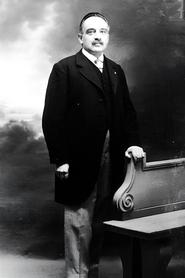
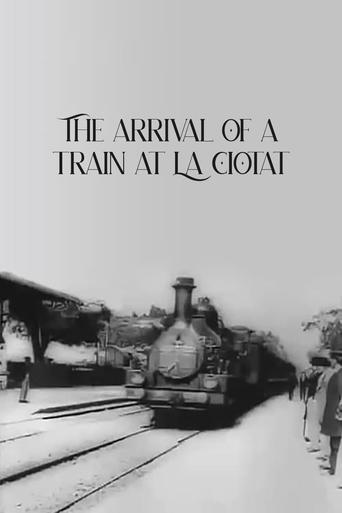
New York. Arrival of a Train at Battery Place
"Train at Battery Place"
Keys: Space play/pause · ←/→ 10s · F fullscreen · M mute · </> speed
About this film
Lumière cameraman films a train arriving at Battery Place in lower Manhattan, 1896.
Cast & crew
More films like this
More Documentary films
View all →
More from Alexandre Promio
View all →
New York, Brooklyn Bridge
1899
Panorama of the Grand Canal Taken from a Boat
1896
Leaving Jerusalem by Railway
1897
Une bataille dans le vieux Stockholm
1897
Danse au bivouac
1896
Constantinople, panorama des rives du Bosphore
1897
Children Digging for Clams
1896
New York: Broadway at Union Square
1896
More about this film
About the production
Release dateOctober 1896
Box officeNot applicable (early films were exhibited as novelties rather than commercial releases)
ProductionSociété Lumière
Filmed inBattery Place, Manhattan, New York City, New York, USA
Filmed using the Lumière Cinématographe, which served as both camera and projector. Alexandre Promio was sent by the Lumière brothers as their official cameraman to document scenes from around the world. The camera was likely set up on a tripod at ground level to capture the dramatic arrival of the train. The film was shot on 35mm film stock at approximately 16 frames per second. Battery Place was a significant transportation hub in lower Manhattan, connecting ferry services with local rail lines.
Themes
Themes & topics
trainstationarrivalNew York Citytransportationdocumentaryactualityurban life19th centurysteam locomotive
Historical background
1896 placed New York. Arrival of a Train at Battery Place within France (filmed in United States) cinema as Société Lumière navigated wartime markets, immigration audiences, and the shift from intertitles to sound.
Why this film matters
Archivists revisit New York. Arrival of a Train at Battery Place (1896) for Alexandre Promio style, genre norms at Société Lumière, and the exhibition context of 0:33 (approximately 33 seconds) programming.
Making of
Alexandre Promio, a former optician hired by the Lumière brothers, embarked on a world tour in 1896 as their chief cinematographer. His journey to New York was part of the Lumière brothers' strategy to create a comprehensive catalog of 'views' from around the world to satisfy public curiosity about distant places. The Cinématographe equipment weighed about 5 kilograms and required careful setup and hand-cranking during filming. Promio had to transport this fragile equipment across the Atlantic and navigate the bustling streets of New York to find suitable filming locations. The filming process attracted curious onlookers who had never seen a movie camera before. Promio's technical skill in achieving proper exposure and focus with primitive equipment was remarkable for the time. The film was processed in a portable darkroom that Promio carried with him during his travels.
What critics said
Retrospective writing on New York. Arrival of a Train at Battery Place stresses craft by Alexandre Promio, print survival, and repertory value rather than opening-week gross alone.
Did you know?
- This was one of the first films ever shot in the United States, representing cinema's earliest documentation of American life
- Alexandre Promio was the Lumière brothers' first official cameraman and traveled extensively to create films for their catalog
- The film was part of the Lumière brothers' 'Actualités' (actualities) series, which showed real events rather than staged scenes
- Battery Place was located near the Manhattan terminal of the Brooklyn Bridge Railway and ferry connections
- The train shown was likely part of the Manhattan Railway system, which operated elevated and street-level rail lines
- This film predates the famous 'Arrival of a Train at La Ciotat' (1896) by the Lumière brothers, showing their systematic approach to documenting transportation
- The film was hand-cranked, meaning the speed could vary slightly during shooting
- Only one copy of the film is known to survive, preserved at the French Film Archives
- The film was originally shown as part of Lumière programs that included 10-12 short films per screening
- Promio's American trip in 1896 resulted in approximately 20 films, making him the first person to systematically document the United States on film
Visual style
The film employs the characteristic Lumière style of static camera positioning, with the Cinématographe mounted on a tripod to capture a single, continuous view. The composition places the train tracks diagonally across the frame, creating a sense of depth and movement as the locomotive approaches. The natural lighting reflects the outdoor setting of Battery Place, with the soft illumination characteristic of late 19th-century film stock. The wide-angle perspective captures not only the train but also the surrounding urban environment, including buildings and pedestrians. The camera's position provides an unobstructed view of the train's arrival and the activities of passengers, demonstrating Promio's skill in finding optimal vantage points. The black and white imagery creates a stark contrast between the dark steam of the locomotive and the lighter elements of the station and sky.
Innovations
This film represents a significant technical achievement as one of the earliest successful applications of motion picture photography outside of Europe. The use of the Lumière Cinématographe, which was lighter and more portable than competing devices like Edison's Kinetograph, enabled location filming in distant places. The film demonstrates the remarkable stability and image quality achievable with 1890s technology when operated by skilled technicians. The successful capture of a moving train showed the camera's ability to render motion smoothly and convincingly, a crucial demonstration of the medium's capabilities. The preservation of this film for over 125 years is itself a technical achievement, given the fragile nature of early nitrate film stock. The film's existence demonstrates the foresight of the Lumière brothers in creating and preserving a comprehensive catalog of early motion pictures.
Music
Originally silent, as all films were in 1896. During early exhibitions, live musical accompaniment was often provided, typically a pianist or small ensemble playing popular music of the era. Some screenings might have included sound effects created by theater staff to enhance the experience, such as train whistle sounds. Modern screenings of restored versions often feature period-appropriate musical scores compiled from 19th-century compositions. The Lumière brothers themselves did not produce synchronized soundtracks for their films, as sound cinema technology would not be developed for another three decades. The absence of recorded sound emphasizes the visual nature of early cinema and the importance of movement and composition in storytelling.
Memorable scenes
- The dramatic moment when the steam locomotive fills the frame as it arrives at the station, billowing smoke and steam, with passengers visible on the platform and the bustling activity of 19th-century New York transportation captured in a single, continuous take
What audiences thought
19th-century audiences were reportedly mesmerized by early films like this one, often reacting with surprise and excitement to the seemingly magical moving images. Viewers in both Europe and America were fascinated by these 'living photographs' of everyday scenes from around the world. The film of the train arrival would have been particularly impressive to audiences who may have never seen such detailed, moving images of transportation technology. Some early viewers reportedly ducked or recoiled when the train appeared to approach the camera, demonstrating the powerful illusion of depth created by the new medium. The film's inclusion in Lumière programs helped ensure consistently popular screenings, as audiences were eager to see glimpses of foreign lands and modern technology. Contemporary audiences viewing the film today often express fascination with this window into 19th-century life and the primitive beginnings of cinema.
Film connections
Influenced by
- Lumière brothers' 'Actualités' series
- Étienne-Jules Marey's chronophotography
- Eadweard Muybridge's motion studies
This film influenced
- Arrival of a Train at La Ciotat (1896)
- The Great Train Robbery (1903)
- Various early transportation documentaries
Film restoration
Preserved at the French Film Archives (Cinémathèque Française). The film survived in the Lumière brothers' collection and has been digitally restored. The original 35mm nitrate print has been carefully preserved and transferred to modern safety film stock. Multiple digital versions exist for archival and educational purposes.
Where to watch
- Available on various streaming platforms specializing in classic cinema
- YouTube through official film archive channels
- DVD collections of early Lumière films
- Museum screenings and film festival retrospectives
- Educational film databases and university collections