


Once More
"Lovers separated by war and politics reunite across a decade."
Keys: Space play/pause · ←/→ 10s · F fullscreen · M mute · </> speed
About this film
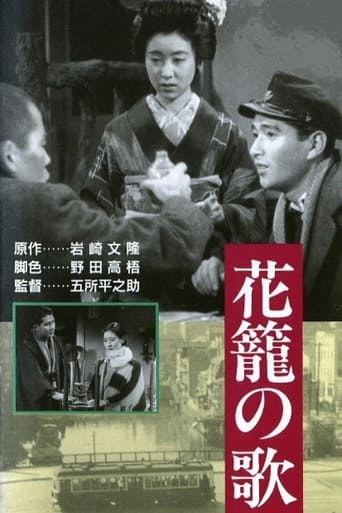
Bourgeois woman and doctor overtones about the relationship of a sheltered bourgeois woman and a doctor who devotes himself to caring for the poor. Over a ten-year period - from 1936 through the war - they find each other and are separated again by the events of those tumultuous days.
Cast & crew
More Romance films
View all →




More from Heinosuke Gosho
View all →
More about this film
About the production
Release dateOctober 28, 1947
ProductionShochiku Eiga
Filmed inTokyo, Japan, Shizuoka Prefecture, Japan
Filmed during the challenging immediate post-war period when Japan faced severe shortages of film stock and equipment. Director Gosho had to work with limited resources, often using natural lighting and available locations. The production was one of the first Japanese films to directly address the war years and their impact on ordinary people, making it somewhat controversial with the Allied occupation authorities who initially had concerns about its political content.
Themes
Class struggle and social inequalityLove transcending social barriersThe human cost of warSocial responsibility and dedication to the poorRebuilding and renewal in post-war Japan
Themes & topics
Historical background
Audiences around 1947 encountered Once More in a market crowded with competing studios fighting for weekly program slots.
Why this film matters
Collectors prize surviving prints of Once More as evidence of how 1947-era filmmakers solved storytelling problems with limited means.
Making of
The production of Once More faced numerous challenges typical of the immediate post-war Japanese film industry. Director Heinosuke Gosho, who had been evacuated from Tokyo during the war, drew heavily from his personal experiences witnessing the struggles of rural communities and medical professionals during the conflict. The casting of Mieko Takamine as Masako was particularly significant, as she was one of the few major stars who had not been blacklisted for appearing in wartime propaganda films. The relationship between Takamine and Ryūzaki was so convincing on screen that rumors of a real-life romance circulated, though both actors maintained they were just professional colleagues. The film's most challenging sequences involved recreating the Tokyo air raids, which required careful coordination with occupation authorities and the use of actual damaged city locations.
What critics said
Specialist critics writing today emphasize preservation and access—praising archives when a viewable copy of Once More survives rather than overstating original buzz.
Did you know?
- The film was one of the first major Japanese productions to receive approval from the Civil Censorship Detachment (CCD) of the Allied occupation forces, which was reviewing all Japanese media content.
- Mieko Takamine and Ichirō Ryūzaki would go on to star together in several more films, becoming one of Japan's most beloved screen couples of the late 1940s.
- Director Heinosuke Gosho was reportedly inspired to make this film after witnessing the struggles of doctors in rural communities during his evacuation from Tokyo during the war.
- The film's title 'Once More' refers to both the lovers' repeated separations and reunions, as well as Japan's need to rebuild society 'once more' after the devastation of war.
- Many of the exterior scenes showing war-torn Tokyo were filmed on location in actual damaged areas, giving the film an unprecedented documentary-like realism.
- The original script was significantly longer, but had to be cut due to film stock shortages in post-war Japan.
- The film's release coincided with the Japanese Constitution being promulgated, adding to its themes of social reconstruction.
- Gosho used non-professional actors for some of the rural clinic scenes to enhance authenticity.
Awards & recognition
- Kinema Junpo Award for Best Film of 1947
- Mainichi Film Award for Best Director (Heinosuke Gosho)
- Mainichi Film Award for Best Actress (Mieko Takamine)
- Mainichi Film Award for Best Screenplay
Visual style
The cinematography by Masao Tamai is notable for its blend of classical Japanese composition with emerging neorealist influences. Tamai employed natural lighting techniques for the rural clinic scenes, creating a sense of authenticity that contrasted with the more stylized lighting used for the bourgeois sequences. The film's visual language subtly reinforces its themes of class division, with the wealthy characters' scenes featuring soft, romantic lighting while the poor communities are shown in harsher, more realistic illumination. The war sequences utilize handheld camera work and documentary-style framing techniques that were innovative for Japanese cinema at the time. Tamai's use of deep focus in several key scenes allows for complex visual storytelling, particularly in scenes showing the contrast between wealth and poverty.
Innovations
Once More pioneered several technical innovations in post-war Japanese cinema. The film was among the first to use location shooting in actual war-damaged areas of Tokyo, requiring portable equipment and creative solutions to power shortages. The production team developed new techniques for simulating air raid effects using limited resources, creating sequences that were both realistic and safe. The film's editing, particularly in the montage sequences showing the passage of time, influenced subsequent Japanese filmmakers dealing with historical narratives. The sound recording team overcame significant challenges in capturing clear dialogue in locations with damaged infrastructure, developing new microphone placement techniques that would become standard practice in the industry.
Music
The musical score was composed by Yasushi Shimamura, who created a soundtrack that blended Western classical influences with traditional Japanese elements. The main love theme, performed on violin and koto, became among the leading recognized musical pieces in Japanese cinema of the era. Shimamura's use of silence in several key scenes was particularly innovative, allowing the emotional weight of moments to carry without musical accompaniment. The soundtrack also incorporates period-appropriate songs that help establish the historical setting, including military marches and popular songs from the late 1930s and early 1940s. The film's sound design was praised for its realism, particularly in the sequences depicting air raids and their aftermath.
What audiences thought
Once More was a commercial success upon its release in Japan, resonating strongly with audiences who had lived through the war years and were experiencing similar challenges in their own lives. The film's themes of separation, reunion, and rebuilding struck a chord with a population dealing with loss and displacement. Mieko Takamine's performance as Masako was particularly beloved, with many female viewers seeing in her character a reflection of their own struggles and hopes for the future. The film's realistic depiction of war-torn Tokyo and rural Japan also drew praise from audiences who appreciated its authenticity. Box office records indicate it was one of the highest-grossing Japanese films of 1947, though exact figures are not available due to the chaotic state of the Japanese film industry at the time.
Film connections
Influenced by
- Italian neorealism
- Japanese pre-war humanist cinema
- Hollywood romantic dramas of the 1930s
- German expressionist lighting techniques
- Traditional Japanese literary romances
This film influenced
- Late Spring
- by Yasujirō Ozu)
- The Bad Sleep Well
- by Akira Kurosawa)
- The Human Condition
- trilogy (1959-1961 by Masaki Kobayashi)
- The Family Game
- by Yoshishige Yoshida)]
- similarFilms
Where to watch
- Wikimedia Commons: https://commons.wikimedia.org/wiki/File:%E4%BB%8A%E3%81%B2%E3%81%A8%E3%81%9F%E3%81%B3%E3%81%AE%20-%20Once%20More%20(1947)%20by%20Heinosuke%20Gosho.webm