Keys: Space play/pause · ←/→ 10s · F fullscreen · M mute · </> speed
Plot
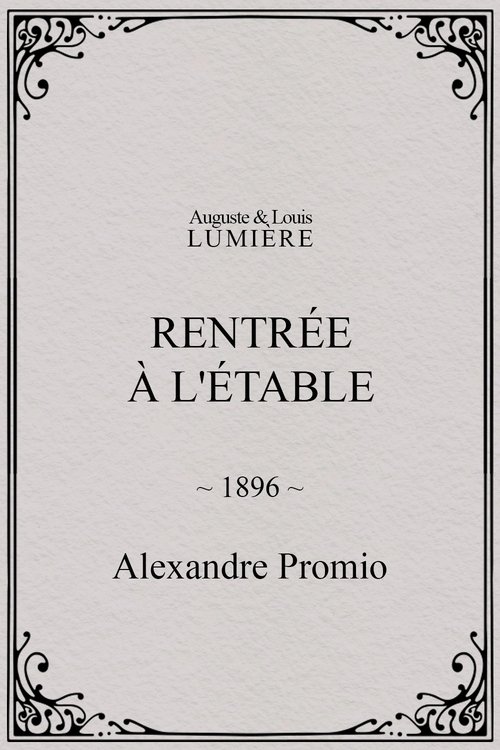
This brief documentary film captures a simple yet evocative scene of farm animals, primarily cows, being herded back to their barn at the end of the day. The camera remains stationary as the animals make their way across the frame, guided by unseen handlers. The natural movement of the cattle creates a rhythm that was mesmerizing to 1896 audiences who had never seen such realistic motion captured on film. The scene concludes with the animals disappearing into the barn structure, leaving an empty pastoral landscape. This everyday agricultural activity, when preserved on celluloid, became a remarkable testament to the new medium's ability to capture and preserve moments of reality.
Director
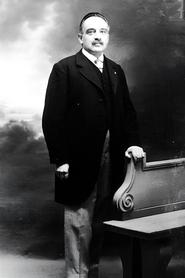 Alexandre Promio
About the Production
Release Date 1896
Production Lumière
Filmed In Geneva, Switzerland
Filmed during the 1896 Geneva National Exhibition, this film represents Alexandre Promio's work as one of the Lumière company's most prolific cinematographers. The film was shot using the Lumière Cinématographe, which served as both camera and projector. As with most Lumière productions of this era, it was a single continuous take with no editing. The stationary camera placement was typical of early Lumière actualités, capturing scenes as they naturally unfolded.
More Documentary Films
View all →
More from Alexandre Promio
View all →
New York, Brooklyn Bridge
1899
Panorama of the Grand Canal Taken from a Boat
1896
Leaving Jerusalem by Railway
1897
Une bataille dans le vieux Stockholm
1897
Danse au bivouac
1896
Constantinople, panorama des rives du Bosphore
1897
Children Digging for Clams
1896
New York: Broadway at Union Square
1896
Themes & Topics
cowsbarnfarmanimalsherdingGenevaexhibitioncountrysidelivestockpastoral
Historical Background
1896 was a pivotal year in cinema history, marking the first full year of commercial film exhibition following the Lumière brothers' first public screening in December 1895. The medium was still in its infancy, with films typically lasting less than a minute and depicting simple, unedited scenes of reality. The Geneva National Exhibition of 1896 was part of the World's Fair movement that showcased technological and cultural achievements of the late 19th century. Alexandre Promio's work during this period represents the global expansion of cinema as the Lumière company sent operators worldwide to capture images for an international audience hungry for these moving pictures. This film emerged during the Belle Époque, a period of relative peace and prosperity in Europe that fostered artistic and technological innovation.
Why This Film Matters
As one of the earliest documentary films, 'Rentrée à l'étable' represents the fundamental power of cinema to preserve and share everyday moments across time and space. The film exemplifies the Lumière brothers' vision of cinema as a window onto the world, capturing authentic scenes rather than creating theatrical fantasies. This approach would influence documentary filmmaking for decades to come. The film also demonstrates how early cinema served as a form of virtual tourism, allowing urban audiences to experience rural life they might never otherwise witness. Its inclusion in the Geneva Exhibition programming highlights how quickly cinema was recognized as a legitimate medium for documenting and celebrating cultural and agricultural achievements. The survival of such early actualités provides invaluable historical documentation of late 19th-century life and practices.
Making Of
Alexandre Promio, working as an operator for the Lumière company, traveled extensively throughout Europe in 1896 to capture scenes of daily life and notable events. The filming of 'Rentrée à l'étable' took place during his assignment to document the Geneva National Exhibition, a major international showcase of industrial and agricultural achievements. The film required careful positioning of the cumbersome Cinématographe camera to capture the animals' movement effectively. Early cameras of this period were hand-cranked, requiring the operator to maintain a consistent speed of approximately 16 frames per second. The scene was likely filmed in late afternoon to capture the natural lighting and the authentic time when farmers would typically bring their livestock in for the evening. The presence of the exhibition suggests this may have been a demonstration of agricultural practices rather than a routine farm activity.
What Critics Said
Contemporary reception of Lumière actualités like 'Rentrée à l'étable' was overwhelmingly positive, with audiences marveling at the lifelike reproduction of movement. Critics and viewers of 1896 were particularly struck by the realism of scenes depicting animals in motion, as this was something photography had never before achieved. The film would have been praised for its clarity and the fascinating spectacle of cattle movement. Modern film historians recognize such works as essential documents of cinema's birth, though they note that what was once revolutionary now appears simple. The film is studied by scholars as an example of the Lumière aesthetic and the early development of documentary cinema, with particular attention paid to its composition and the choices made in framing this agricultural scene.
Did You Know?
- Alexandre Promio was one of the Lumière brothers' most important cinematographers, filming over 100 actualités between 1896 and 1897
- This film was part of the Lumière company's extensive documentation of the 1896 Geneva National Exhibition
- The title 'Rentrée à l'étable' translates literally to 'Return to the stable' or 'Back to the barn'
- Like most films of 1896, it would have been shown as part of a program of 10-15 short films lasting approximately 15-20 minutes total
- The film exemplifies the Lumière philosophy of capturing 'actualités' - real scenes from everyday life rather than staged theatrical productions
- Promio was known for pioneering the moving camera shot, though this particular film uses the static camera typical of early Lumière productions
- The Geneva Exhibition was one of many international events the Lumière company documented to showcase their new invention
- This film survives in the Lumière archives and has been preserved by various film institutions including the French Cinémathèque
More film details Visual style, music, quotes, restoration, and more
Visual Style
The cinematography of 'Rentrée à l'étable' represents the foundational techniques of early cinema. Shot on 35mm film using the Lumière Cinématographe, the film employs a static, wide-angle composition typical of actualités. The camera is positioned at an elevated angle to capture the full movement of the animals across the frame, creating a clear diagonal line of action. The natural lighting and outdoor setting demonstrate the practical limitations and aesthetic choices of early filmmaking. The composition balances the barn structure with the moving animals, creating visual interest through the contrast of static and dynamic elements. The shallow depth of field characteristic of early lenses creates a slightly soft, dreamlike quality while maintaining sufficient clarity to discern the animals' movement.
Innovations
While appearing simple by modern standards, 'Rentrée à l'étable' represents several important technical achievements of early cinema. The film was captured using the Lumière Cinématographe, a groundbreaking device that served as camera, developer, and projector in one unit. The successful capture of moving animals demonstrated the medium's ability to record fast motion clearly, a significant technical challenge in 1896. The film's survival is itself a testament to the durability of early celluloid and the preservation efforts of film archives. The exposure and development of outdoor scenes like this one helped establish technical standards for lighting and processing that would influence the entire industry. The consistent frame rate achieved through hand-cranking represents the skill of early camera operators like Promio.
Music
As a film from 1896, 'Rentrée à l'étable' was produced as a silent work with no synchronized soundtrack. During its original exhibition periods, the film would have been accompanied by live music, typically a pianist or small ensemble performing popular tunes of the era or improvised mood music. The musical accompaniment would have been chosen to complement the pastoral, peaceful nature of the scene. Some venues might have used sound effects created by live performers to enhance the realism, such as the sound of cowbells or footsteps. The absence of recorded sound was standard for the period, with the visual spectacle alone being sufficient to captivate audiences of this revolutionary new medium.
Memorable Scenes
- The graceful procession of cattle moving across the frame toward the barn, their natural movement creating a mesmerizing rhythm that captivated 1896 audiences unused to seeing such realistic motion preserved on film
What Audiences Thought
1896 audiences were reportedly astonished by films like 'Rentrée à l'étable', reacting with gasps and applause to the seemingly magical reproduction of reality. The simple scene of animals returning to a barn would have been captivating to viewers who had never experienced moving images before. Many early filmgoers believed they were watching actual events happening in real-time through some form of window or portal. The rural subject matter would have resonated with both urban and rural viewers, offering either nostalgia or exoticism depending on the viewer's background. The film's brevity and simplicity made it accessible to all audiences, contributing to the immediate popularity of the Lumière programs worldwide.
Film Connections
Influenced By
- Lumière brothers' actualité style
- Early documentary tradition
- Agricultural documentation
This Film Influenced
- Other Lumière actualités featuring animals
- Early agricultural documentaries
- Farm life films of the silent era
Film Restoration
The film survives in the Lumière collection and has been preserved by film archives including the Institut Lumière in Lyon and the French Cinémathèque. Digital restorations have been made available for scholarly and public viewing, ensuring this important early work remains accessible.
Where to Watch
- YouTube (through various film history channels)
- Institut Lumière website
- French Cinémathèque archives
- European Film Gateway
- Internet Archive
- Museum of Modern Art film collection