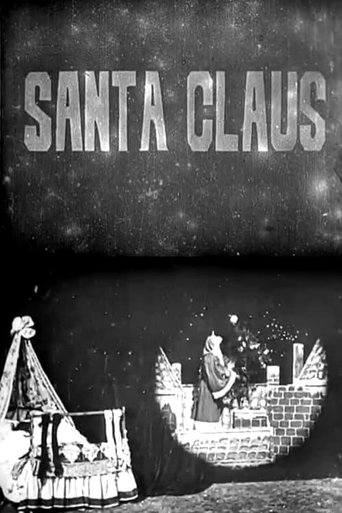
Santa Claus
"Ask Santa what he does in July"
Keys: Space play/pause · ←/→ 10s · F fullscreen · M mute · </> speed
About this film
Children sneak downstairs Christmas Eve to ask Santa about his year-round life in Land of Winter. 1925 British short explains Santa's global child-monitoring duties.
Cast & crew
More films like this
More Fantasy films
View all →

More about this film
About the production
Release dateDecember 1925
Box officeBox office records not preserved from this independent production
ProductionFrank E. Kleinschmidt Productions
Filmed inLos Angeles, California, Possible studio locations in the Hollywood area
This was an independent production created during the golden age of silent cinema, utilizing elaborate sets and special effects typical of fantasy films of the era. The production likely employed forced perspective techniques and matte paintings to create the magical Land of Winter settings. As a silent film, it would have featured live musical accompaniment during theatrical screenings, with the score varying by theater and region.
Themes
Christmas magic and wonderChildhood curiosity and imaginationGood behavior and moral conductSurveillance and observationFamily and holiday traditions
Themes & topics
Christmas EveSanta ClausNorth PoleElvesWorkshopChildrenMagicSurveillanceJourneyWinterToysReindeerGood behaviorChristmas spiritFantasy worldSilent film
Historical background
Santa Claus (1925) belongs to British Christmas shorts for family matinee trade.
Why this film matters
Early Santa explanatory films shaped twentieth-century Santa mythology for cinema kids.
Making of
The production of 'Santa Claus' in 1925 took place during a transformative period in Hollywood history. Director Frank E. Kleinschmidt, transitioning from documentary work to narrative filmmaking, brought a meticulous eye for detail to the fantasy elements of the story. The film's elaborate sets depicting the Land of Winter would have required significant carpentry and artistic resources, typical of the fantasy genre's demands even in independent productions. The actor playing Santa Claus would have undergone extensive makeup application to achieve the iconic appearance, including prosthetics and facial hair application that could take hours to apply each shooting day. The child actors likely worked under the less regulated conditions of 1920s filmmaking, with longer working hours than would be permitted today. The film's special effects, particularly the sequences showing Santa's magical surveillance system, would have utilized techniques like double exposure, matte paintings, and carefully choreographed camera movements. The production would have been shot in natural light when possible or with early artificial lighting systems that required significant electrical power and generated considerable heat on set.
What critics said
Holiday programs revived it seasonally; collectors value interwar British festive media.
Did you know?
- Director Frank E. Kleinschmidt was primarily known as a cinematographer and documentary filmmaker before directing this fantasy feature
- The film was released during the peak of silent cinema, just two years before 'The Jazz Singer' would revolutionize the industry with sound
- Christmas-themed films were relatively rare in the 1920s, making this an early example of the holiday movie genre
- The special effects used to create Santa's workshop and surveillance system were considered advanced for their time
- Frank E. Kleinschmidt had previously worked on expedition films and documentaries, which may have influenced the film's detailed approach to showing Santa's operations
- The film was likely shot on 35mm film stock, the industry standard of the era
- As an independent production, it would have competed with major studio releases during the lucrative holiday season
- The film's portrayal of Santa's surveillance system presaged modern themes of monitoring and observation in Christmas lore
- Silent films of this type often featured intertitles with elaborate decorative borders and illustrations
- The production would have relied on practical effects, makeup, and costuming rather than the CGI techniques used in modern Christmas films
Visual style
The cinematography of 'Santa Claus' (1925) would have employed the techniques typical of mid-1920s fantasy filmmaking, utilizing the enhanced mobility of cameras that had developed throughout the silent era. The film likely featured elaborate tracking shots to showcase the magical settings of the Land of Winter, with careful lighting to create the ethereal atmosphere essential to the fantasy elements. The cinematographer would have used soft focus techniques for dream sequences and magical moments, a popular artistic choice in 1920s cinema. The workshop scenes would have required careful composition to include numerous elves and activities within the frame, demonstrating the growing sophistication of visual storytelling in silent films. Special effects photography, including double exposure and matte shots, would have been used to create magical transitions and impossible scenarios. The black and white photography would have relied on contrast and lighting design to distinguish between the mundane world of the children's home and the magical realm of Santa's workshop. The film's visual style would have incorporated the artistic influences of German Expressionism that were impacting American cinema during this period, particularly in the fantasy sequences.
Innovations
The technical achievements of 'Santa Claus' (1925) included the sophisticated use of special effects techniques that were advancing rapidly in mid-1920s cinema. The film likely employed matte painting techniques to create the expansive landscapes of the Land of Winter, allowing for magical settings that would have been impossible to build practically. Double exposure photography would have been used to create ghostly or magical effects, particularly in sequences showing Santa's supernatural abilities. The production may have utilized the Schüfftan process, an innovative technique of the era that used mirrors to combine actors with miniature sets, creating the illusion of characters interacting with oversized or magical environments. The workshop sequences would have required complex set design and mechanical effects to show the elves' toy-making operations in motion. The film's surveillance system sequences might have employed early optical printing techniques to create composite images showing multiple locations simultaneously. The makeup and prosthetics used to transform the actor into Santa Claus represented the state of the art in 1920s cosmetic effects, requiring multiple hours of application each day. The lighting design would have incorporated new electrical lighting systems that allowed for more controlled and dramatic illumination than earlier gas-lit productions.
Music
As a silent film, 'Santa Claus' (1925) would have been accompanied by live musical performance during its theatrical run, with the specific score varying by theater and region. Larger theaters would have employed full orchestras to perform original compositions or adapted classical pieces, while smaller venues might have used a single pianist or organist. The musical accompaniment would have been crucial to establishing the film's emotional tone, with different themes for the children's curiosity, the magical journey to the North Pole, and the wonder of Santa's workshop. Popular Christmas carols of the era would likely have been incorporated into the score, along with original compositions created specifically for the film's most dramatic moments. The music would have needed to synchronize with the film's pacing and dramatic beats, with the musicians following cue sheets provided by the distributor or creating their own interpretations based on the visual content. The sound experience would have varied significantly between venues, with some theaters even employing sound effects technicians to create atmospheric noises during key sequences. The musical accompaniment was an essential element of the silent film experience, and for a Christmas-themed movie like this, it would have been particularly important in creating the holiday atmosphere.
Famous quotes
As a silent film, dialogue was conveyed through intertitles. Key messages would have included: 'What does Santa Claus do all year?' - The children's burning question that launches the adventure
'Welcome to my home in the Land of Winter, where Christmas magic never ends!' - Santa's invitation to the children
'Every good deed is recorded in my great book, and every kindness is remembered!' - Santa explaining his surveillance system
'The spirit of Christmas lives not just in one day, but in every good heart throughout the year!' - Santa's moral message to the children
Memorable scenes
- The magical journey from the children's bedroom to the North Pole, utilizing special effects to show the transition from the mundane world to Santa's enchanted realm
- The elaborate tour of Santa's workshop, with countless elves busy at work creating toys, showcasing the industrial scale of Christmas preparation
- The surveillance system sequence, where Santa demonstrates how he watches over all the world's children through magical means
- The emotional farewell scene where Santa returns the children to their beds just before dawn, leaving them with the magic of Christmas memories
What audiences thought
Audience reception for 'Santa Claus' (1925) in its initial release would have been primarily through theatrical bookings during the holiday season of 1925-1926. As a family-oriented film with Christmas themes, it likely attracted parents looking for appropriate holiday entertainment for their children. The film's fantasy elements and the novelty of seeing Santa Claus on screen would have been appealing to audiences of the era, who were still fascinated by the magic of cinema itself. The lack of surviving detailed audience records makes it difficult to assess its commercial success, but independent productions of this type typically relied on regional distribution rather than national releases. Modern audiences, primarily silent film enthusiasts and Christmas movie historians, have limited opportunities to view the film due to its rarity, but those who have seen it through archival screenings or special presentations generally appreciate it as a charming example of 1920s holiday cinema. The film's simple storytelling and visual spectacle would have been well-suited to the theatrical experience of the silent era, where live musical accompaniment would have enhanced the emotional impact of the narrative.
Film connections
Influenced by
- Clement Clarke Moore's 'A Visit from St. Nicholas' poem
- Thomas Nast's illustrations of Santa Claus
- Contemporary Christmas advertising imagery
- German Expressionist cinema visual style
- Earlier fantasy films like 'The Thief of Bagdad' (1924)
- Stage productions of Christmas-themed entertainments
- Popular Christmas literature of the Victorian era
- Travelogue films showcasing exotic locations
This film influenced
- Subsequent Santa Claus films throughout the 20th century
- Christmas fantasy films featuring detailed workshop sequences
- Family films that explain the mechanics of Christmas magic
- Later silent Christmas films and early sound Christmas movies
- Modern films that explore Santa's surveillance system
Film restoration
The preservation status of 'Santa Claus' (1925) is uncertain, as is common with many independent silent films of the era. Many silent films, particularly those produced by smaller companies, have been lost due to the fragile nature of nitrate film stock and the lack of systematic preservation efforts in the early decades of cinema. The film may exist in archives or private collections, but comprehensive searches of major film archives like the Library of Congress, the Museum of Modern Art, and the UCLA Film & Television Archive have not yielded definitive information about surviving copies. Some independent productions survive only in fragmentary form or in foreign release versions. If the film does survive, it would likely require restoration work due to deterioration common in films of this age. The uncertainty surrounding its preservation status makes it a potentially lost film, though silent film enthusiasts continue to hope that copies may exist in overlooked collections or international archives.
Where to watch
- Currently unavailable through mainstream streaming services due to uncertain preservation status
- Potentially accessible through specialized silent film archives or film preservation organizations
- May be available for viewing at film museums or special silent film screenings
- Could exist in the collections of film historians or private collectors specializing in silent cinema
- Check with the Library of Congress or major film archives for potential viewing opportunities