
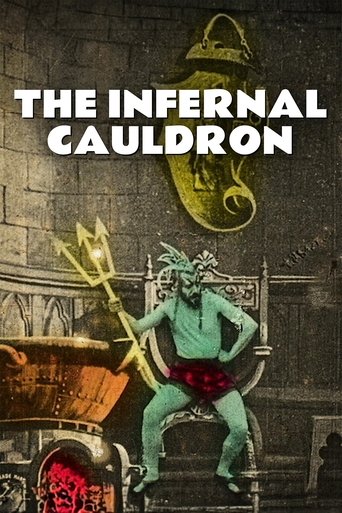
Scullion's Dream
"When the entire kitchen staff falls asleep from exhaustion."
Keys: Space play/pause · ←/→ 10s · F fullscreen · M mute · </> speed
About this film
When the entire kitchen staff falls asleep from exhaustion, a dwarf appears and animates various objects via stop motion -- including their hands, which he cuts off while they snooze -- to do their work.
Cast & crew
More films like this
More Comedy films
View all →







More from Segundo de Chomón
View all →

More about this film
About the production
Release date1908
ProductionPathé Frères
Filmed inParis, France
This film was produced during Segundo de Chomón's most productive period at Pathé Frères, where he served as a technical innovator and special effects expert. The stop-motion animation of the hands required meticulous frame-by-frame manipulation, with each movement requiring precise positioning of the props. The kitchen set was constructed to allow for the complex camera tricks and hidden mechanisms needed to create the illusion of disembodied hands working independently. Chomón employed multiple exposure techniques and substitution splices to achieve the magical appearance and disappearance of the dwarf character.
Themes
Dreams vs. RealityMagical InterventionLabor and ExhaustionThe Supernatural in Everyday LifeAnimation of the Inanimate
Themes & topics
stop motiondwarfkitchenmagicdreamsanimationdisembodied handsfantasytrick filmsupernaturalcookingsleepspecial effects
Historical background
Production circa 1908 meant fixed cameras, intertitles or early sound rigs, and studio economies that shaped every scene in Scullion's Dream.
Why this film matters
Archivists revisit Scullion's Dream (1908) for performance styles and craft choices later mainstream releases refined.
Making of
Segundo de Chomón excelled in visual effects who constantly pushed the boundaries of what was possible in early cinema. For 'Scullion's Dream,' he combined several innovative techniques including stop-motion animation, substitution splices, and multiple exposures. The production required extensive planning, as each animated sequence of the hands had to be carefully choreographed and shot frame by frame. The dwarf's magical appearances were achieved through careful editing and timing. Chomón worked closely with Pathé's technical department to develop new camera mounts and lighting setups that would allow for the complex trick photography needed. The film was shot on Pathé's standardized 35mm film stock using their proprietary cameras, which Chomón had helped modify to better accommodate special effects work.
What critics said
Trade papers near 1908 listed Scullion's Dream as program material rather than headline art cinema.
Did you know?
- This film is also known by its French title 'Le Rêve d'un cuisinier' (The Cook's Dream)
- Segundo de Chomón was often called 'the Spanish Méliès' due to his similar style of fantasy films
- The film showcases Chomón's pioneering work in stop-motion animation, predating many more famous examples
- The disembodied hands effect was achieved using wire manipulation and careful frame-by-frame photography
- Pathé Frères was among the pivotal film production companies in the early 1900s
- The dwarf character was played by an actual little person performer, common in early cinema for magical roles
- This film was part of a series of trick films Chomón produced for Pathé between 1905-1910
- The kitchen setting was deliberately chosen to showcase multiple animated objects in a familiar environment
- Chomón's wife, Julienne Mathieu, often appeared in his films and may have been involved in this production
- The film's title refers to a 'scullion,' which historically meant the lowest-ranking kitchen worker who did the dirtiest jobs
Visual style
The cinematography in 'Scullion's Dream' demonstrates Segundo de Chomón's mastery of early camera techniques. The film uses static camera positioning typical of the era, but employs careful framing to maximize the impact of the special effects. The lighting is designed to create a dreamlike atmosphere while ensuring the animated elements remain clearly visible. Chomón utilized multiple exposure techniques to create the ghostly appearance of the dwarf and the magical transformation of ordinary objects. The close-up shots of the animated hands were particularly innovative for the time, allowing audiences to clearly see the intricate movements. The cinematography also incorporates subtle camera tricks to enhance the illusion of disembodied limbs moving independently.
Innovations
'Scullion's Dream' showcases several groundbreaking technical achievements for its time. The stop-motion animation of the hands represents some of the earliest use of this technique in narrative cinema. Chomón's mastery of substitution splices allows for seamless magical transformations. The film demonstrates sophisticated understanding of multiple exposure photography to create ghostly effects. The wire work used to manipulate the animated objects was innovative for the period. The film also features early examples of practical effects combined with camera tricks to create illusions. Chomón's techniques in this film would influence special effects development for decades and some methods remain fundamentally similar to those used in modern stop-motion animation.
Music
As a silent film from 1908, 'Scullion's Dream' was originally accompanied by live musical performance. The typical accompaniment would have been provided by a pianist or small orchestra in the exhibition venue, using popular pieces of the era or improvisation to match the on-screen action. The music would have been particularly important during the magical sequences, with performers likely using whimsical or mysterious melodies to enhance the fantasy elements. Some venues might have used sound effects created mechanically or by the musicians themselves to punctuate key moments. Modern screenings of the film are typically accompanied by newly composed scores or period-appropriate music performed live or recorded.
Famous quotes
(Silent film - no dialogue)
Memorable scenes
- The sequence where the dwarf magically removes the sleeping cooks' hands and brings them to life, with the disembodied hands then proceeding to chop vegetables, stir pots, and wash dishes with eerie precision while their owners remain completely unaware of the supernatural assistance.
What audiences thought
Early 20th-century audiences were reportedly delighted and amazed by 'Scullion's Dream,' which was a popular attraction in vaudeville and fairground programs. Viewers of the era were still relatively new to cinema's possibilities, and films featuring magical effects like this were particularly successful. The combination of humor, fantasy, and technical wizardry made it a crowd-pleaser. Modern audiences who view the film in retrospectives and archives often express surprise at the sophistication of the effects given the film's age. The film continues to be featured in early cinema festivals and special programs, where contemporary viewers appreciate its historical significance and charming execution.
Film connections
Influenced by
- Georges Méliès' fantasy films
- Stage magic traditions
- Fairy tale literature
- Commedia dell'arte character archetypes
This film influenced
- The Hands of Orlac (1924)
- Becky Sharp (1935)
- The Nightmare Before Christmas (1993)
- Coraline (2009)
- Modern stop-motion animation films
Film restoration
The film is preserved in various film archives including the Cinémathèque Française and the Library of Congress. While some prints show deterioration typical of films from this era, multiple copies exist in different archives. The film has been digitally restored as part of early cinema preservation projects and is available through specialized film archives and some streaming services dedicated to classic cinema.
Where to watch
- Internet Archive
- European Film Gateway
- Cinémathèque Française online collections
- Early Cinema streaming platforms
- Film museum screenings
- Academic film archives
- YouTube (through authorized archive channels)