Steamboat Willie
"fate and mickey mouse collide"
Keys: Space play/pause · ←/→ 10s · F fullscreen · M mute · </> speed
About this film
Led by Jazz Age life, mickey Mouse, piloting a steamboat, delights his passenger, Minnie Mouse, by making musical instruments out of the menagerie on deck.
Cast & crew
More films like this

More Animation films
View all →



More from Walt Disney
View all →

More about this film
About the production
Release dateNovember 18, 1928
Budget$4,986
Box officeOver $1 million (inflation-adjusted earnings from initial run and re-releases)
ProductionWalt Disney Productions
Filmed inHyperion Avenue Studio, Hollywood, California
Steamboat Willie was revolutionary for its use of synchronized sound, requiring Disney to take out a $500 loan to complete the sound recording. The film was animated on a tight schedule of six weeks, with Ub Iwerks doing the majority of the animation work. Disney had to sell his car to finance the sound recording equipment. The synchronization process was painstaking, with animators timing each frame to match the prerecorded soundtrack using a metronome and musical score.
Themes
Innovation and technological progressThe power of music and creativityYouthful rebellion against authorityThe triumph of the underdogRomance and courtship
Themes & topics
Historical background
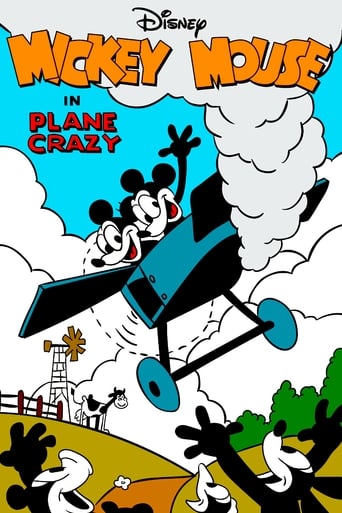
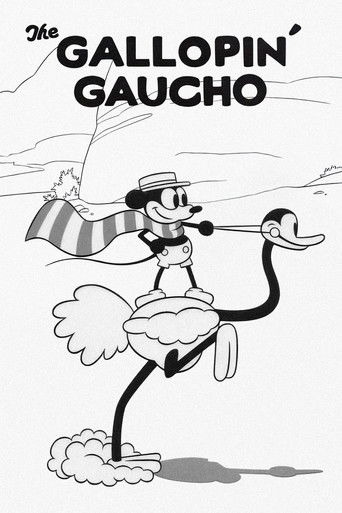
Made in 1928, Steamboat Willie belongs to the Jazz Age and carries the visual and narrative habits of its time. It was produced in black-and-white by Disney Cartoons and was released by Pat Powers' Celebrity Productions. The cartoon is considered the official debut of Mickey Mouse and Minnie Mouse, although both appeared months earlier in a test screening of Plane Crazy and the then-unreleased The Gallopin' Gaucho.
Why this film matters
For collectors of early and classic cinema, Steamboat Willie illustrates the range of subjects and styles that reached theaters in 1928.
Making of
The production of Steamboat Willie marked a pivotal moment in animation history. Walt Disney had seen The Jazz Singer and was determined to create a cartoon with synchronized sound. He initially struggled to find a studio willing to work with him on the sound aspect, eventually partnering with Pat Powers who provided the Cinephone sound system. Ub Iwerks, Disney's primary animator, worked tirelessly to create the fluid animation while ensuring it matched the prerecorded soundtrack. The team used a metronome to maintain timing consistency throughout the animation process. Disney himself performed Mickey's voice and whistling, marking the beginning of his long association with voicing the character. The film's success was not immediate - Disney had to personally convince theater owners to book the cartoon, with many skeptical about the appeal of a talking cartoon.
What critics said
Critics writing near 1928 focused on how Steamboat Willie compared with rival titles in the same season. It has received wide critical acclaim, for introducing one of the world's most popular cartoon characters and for its technical innovation.
Did you know?
- This was the third Mickey Mouse cartoon produced, but the first to be released with synchronized sound, making it the official public debut of Mickey Mouse.
- The film's premiere at the Colony Theater in New York City was an immediate sensation, with audiences reportedly applauding and stomping their feet throughout.
- Walt Disney provided both the voice for Mickey Mouse and the whistling sounds in the film.
- The character of Mickey Mouse was originally going to be named Mortimer Mouse, but Disney's wife Lillian convinced him to change it to Mickey.
- The steamboat captain character, Pete, would become Mickey's recurring nemesis in future cartoons.
- The film's synchronized sound was achieved using the Cinephone system, a sound-on-film process developed by Pat Powers.
- A scene showing Mickey playing a nursing sow's teats like an accordion was later edited out for modern releases due to changing standards of appropriateness.
- The music includes adaptations of popular songs like 'Turkey in the Straw' and 'Steamboat Bill'.
- The film entered the public domain on January 1, 2024, after its 95-year copyright term expired.
- Ub Iwerks animated approximately 700 drawings per day to complete the film on schedule.
Awards & recognition
- Academy Honorary Award (1932) - For the creation of Mickey Mouse
- Inducted into the National Film Registry (1998) - Selected for preservation in the United States National Film Registry
- Winsor McCay Award (1978) - Posthumous award to Walt Disney for lifetime achievement in animation
Visual style
Steamboat Willie utilized black and white cinematography with a 1.33:1 aspect ratio, standard for films of the silent era. The animation was created on paper and then transferred to celluloid sheets, a process that allowed for smoother movement than earlier techniques. The visual style featured the rubber hose animation style popular in the 1920s, with characters having flexible, boneless limbs that could stretch and bend in exaggerated ways. The backgrounds were relatively simple but effective, using perspective to create depth on the steamboat. The cinematography emphasized clear, bold lines and strong silhouettes to ensure characters remained recognizable even in complex action sequences. The visual storytelling was enhanced by careful attention to timing and spacing, creating fluid motion that matched the rhythm of the soundtrack.
Innovations
Steamboat Willie pioneered several technical achievements that would become standard in animation. Most significantly, it was one of the first cartoons to feature fully synchronized sound, with every action matched to corresponding audio effects. The film used a click track during production to maintain timing consistency between animation and sound. The sound was recorded on optical film tracks using the Cinephone system, allowing for precise synchronization. The animation itself pushed technical boundaries with its fluid character movement and complex action sequences. The film demonstrated the potential for using sound to enhance storytelling in animation, with musical elements and sound effects becoming integral parts of the narrative. These technical innovations helped establish animation as a serious artistic medium capable of competing with live-action films.
Music
The soundtrack for Steamboat Willie was groundbreaking for its time, featuring fully synchronized sound effects, music, and limited dialogue. The score was arranged by Carl Stalling, who would later become famous for his work on Looney Tunes cartoons. The music incorporates several popular songs of the era, most notably 'Turkey in the Straw' and 'Steamboat Bill,' which Mickey creatively plays using various animals and objects as instruments. The sound effects were created using innovative techniques for the time, including using real objects to match the on-screen action. Walt Disney himself provided the voice for Mickey Mouse, including the character's distinctive whistling. The soundtrack was recorded using the Cinephone system, a sound-on-film process that allowed for precise synchronization between the audio and visual elements.
Famous quotes
Mickey's whistling of 'Steamboat Bill' while piloting the boat
The musical sequence where Mickey plays various animals as instruments
Captain Pete's angry commands: 'Get back to work!'
Minnie's greeting: 'Oh Mickey!'
The synchronized sound effects of the steamboat's whistle and engine
Memorable scenes
- The opening scene with Mickey confidently piloting the steamboat while whistling
- The musical sequence where Mickey turns various animals into instruments, including playing a sow's teats like an accordion
- Minnie's dramatic entrance as she rushes to catch the steamboat
- The scene where Mickey uses a crane to lift Minnie and her guitar aboard
- The finale where Captain Pete throws Mickey off the boat for his musical antics
What audiences thought
Audiences in 1928 were absolutely enthralled by Steamboat Willie, with theater reports describing standing ovations and enthusiastic responses. The film's premiere at the Colony Theater in New York was so successful that it was held over for weeks. Viewers were particularly amazed by the synchronized sound effects and Mickey's whistling, which seemed magical to audiences accustomed to silent films. The character of Mickey Mouse immediately resonated with viewers of all ages, sparking a merchandising phenomenon that included watches, dolls, and other products. Over the decades, Steamboat Willie has maintained its appeal, continuing to entertain new generations of viewers while serving as an important historical artifact in the evolution of animation.
Film connections
Influenced by
- The Jazz Singer (1927) - First feature film with synchronized dialogue
- Plane Crazy (1928) - First Mickey Mouse cartoon produced (released later)
- The Gallopin' Gaucho (1928) - Second Mickey Mouse cartoon
- Felix the Cat cartoons - Popular silent era animation series
- Vaudeville performances - Influenced the musical and comedic elements
This film influenced
- All subsequent Disney animated shorts
- Snow White and the Seven Dwarfs (1937)
- Looney Tunes and Merrie Melodies series
- Tom and Jerry cartoons
- Every animated film with synchronized sound
- Modern 3D animated features
- The entire animation industry as we know it
Film restoration
Steamboat Willie has been excellently preserved and is part of the Disney company's extensive film archive. In 1998, it was selected for preservation in the United States National Film Registry by the Library of Congress for being 'culturally, historically, or aesthetically significant.' The film has undergone multiple restorations over the years, with digital restorations ensuring the highest possible quality for modern viewing. As of January 1, 2024, the film entered the public domain in the United States, though the character of Mickey Mouse remains under trademark protection by Disney.
Where to watch
- Disney+ streaming service
- YouTube (official Disney channels)
- The Walt Disney Family Museum
- Various public domain archives (post-2024)
- Classic animation collections on Blu-ray and DVD
- Film archives and museum exhibitions